Summary
- Happy November with a photograph taken on the Moon on 20 November 1969.
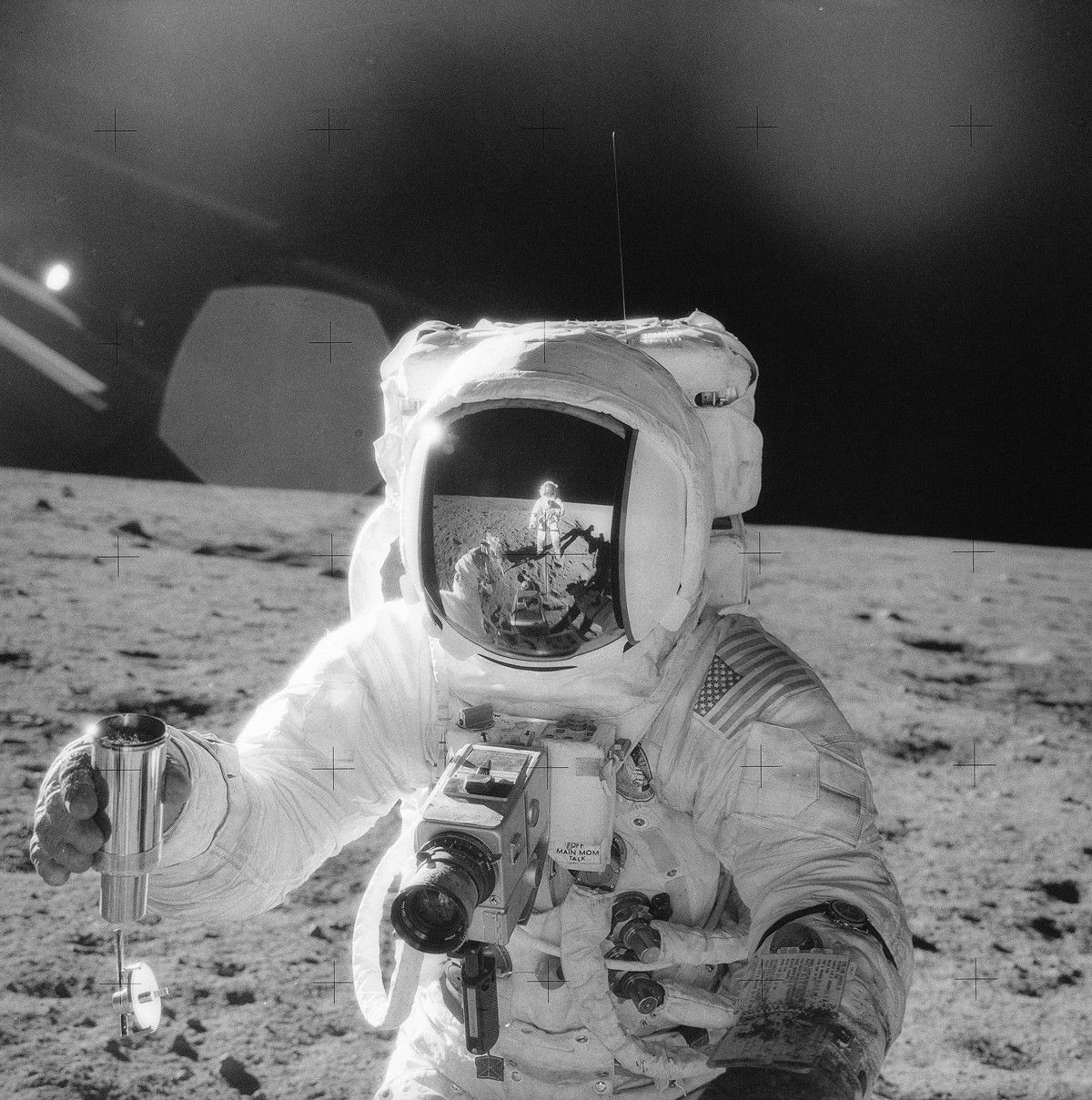
- Pete Conrad photographed Alan Bean and appears in the reflection on his visor.
- Frame AS12-49-7278 was captured on 70mm black-and-white film using a Hasselblad.
- The crosses in the picture were reference marks for scientific measurements.
Happy November, with a photograph taken on the Moon during the same month 57 years ago — and with the person who pressed the shutter hidden inside the frame.
In November 1969, the astronauts of Apollo 12 were walking across the Ocean of Storms. Among the thousands of frames they brought home is a black-and-white photograph worth a closer look as we welcome the new month. Its official reference is AS12-49-7278, and NASA dates it to 20 November 1969.
The photographer is hiding in the visor
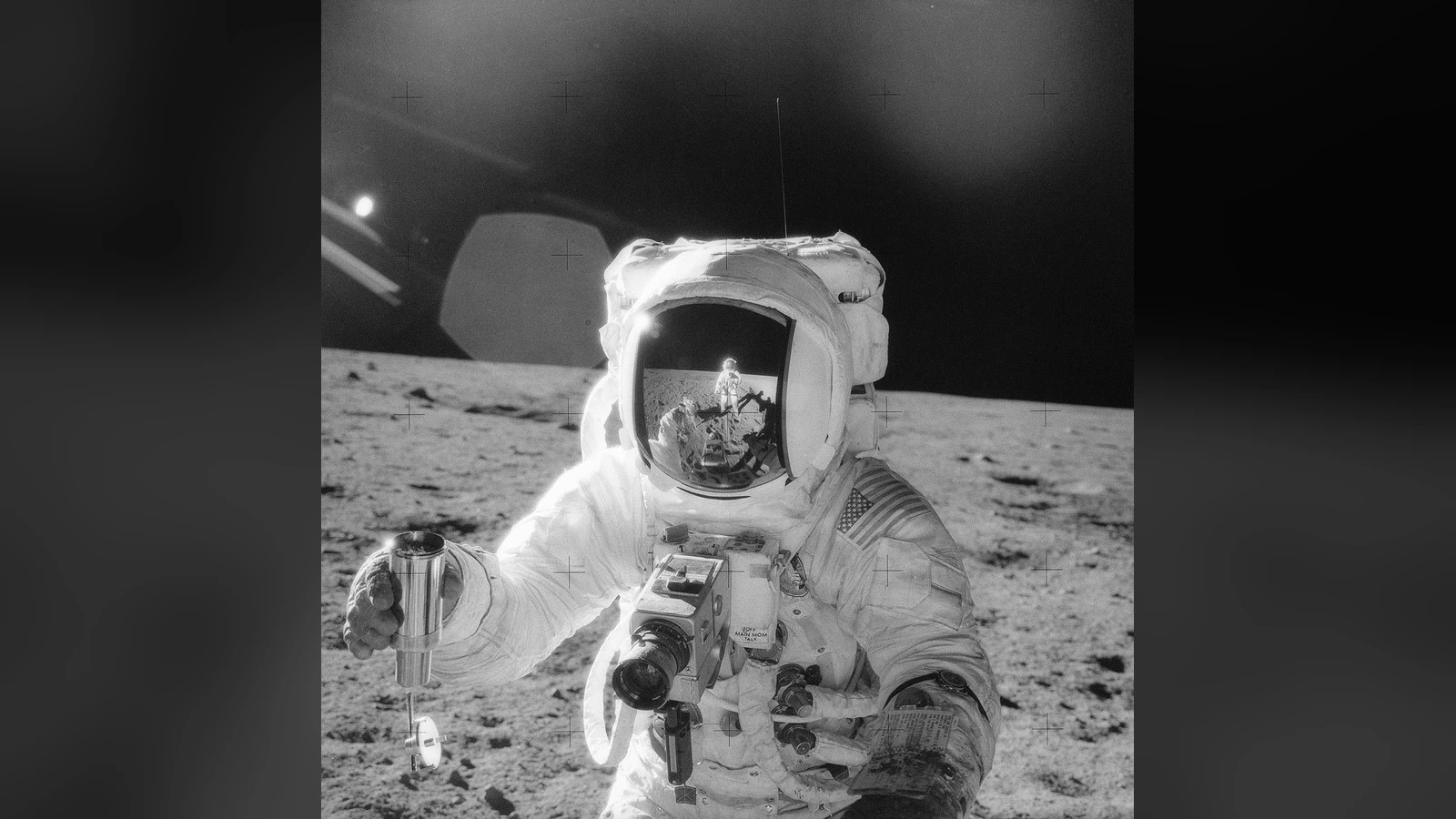
At the centre of the frame is Alan Bean, with a Hasselblad mounted on the chest of his spacesuit. In his hand is a Special Environmental Sample Container used to hold lunar soil. The photograph was taken near Sharp Crater during the astronauts’ second moonwalk.
The most intriguing detail is in the dark glass of the helmet. Look closely and you can spot Charles “Pete” Conrad, mission commander and the photographer behind the image, alongside some of the equipment the astronauts had placed on the surface. Without standing in front of the camera, he becomes part of his own picture through a reflection.
A Hasselblad, black-and-white film and crosses across the frame
The image was made with a specially adapted 70mm Hasselblad. The mission’s lunar-surface cameras had 60mm f/5.6 Zeiss Biogon lenses, electric film advance and fittings for mounting them on spacesuits. Black-and-white film was used during the second moonwalk, which is why this scene is monochrome.
The small crosses scattered throughout the picture are neither a watermark nor defects in the scan. They were recorded by a reference grid on a glass plate at the film plane, allowing the images to be used for scientific measurements. It is a reminder that these photographs were both historical records and research tools.
The November when people returned to the Moon
Apollo 12 launched on 14 November 1969 and achieved the second crewed lunar landing in history. Conrad and Bean explored the area around the Intrepid lunar module and visited Surveyor 3, an uncrewed spacecraft that had landed nearby in 1967. The third astronaut, Richard Gordon, remained in lunar orbit. The crew returned to Earth on 24 November.
Photographs from these missions also tell us who was behind the camera — something that is not always obvious. Another telling example is the rare photograph of Neil Armstrong on the lunar surface, whose historical significance is closely tied to the scarcity of comparable portraits of him.
What we think
To wish everyone a good start to the month, we could have chosen a spectacular lunar landscape. But this frame has something we find even more appealing as photographers: it makes you stop and search the picture. First you notice the astronaut, then his camera, and finally the person who actually made the photograph.
There is another lovely detail here. The reference crosses and black-and-white film remind us that this was a very practical piece of photographic work, made with highly specialised equipment. Yet it still has the immediacy of a spontaneous portrait. It did not need to be staged to have a personality of its own.
Happy November, then, with a photograph from 1969 that still gives us an excellent reason to look a little more carefully at every frame.