

Summary
- Kodak was used by 71% and Fujifilm by 68% of the survey's 1,337 valid respondents
- The figures represent brand usage over the previous 12 months rather than market share
- The average number of major brands used per photographer fell from 3.0 to 2.2
- Average annual 35mm use remained almost unchanged at 13.9 rolls
- Cost was cited by 62% of those who reduced their film usage
- Among newcomers 49% said they were shooting more film
- Kodak 71%, Fujifilm 68% — but this is not market share
- The more interesting story: photographers are trying fewer films
- Fujifilm’s price increases provide important context
- Despite higher prices, photographers are not shooting fewer rolls
- 28% are shooting more film and 26% less
- New users are driving increased use
- The PENTAX 17 appears to have genuinely brought new people into film
- What people shoot most: C-41 and black-and-white
- Why new photographers are discovering film
- Lab quality matters more than price
- The survey needs to be interpreted carefully
- What we think
- Frequently asked questions
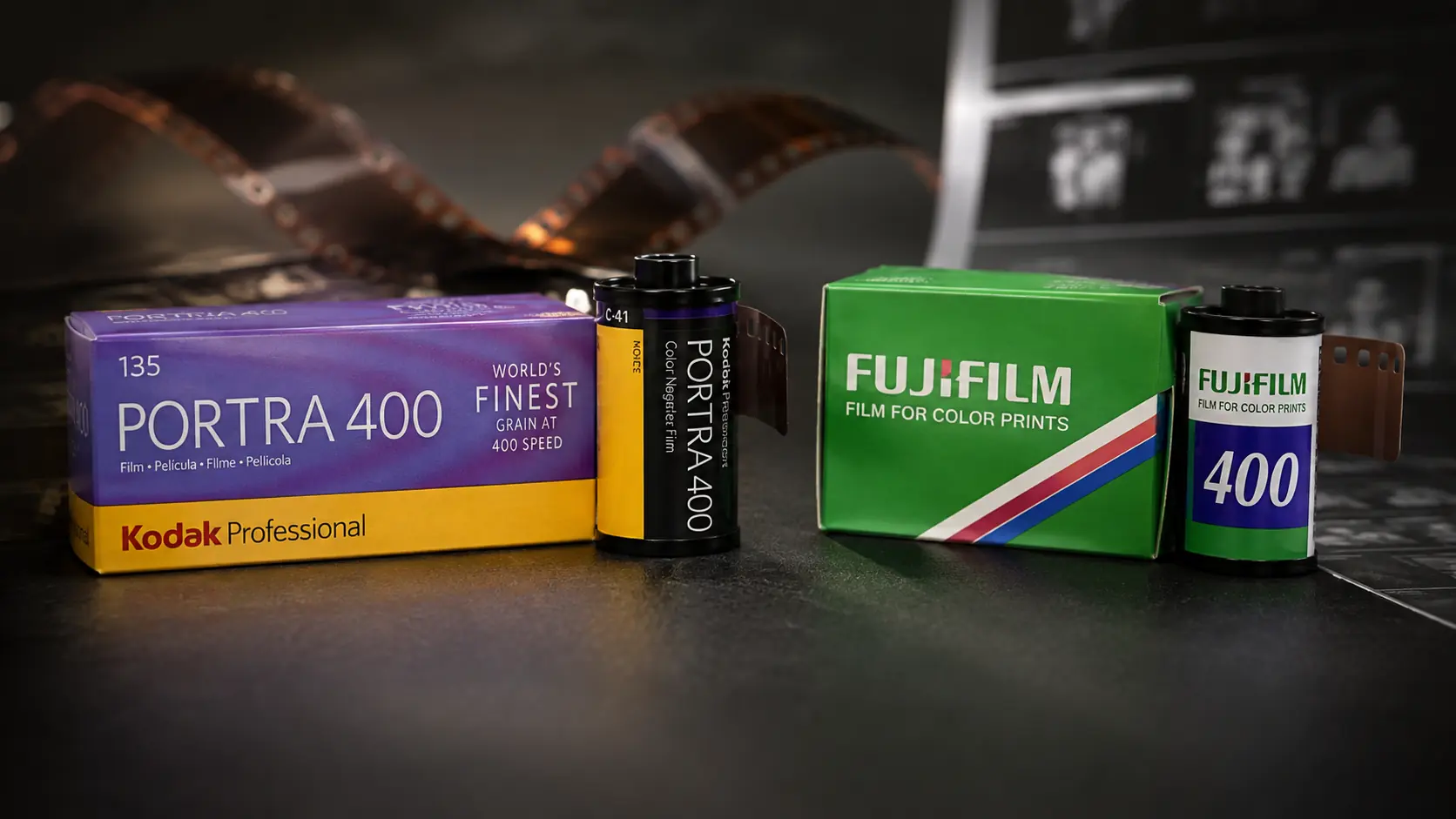
Kodak has overtaken Fujifilm as the most frequently used film brand in a new Japanese survey of 1,337 users, but the data reveals a broader trend: photographers are buying fewer different brands without substantially reducing the amount of film they shoot.
The new FilmFocus survey of film use in Japan was conducted between November 30 and December 31, 2025 and published on August 8, 2026. Of 1,359 submissions, 22 suspected duplicate responses were removed, leaving 1,337 valid responses. When participants were asked which film brands they had used over the previous 12 months, Kodak reached 71% and Fujifilm 68%, reversing their positions from the 2024 survey.
The more important point, however, is that both brands lost usage share compared with the previous survey. Fujifilm fell from 84% to 68% and Kodak from 81% to 71%, while the average number of major brands used by each photographer declined from 3.0 to 2.2. The picture is therefore not simply “Kodak wins, Fujifilm loses,” but a market in which rising costs appear to be making photographers more selective.
Kodak 71%, Fujifilm 68% — but this is not market share
The first distinction is crucial.
Kodak’s 71% and Fujifilm’s 68% are not sales figures or market-share percentages. The question allowed multiple answers and asked participants which film brands they had used during the previous year.
A photographer could therefore select Kodak, Fujifilm, Ilford and other brands at the same time.
In the same survey, Ilford was used by 41% of respondents, Lomography by 30%, Kentmere — added as a separate option this year — by 16%, and CineStill by 12%.
The change at the top is nevertheless symbolically significant. Fujifilm led the corresponding 2024 survey at 84%, compared with Kodak’s 81%. One year later, Kodak leads by three percentage points.
The more interesting story: photographers are trying fewer films
Looking only at which brand is number one misses perhaps the survey’s most important finding.
Usage of most major brands declined:
Fujifilm from 84% to 68%
Kodak from 81% to 71%
Ilford from 52% to 41%
Lomography from 38% to 30%
At the same time, the average number of brands used by each photographer during the year fell from 3.0 to 2.2.
FilmFocus suggests that repeated price increases are encouraging photographers to experiment less and concentrate on a smaller number of films they already know and trust.
That helps explain how major-brand penetration can decline without overall film use collapsing.
Fujifilm’s price increases provide important context
Cost is not a theoretical concern.
In April 2025, Fujifilm Imaging Systems officially announced Japanese price increases of approximately 21%–22% for 135 color negative film, around 44% for its single-use cameras, and 31%–52% for 135 and 120 reversal films. The company cited higher material, component and transportation costs.
PTTL covered Fujifilm’s film price increases of up to 52% and what they could mean for analog photography.
In the new survey, 62% of those who said they were shooting less film identified cost as the main reason. The equivalent figure in the previous survey was even higher at 70%.
Despite higher prices, photographers are not shooting fewer rolls
This is one of the survey’s biggest surprises.
35mm users shot an average of approximately 13.9 rolls over the year, compared with 13.7 in the previous survey.
For 120 medium format film, the average was approximately 7.0 rolls, compared with 6.9.
A total of 95% of respondents had used at least one roll of 35mm film during the year and 53% had used at least one roll of 120.
In other words, rising costs do not appear to have significantly reduced consumption among those who continue shooting film.
What is changing is how they spend their money.
28% are shooting more film and 26% less
The question about changes in shooting frequency offers an even more interesting picture.
28% said they were using more film than a year earlier, while 26% said they were using less.
The figures are very close to the 2024 results, when 30% reported an increase and 27% a decrease.
This is not therefore a market in which existing users are abandoning the medium en masse because of prices.
It is a more complex situation: some photographers are cutting back, others are increasing their shooting, and newcomers continue to enter film photography.
New users are driving increased use
The difference by experience level is striking.
Among people who had started shooting film within the previous year, 49% said they had increased their usage, while only 6% said they had reduced it.
Among photographers with more than ten years of film experience, the picture reverses: 15% are shooting more, while 40% are shooting less.
This suggests that the market is being supported to a meaningful degree by new participants, while long-term users are feeling the effects of higher costs more strongly.
The PENTAX 17 appears to have genuinely brought new people into film
Another survey finding links increased usage directly to new cameras.
Among those who increased their film use, 19% cited the purchase or acquisition of a new camera as the main reason. Free-text responses repeatedly mentioned the PENTAX 17 both as a new purchase and as a reason for beginning film photography.
PTTL covered the launch of the PENTAX 17, Ricoh’s modern half-frame film camera from day one.
This matters for the wider industry: new analog hardware is not necessarily being sold only to existing collectors. It can genuinely create new active film users.
What people shoot most: C-41 and black-and-white
For the first time, the survey also asked which types of film respondents had used.
C-41 color negative film remains dominant at 82%, but black-and-white film also recorded a very strong 61%.
Reversal/E-6 was used by 28%, while cinema ECN-2 film reached 7%.
The strong position of black-and-white is particularly interesting during a period of increasingly expensive color film. FilmFocus also connects the trend with access to more affordable options such as Kentmere, which reached 16% usage in the survey.
Why new photographers are discovering film
The survey also gives an indication of how the new audience is being created.
Among those who had started film photography during the previous year, 36% cited the internet and social media as the main trigger, while 27% mentioned friends or photography groups.
When participants were asked what they like about film, the most popular answers were:
58% the distinctive look of film photographs
53% the characteristics of film cameras
52% the anticipation of waiting to see the final photograph
Interest is therefore not driven only by nostalgia. For many newcomers, film photography is something they are discovering for the first time through an entirely digital environment.
Lab quality matters more than price
This year’s survey also added a question about choosing a processing lab.
41% ranked developing and scanning quality as their most important criterion, compared with 24% for price and 20% for location.
The result is notable because it comes from the same market in which users simultaneously report significant pressure from rising costs.
Photographers appear to be saving money by narrowing their brand choices or selecting different films, rather than necessarily compromising on developing and scanning quality.
The survey needs to be interpreted carefully
The data is highly useful, but it is not an official census of Japan’s entire film market.
The survey was conducted online and participation was voluntary. FilmFocus also notes that the composition of the sample changed: respondents with more than ten years of experience increased from 31.5% to 36.3%, while participation among people aged 50 and above also increased. For this reason, year-to-year comparisons of the overall percentages require caution.
Most importantly, Kodak’s 71% should not be translated into “71% market share in Japan.”
What can safely be said is that among the 1,337 valid respondents to this particular survey, more people reported using Kodak than Fujifilm over the previous 12 months.
What we think
The Kodak–Fujifilm reversal is the headline that attracts attention, but it is not the survey’s most important conclusion.
More significant is the evidence that film photographers are adapting to higher prices without abandoning the medium. They are narrowing the number of brands they try, choosing more affordable options and continuing to shoot roughly the same number of rolls.
Even more important is the contrast between new and long-term users. Veterans are more frequently cutting back, but the newer audience is rapidly increasing its usage. Mentions of the PENTAX 17 also suggest that new products can genuinely refresh the analog market.
Film is not returning to the mass-market position it occupied before digital photography. The data does, however, suggest that it has developed a smaller, active and remarkably resilient ecosystem.
Frequently asked questions
Has Kodak really overtaken Fujifilm in Japan?
In this specific FilmFocus survey, yes: 71% of respondents said they had used Kodak during the previous year and 68% Fujifilm. These figures are not official Japanese sales-market shares.
How many people participated in the survey?
There were 1,359 submissions, with 22 suspected duplicates removed, leaving 1,337 valid responses.
Are photographers using less film because of higher prices?
Average roll use remained essentially stable. 35mm users shot approximately 13.9 rolls per year compared with 13.7 the year before. However, cost was the main reason cited by 62% of those who were shooting less.
Which type of film is used most?
C-41 color negative film ranks first at 82%, followed by black-and-white film at 61%.
Is interest in film increasing among new photographers?
In the survey, 49% of respondents with less than one year of film experience said they had increased their film use. The internet and social media were the most frequently cited entry point for this group.