Summary
- NASA completed its most comprehensive simulation yet of Dragonfly’s first flight on Titan.
- Navigation cameras, lidar and motion sensors supplied data for an autonomous landing.
- A camera emulator rendered images in 20–70 milliseconds.
- The next step is to test the sequence on the actual flight system.
How can a robot identify a safe place to land on Titan all by itself? NASA has tested the answer in a comprehensive simulation of Dragonfly’s first flight.
In the test announced on October 23, 2026, the rotorcraft “flew” over virtual dunes, searched for suitable terrain, turned back toward its chosen site, and completed its descent. Everything took place on a computer testbed at the Johns Hopkins Applied Physics Laboratory (APL) in Maryland, not on Titan.
A complete flight, from terrain search to landing
NASA describes the exercise as the most comprehensive simulation yet of Dragonfly’s first flight. Its software ran in real time on flight-like avionics, reproducing most of the systems and maneuvers the vehicle will need when it reaches Titan.
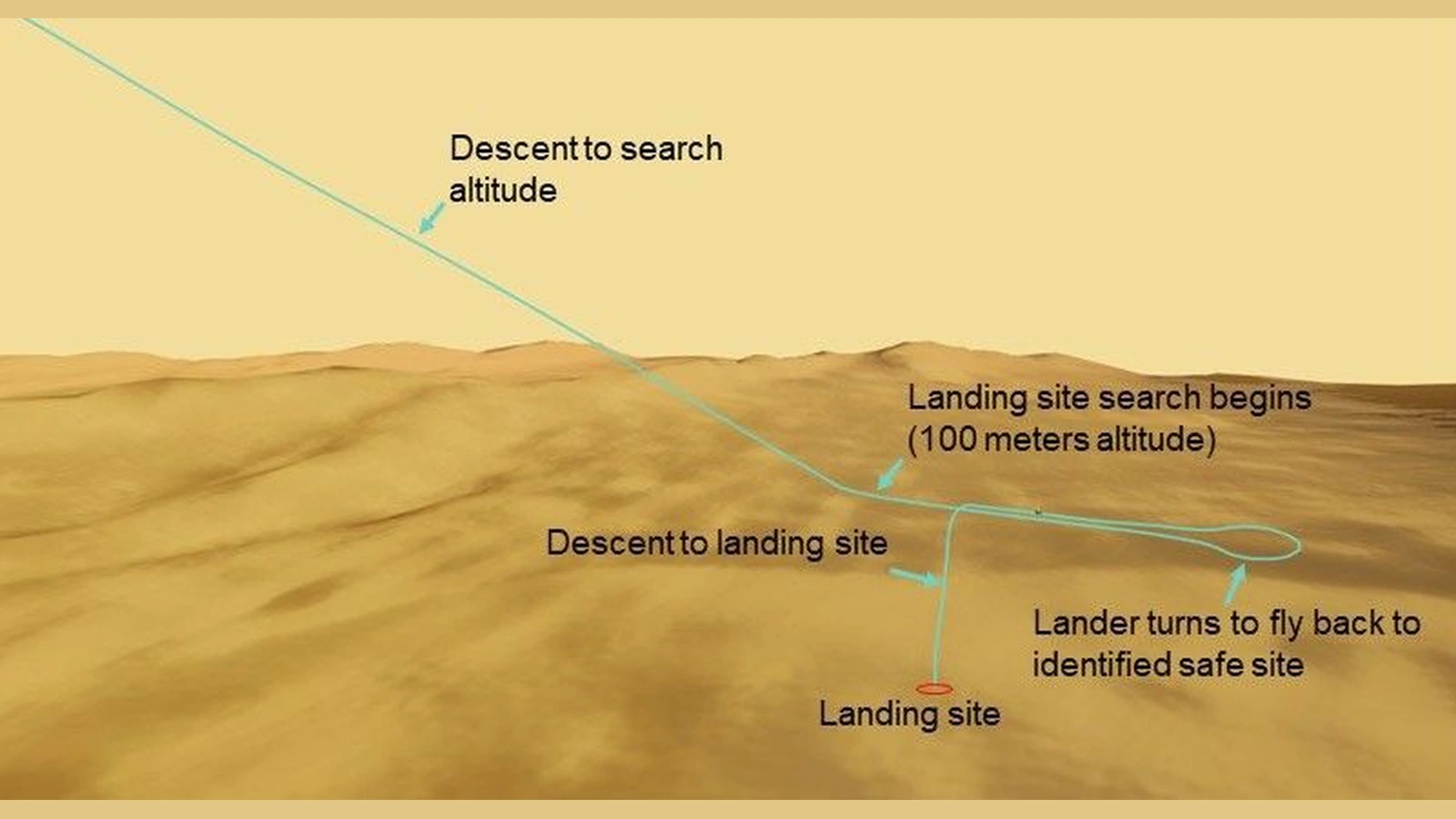
The test diagram traces the route with a blue-green line: Dragonfly descends toward the search area, inspects the terrain at approximately 100 meters altitude, passes its chosen spot, circles back and begins its final descent. The drawing represents a simulated flight, not photographs captured on Titan.
Cameras, motion sensors, and lidar in one decision-making chain
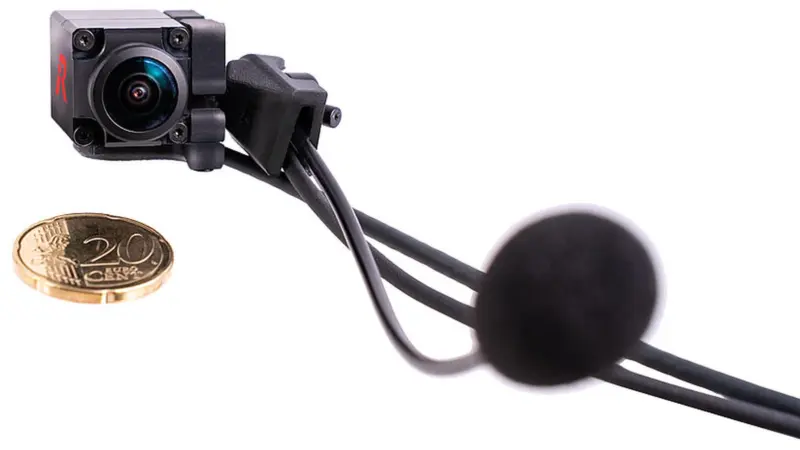
The system received simulated input from two navigation cameras, inertial measurement units (IMUs), and lidar. The cameras provide visual information about the landscape, IMUs track motion and orientation, while lidar measures range, terrain elevation and slope to help identify potential hazards.
For imaging technology, the particularly interesting part is how that input was generated. A custom GPU-powered camera emulator rendered the scenes Dragonfly would “see” in real time. Each scene took approximately 20–70 milliseconds to render, a timescale comparable to the exposure times the actual navigation cameras will use in flight.
That means engineers are testing more than whether the software recognizes imaginary terrain. They can also measure whether images, sensor readings and control commands arrive at the right moments inside the spacecraft electronics. In an autonomous landing, even millisecond-scale delays can affect how the system behaves.
Imagery already supports autonomous travel on Mars: Perseverance uses its AutoNav system to evaluate the terrain as it drives. On Titan, Dragonfly must make similar decisions while flying and selecting a landing site.
The mechanism that will release Dragonfly
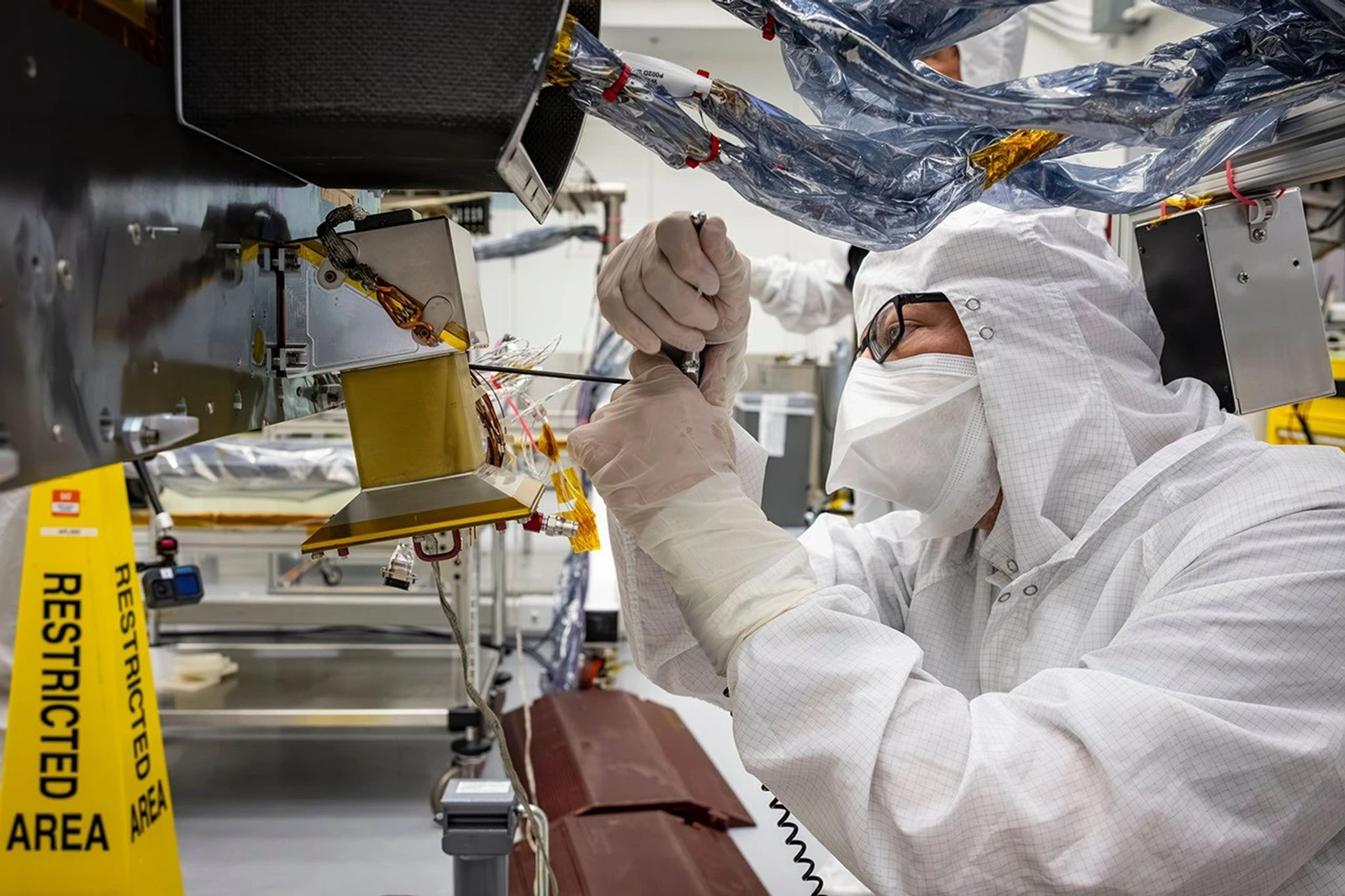
Alongside the simulated flight, teams are testing the deployment assembly known as the pose mechanism. During atmospheric descent at Titan, it will lower Dragonfly from its stowed position beneath the protective backshell, allowing its rotors to spin up before release.
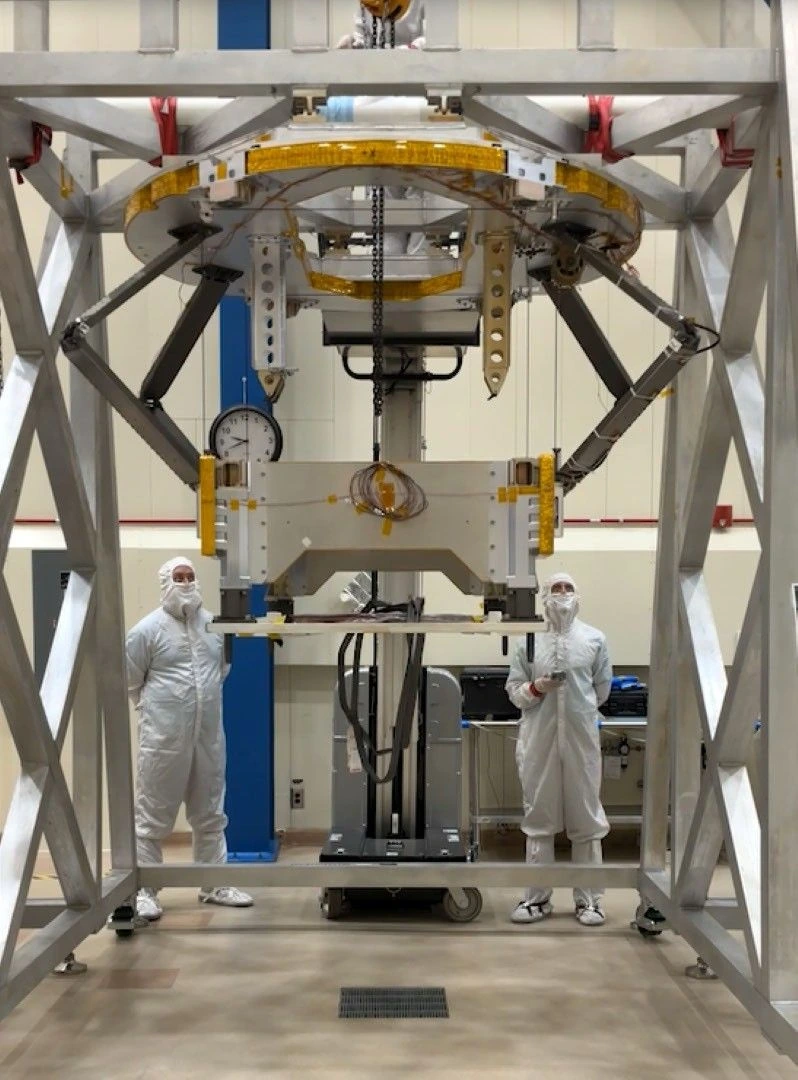
Lockheed Martin is carrying out static-load and deployment tests to check that the mechanism moves smoothly and locks securely in place. Engineers also repeat the procedure at different tilt angles, accounting for the backshell swinging beneath the parachute. This separate mechanical qualification is crucial before autonomous flight control takes over.
What comes next before the journey to Saturn
The team built toward this milestone incrementally, from spinning a single rotor and making a short repositioning flight to a partial scouting flight. Adding lidar completed the sensor suite needed for the most complex sequence.
Next, engineers plan to repeat first flight on Dragonfly’s actual flight system rather than the laboratory testbed. They will also introduce deliberate faults to see whether the vehicle can respond on its own. This autonomy is essential because real-time control from Earth will not be possible at Titan.
Launch is scheduled for no earlier than 2028, with arrival at Titan expected in 2034. Dragonfly is designed to move between different locations for approximately three years, studying the moon’s chemistry, geology and atmosphere.
What we think
For those of us who work with cameras, there is a fascinating detail here: the images are not being made so someone can admire them later. They are part of the process that decides where a flying robot can safely touch down.
We especially like that NASA is reproducing not just what the images contain but how quickly they become available. The 20–70 ms figure can look like a minor technical detail. In practice, it connects photographic exposure to decision-making speed. A system may see the right thing, but if it sees it too late, that information may arrive after the vehicle has already moved.
Another compelling aspect is that computer-generated imagery is being used to test real flight electronics. Engineers can look for timing faults and sensor-integration problems before the craft travels millions of kilometers away. It is a practical example of how far imaging technology has moved beyond photography alone.
Frequently asked questions
Has Dragonfly already flown on Titan?
No. The October 23, 2026 test was a laboratory simulation using flight-like avionics. Dragonfly is expected to arrive at Titan in 2034.
What do the 20–70 ms image times mean?
They indicate approximately how long the emulator took to render each synthetic scene, matching the exposure-time range planned for Dragonfly’s navigation cameras.