

Summary
- Ricoh Imaging is discontinuing production of all current Pentax K-series DSLRs
- The company confirms that it is developing a new series of digital SLR cameras based on an entirely new concept
- No models, specifications, prices or launch date have been announced yet
- Ricoh says it will leverage more than 50 years of K-mount heritage
- Existing models will continue to be sold while remaining stocks are available
- What exactly Ricoh Imaging announced
- Which models are affected and what remains available in Europe
- What we know about the new DSLR series
- Why the K-mount matters so much
- A DSLR strategy running against the mirrorless market
- Pentax has already shown that it is betting on the photographic experience
- What changes in practice for current Pentax users
- What we think
- Frequently asked questions
Ricoh Imaging is discontinuing production of all current Pentax K-series DSLRs, while simultaneously confirming that it is developing a new series of digital SLR cameras based on an “entirely new concept.”
Ricoh Imaging announced on September 9, 2026 that production of the current K-series digital SLR cameras will end as Pentax transitions to what it describes as a “new stage.” The most important part, however, is found in the second half of the official Pentax announcement: the company is not abandoning DSLRs, but says it is developing a new series of digital SLR cameras while leveraging the heritage of the K-mount.
The development matters because this is more than the retirement of aging models. Pentax is effectively clearing its current DSLR lineup before introducing its successor, in a market overwhelmingly dominated by mirrorless cameras. In 2025, companies participating in CIPA statistics shipped 690,911 SLR cameras worldwide compared with 6,311,054 mirrorless interchangeable-lens cameras.
What exactly Ricoh Imaging announced
The company’s wording is clear about the present and deliberately cautious about the future. Ricoh Imaging says it will discontinue production of the “current K series digital SLR cameras,” while developing a new series of digital SLR cameras “based on an entirely new concept.” It also warns that these products will take time to materialize and provides no launch timetable.
No model names, sensors, resolutions, autofocus systems, launch dates or prices have been revealed. Nor has the company provided a technical explanation of what the “entirely new concept” actually means.
That distinction is important: the announcement does not mark the end of the Pentax DSLR. It marks the end of its current generation, with a transition period of unknown length before the next models arrive.
Which models are affected and what remains available in Europe
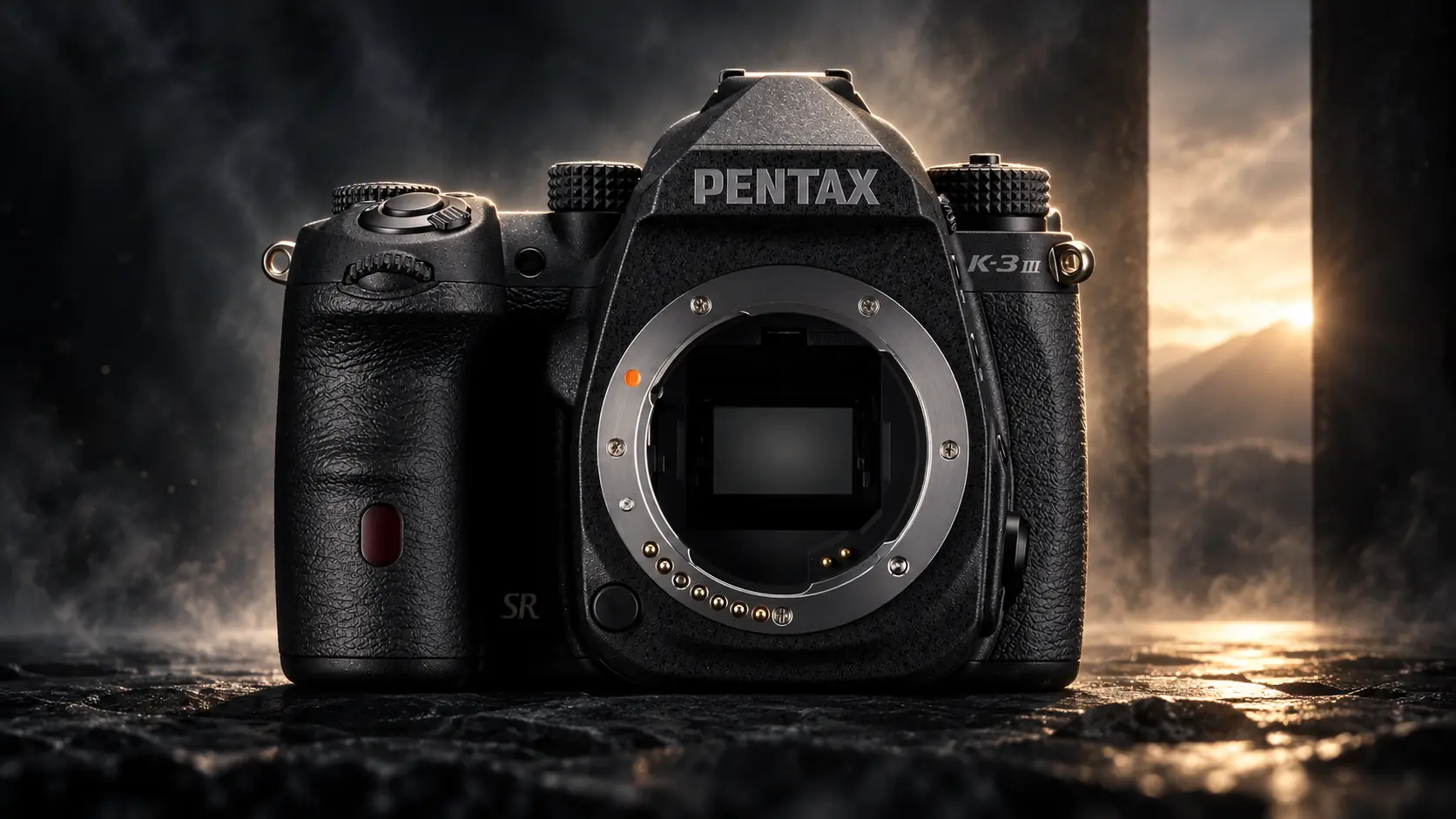
Pentax’s latest DSLR lineup includes the full-frame PENTAX K-1 Mark II, the APS-C PENTAX K-3 Mark III, the PENTAX KF and the specialized PENTAX K-3 Mark III Monochrome. These models were introduced between 2018 and 2023 and continue to appear on the company’s European product pages.
Ending production does not mean they immediately disappear from stores. When Pentax’s official European store was checked on September 9, 2026, the K-1 Mark II body was still listed in stock at €2,099. The K-3 Mark III was listed at €1,999.99 but out of stock, the KF at €949.99 and out of stock, and the K-3 Mark III Monochrome at €2,499.99 without immediate availability. That situation may now change quickly as remaining inventory is depleted.
For context, PTTL covered the official launch of the Pentax K-1 Mark II in 2018 and the announcement of the Pentax K-3 Mark III in 2021. The age of the K-1 Mark II in particular makes it clear that a major refresh of the lineup had become increasingly necessary.
What we know about the new DSLR series
The strongest element of the announcement is Ricoh Imaging’s use of the phrase “new series of digital SLR cameras,” rather than making a vague promise to merely “consider” the future of DSLRs. This is therefore a confirmed intention to develop new digital SLR products.
What remains unknown is equally important. The company has not said whether the first model will use a full-frame or APS-C sensor, whether it will directly replace the K-1 Mark II or K-3 Mark III, or how different it will be from a conventional DSLR.
Ricoh explicitly links the project to the K-mount legacy, but it has not yet published technical specifications concerning compatibility on the future bodies. Continued K-mount philosophy is clearly part of the plan, but exact lens compatibility should not be treated as guaranteed until the new cameras are formally presented.
Why the K-mount matters so much
The Pentax K-mount was introduced in 1975 and its fundamental bayonet design has formed the core of the system for more than half a century. Pentax itself notes that the mount’s foundation has remained consistent since then, with later generations adding functionality such as autofocus and electronic aperture control.
That creates a very different challenge for Pentax than simply launching another camera body: photographers may own collections of K-mount lenses accumulated over decades. The value of the next generation will depend heavily on how effectively it protects that investment while offering a genuine reason to upgrade.
The company’s interchangeable-lens digital history began with the *ist D in 2003, followed by models including the K100D in 2006 with sensor-shift Shake Reduction and the first full-frame K-1 in 2016. Ricoh highlighted those exact milestones in its announcement to underline the continuity it wants to preserve.
A DSLR strategy running against the mirrorless market
The numbers explain why the decision attracts attention. Of the 7,001,965 interchangeable-lens cameras shipped worldwide by CIPA members in 2025, only 690,911 were SLRs. Mirrorless models reached 6,311,054 units, leaving SLRs with less than 10% of that market by shipment volume.
Pentax is therefore not attempting to follow the rest of the industry in the same direction. It is choosing to invest in a smaller group of photographers who continue to value an optical viewfinder, a mechanical mirror and the different shooting experience offered by an SLR.
That does not guarantee commercial success, but it makes the new series considerably more interesting than a conventional successor offering little more than additional megapixels.
Pentax has already shown that it is betting on the photographic experience
This philosophy did not appear for the first time today. Through its Film Camera Project, Pentax returned to manufacturing an analog camera and introduced the half-frame PENTAX 17 in 2024, combining manual film advance, zone focusing and a design centered on the process of taking photographs. Pentax now says the response to the PENTAX 17 has confirmed the continuation of the Film Camera Project.
PTTL covered the PENTAX 17 when it was officially announced. The new DSLR statement uses a similar philosophy: Ricoh talks less about specification numbers and more about the value of the photographic process and the idea of a camera being more than a simple image-capturing tool.
What changes in practice for current Pentax users
For an existing owner of a K-1 Mark II, K-3 Mark III, KF or another Pentax DSLR, the announcement does not change how the camera operates, nor does it announce an end to servicing or support. It specifically concerns production of the current lineup.
The biggest immediate change affects photographers considering a new Pentax DSLR: new examples of the current generation will increasingly depend on remaining inventory. At the same time, anyone waiting for the successor needs to account for Ricoh’s own warning that the new series will take time to arrive.
What we think
Pentax’s decision is more interesting than an ordinary model discontinuation because it comes with a clear commitment to new DSLRs at a time when the wider camera market has moved overwhelmingly toward mirrorless systems.
The biggest risk is the gap between the two generations. Pentax now needs more than a promise: its new concept must give photographers a meaningful reason for a DSLR to exist in 2026 and beyond while preserving as much value as possible for the enormous K-mount ecosystem. Until the first technical details emerge, that is the aspect worth watching most closely.
Frequently asked questions
Is Pentax permanently stopping DSLR production?
No. Ricoh Imaging is ending production of the current K-series DSLRs, while confirming that it is developing a new series of digital SLR cameras based on a new concept.
When will the next Pentax DSLR be announced?
No date has been announced. The company says development will take time and that it will provide updates as the project progresses.
Will the new DSLRs use the K-mount?
Ricoh says the new project will leverage more than half a century of K-mount heritage, but it has not yet published technical specifications or a detailed compatibility list for the future bodies.
Can you still buy a new Pentax DSLR?
Yes, while stocks remain. On September 9, 2026, Pentax’s official European store still listed the K-1 Mark II as available, while several APS-C models were already shown as out of stock.
Does the production stop mean support for current DSLRs is ending?
Not according to this announcement. Ricoh specifically discusses the end of production for the current lineup and does not announce a simultaneous end to servicing or support.