

Summary
- On October 24, 1946, a V-2 carried a DeVry 35 mm camera to an altitude of about 105 kilometres
- The camera used Eastman Super XX film, an f/5.6 aperture and a 1/50 s shutter speed
- A 25.4 mm steel magazine protected the film from an impact faster than 540 km/h
- The flight was suborbital and preceded the first photograph of Earth from orbit by almost 13 years
- The flight of October 24, 1946
- Clyde Holliday’s DeVry 35 mm
- Eastman Super XX and one official disagreement
- The steel magazine was the real memory
- Impact at more than 540 km/h
- What the first image showed
- It was not a photograph from orbit
- The V-2’s dark background
- From film recovery to image transmission
- What we think
- Frequently asked questions
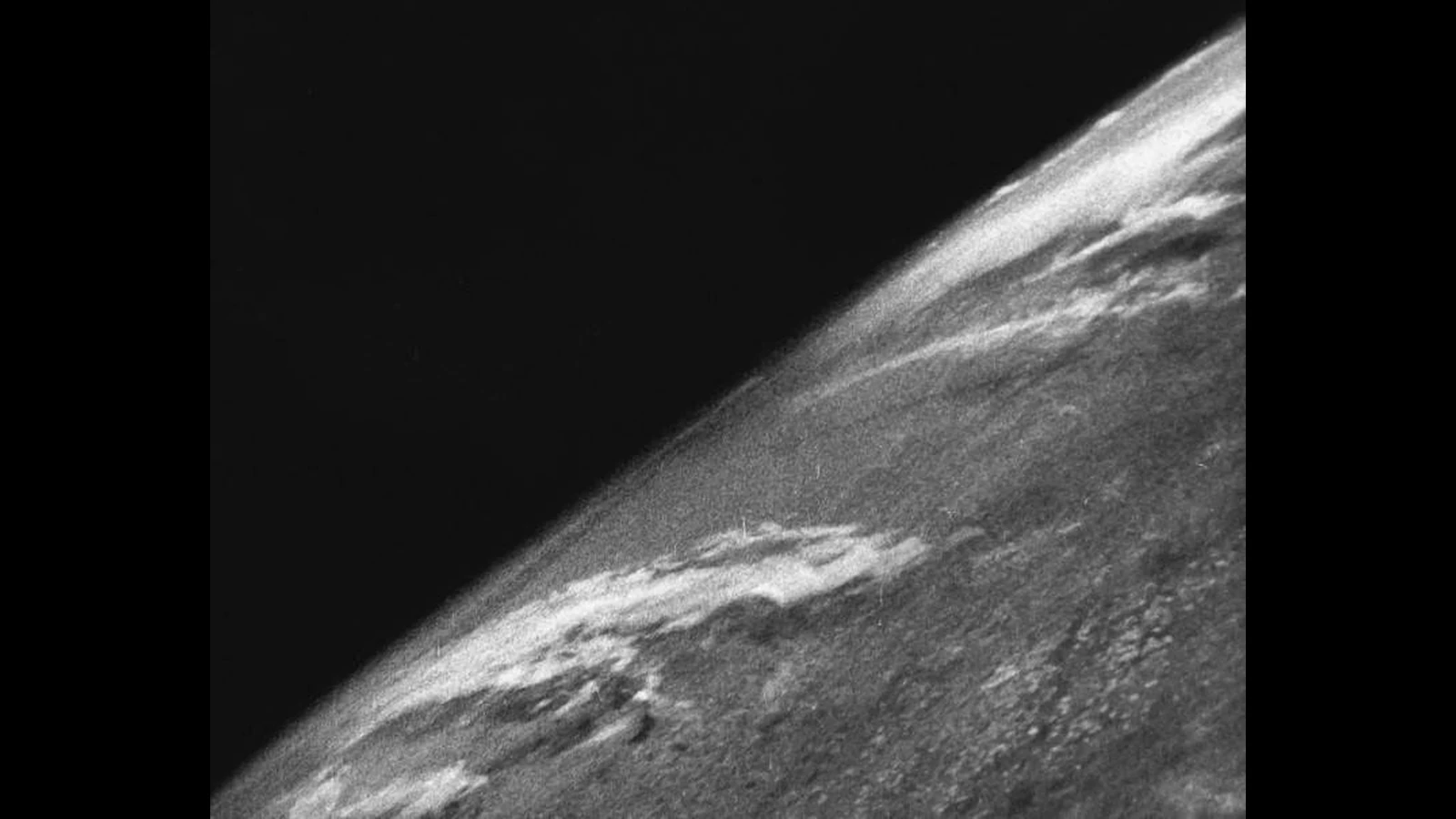
On October 24, 1946, a DeVry 35 mm motion-picture camera aboard a V-2 rocket captured the first photographs of Earth from space, and the film survived the violent impact with the ground.
The rocket launched from White Sands in New Mexico, climbed to about 65 miles or 105 kilometres and completed a suborbital flight more than a decade before Sputnik 1.
The historic first did not rely on image transmission or digital memory. The negative itself had to return, protected by a steel magazine and an aluminium enclosure, so that it could be developed after the rocket fell back to Earth.
The flight of October 24, 1946
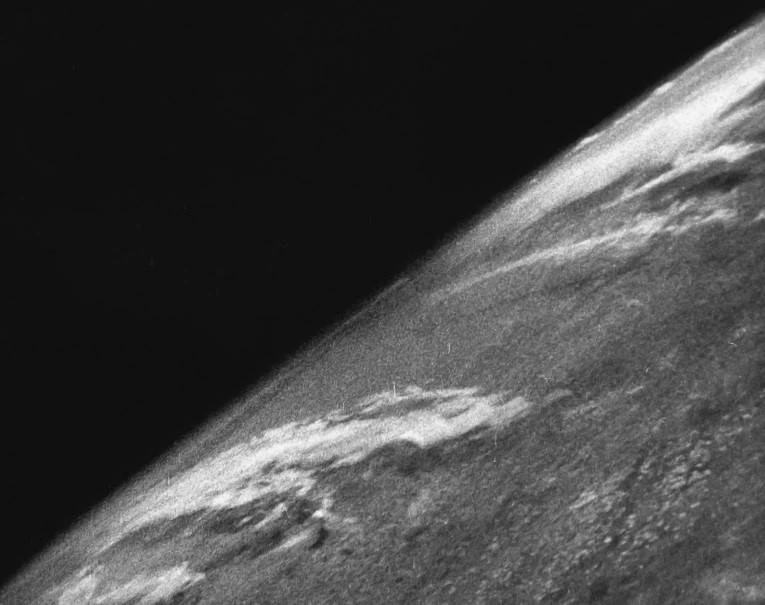
NASA records that the camera was mounted on top of a captured German V-2 and climbed just beyond the widely accepted boundary of space. The images revealed the American Southwest, clouds and the horizon with the darkness of space above it.
The Smithsonian reports that the flight photographed roughly 40,000 square miles, more than 100,000 square kilometres, of the surface. It was not a single still exposure but a sequence of frames from a motion-picture camera, from which the historic panorama associated with the mission was produced.
PTTL first covered the basic story of the first photograph of Earth from space in 2015. The more complete technical documentation now available makes it possible to reconstruct how the image was recorded and saved.
Clyde Holliday’s DeVry 35 mm
The strongest evidence for the camera comes from the Johns Hopkins Applied Physics Laboratory. The historical study High Altitude Research at APL in the 1940s states that engineer Clyde T. Holliday placed a DeVry 35 mm motion-picture camera in a V-2 in October 1946 to obtain the first photographs of Earth from high altitude.
Holliday was not simply the operator of an off-the-shelf camera. Today’s APL describes him as the developer of the mission’s camera system. A commercial motion-picture camera had to be modified to activate automatically, withstand launch vibration and acceleration and, most importantly, protect the exposed film during its return.
Eastman Super XX and one official disagreement
A 2023 technical paper on the NASA Technical Reports Server lists specific photographic parameters: 35 mm Eastman Super XX film, an f/5.6 aperture, a shutter speed of 1/50 second and a rate of four frames per second.
There is, however, a genuine disagreement between institutional sources. NASA’s historical page says the camera made one frame every 1.5 seconds, a much slower rate than the technical paper’s 4 fps. The available sources do not explain whether the figures describe a different setting, another phase or the later repetition of an incorrect detail. Both values should therefore be recorded without arbitrarily choosing one as definitive.
The steel magazine was the real memory
In 1946, no operational network could transmit photographs from this flight back to Earth. The system’s “memory” was the film itself, and its protection determined whether the mission would leave images behind or only an impact crater.
The technical paper describes a one-inch-thick steel film magazine, about 25.4 mm. The entire camera sat inside a three-eighths-inch aluminium enclosure, about 9.5 mm thick, with only the lens protruding.
This arrangement explains the design priority: the camera was expendable compared with the negative. If the mechanism worked during ascent and the magazine remained sealed during impact, the images could be recovered even from wreckage.
Impact at more than 540 km/h
There was no controlled landing. According to NASA, the V-2 returned and hit the ground at more than 340 mph, or about 547 km/h. Johns Hopkins APL reports that the camera and exposed film inside the armoured case were recovered a few hours after the flight.
Once developed, the frames revealed a view no one had previously recorded from space. The mission succeeded not because impact was avoided, but because the system had been designed with impact treated as a certainty.
What the first image showed
The photograph does not show the entire planet. It records an oblique black-and-white view of the surface and atmosphere, with Earth’s horizon separating the clouds from the dark background of space.
The image has enormous historical value precisely because it is transitional. It retains the visual language of aerial photography but has already crossed into space imaging. It is not yet the full blue disk that would become an icon decades later, but the first photographic evidence of Earth framed by the black environment beyond the atmosphere.
It was not a photograph from orbit
The V-2 followed a suborbital trajectory: it climbed above the boundary of space and immediately returned to Earth. It did not gain the horizontal velocity required to remain in orbit.
The first photograph of Earth from an orbiting satellite was made by Explorer 6 on August 14, 1959, as NASA confirms. The distinction is clear: 1946 brought the first photographs of Earth from space, while 1959 brought the first image of Earth from orbit.
The V-2’s dark background
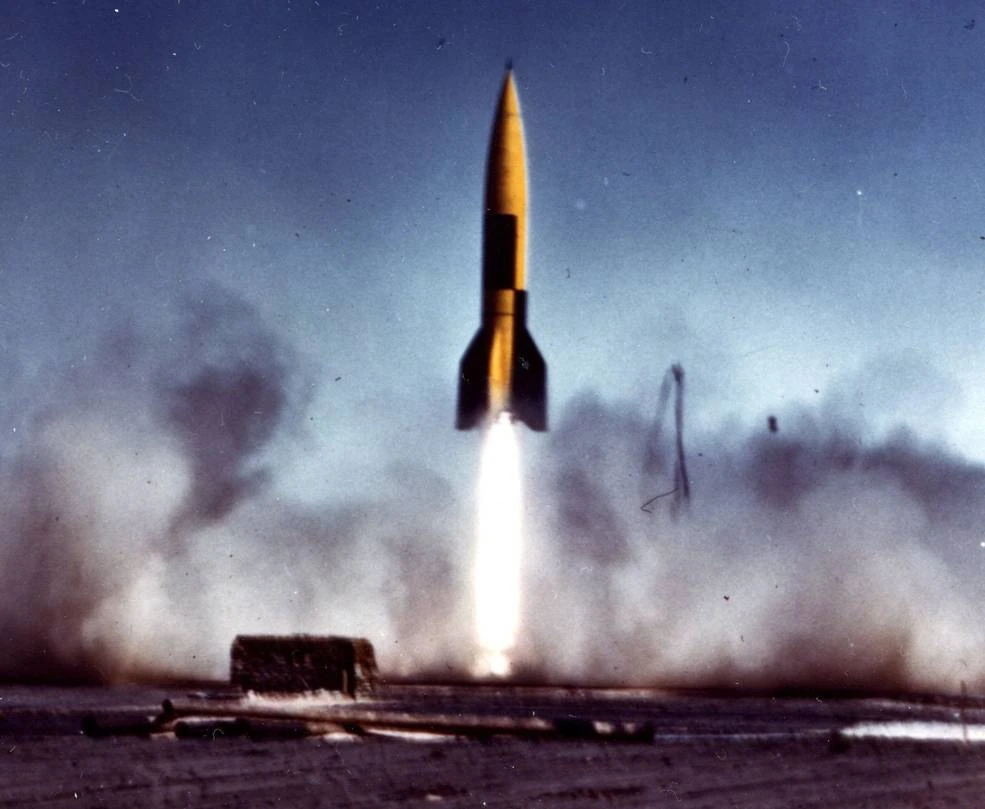
The technological first cannot be separated from the rocket’s origins. The V-2, or A-4, was developed by Nazi Germany as a ballistic weapon and used against European cities. Its production at the underground Mittelwerk factory relied on the forced labour of prisoners from the Mittelbau-Dora concentration-camp system.
The Smithsonian National Air and Space Museum records about 20,000 deaths in the Mittelbau-Dora camp system and estimates that at least half can be attributed to the V-2 production programme. After the war, the United States transferred components, expertise and German specialists through Operation Paperclip and used captured rockets for military and scientific research at White Sands.
The 1946 photograph is therefore part of a complex history: a peaceful scientific and photographic first made possible by weapons technology that carried a grave human cost in both its manufacture and use.
From film recovery to image transmission
The V-2 solution was entirely physical: the film had to return to Earth. Thirteen years later, Luna 3 faced the opposite problem because its negative was behind the Moon and could not be recovered.
The Soviet spacecraft developed, dried and scanned the film by itself before transmitting the image in analog form. The comparison shows how quickly space photography evolved: from an armoured magazine that had to survive a crash to an automatic photographic laboratory that sent an image by radio from lunar distance.
What we think
The first photograph of Earth from space was not produced by a “space camera” in the modern sense, but by a commercial DeVry transformed into a rugged scientific instrument. The most important technical lesson lies in the correct prioritisation of risk: when the fall was unavoidable, engineers protected the only element that could not be recreated, the exposed film. The image’s historical value nevertheless coexists with the obligation not to romanticise the wartime and forced-labour origins of the platform that carried it.
Frequently asked questions
When were the first photographs of Earth from space taken?
On October 24, 1946, by a DeVry 35 mm motion-picture camera aboard a V-2 launched from White Sands in New Mexico.
How did the film survive the impact?
The roll sat in a steel magazine about 25.4 mm thick, while the camera was protected by an aluminium enclosure about 9.5 mm thick. The armoured case was recovered a few hours after the flight.
Was this the first photograph of Earth from orbit?
No. The V-2 flight was suborbital. The first photograph of Earth from an orbiting satellite was captured by Explorer 6 on August 14, 1959.
How fast did the DeVry shoot?
Official sources disagree. A technical paper on the NASA Technical Reports Server lists four frames per second, while a NASA history page says one frame every 1.5 seconds.