Summary
- Aura introduced the Ink 10″ with a 10-inch color E Ink display at 1600 × 1200 resolution.
- Its screen uses nine base colors at 200 PPI.
- The cordless frame can last up to three months under the stated usage conditions.
- It costs $349 in the United States.
Can a digital picture frame look more like a photograph on paper than a glowing screen? The new Aura Ink 10″ aims to do exactly that, combining color E Ink with a cordless design.
Announced on November 10, 2026, the smaller Ink model increases pixel density and adds three base colors compared with the Ink 13″. The focus is on the way photographs look in a room and the freedom to hang a frame much like a conventional print.
Color E Ink with nine base colors
The 10-inch E Ink Spectra 6 screen has a 1600 × 1200 resolution, a 4:3 aspect ratio and a density of 200 PPI, compared with 150 PPI on the larger Ink 13″. Charged ink particles form the image and hold it without continuous power.
Three added colors — off-white, mustard yellow and orange — join black, white, red, yellow, blue and green. Aura uses dithering to create the appearance of a broader palette, aiming for smoother skin tones, richer textures and more natural gradients.
There is a photographic trade-off: colors do not precisely match the original file as they might on a calibrated display, and changing an image is not instantaneous. This frame is intended to show selected photographs, not to proof color or run a fast slideshow.
Cordless display and subtle front lighting
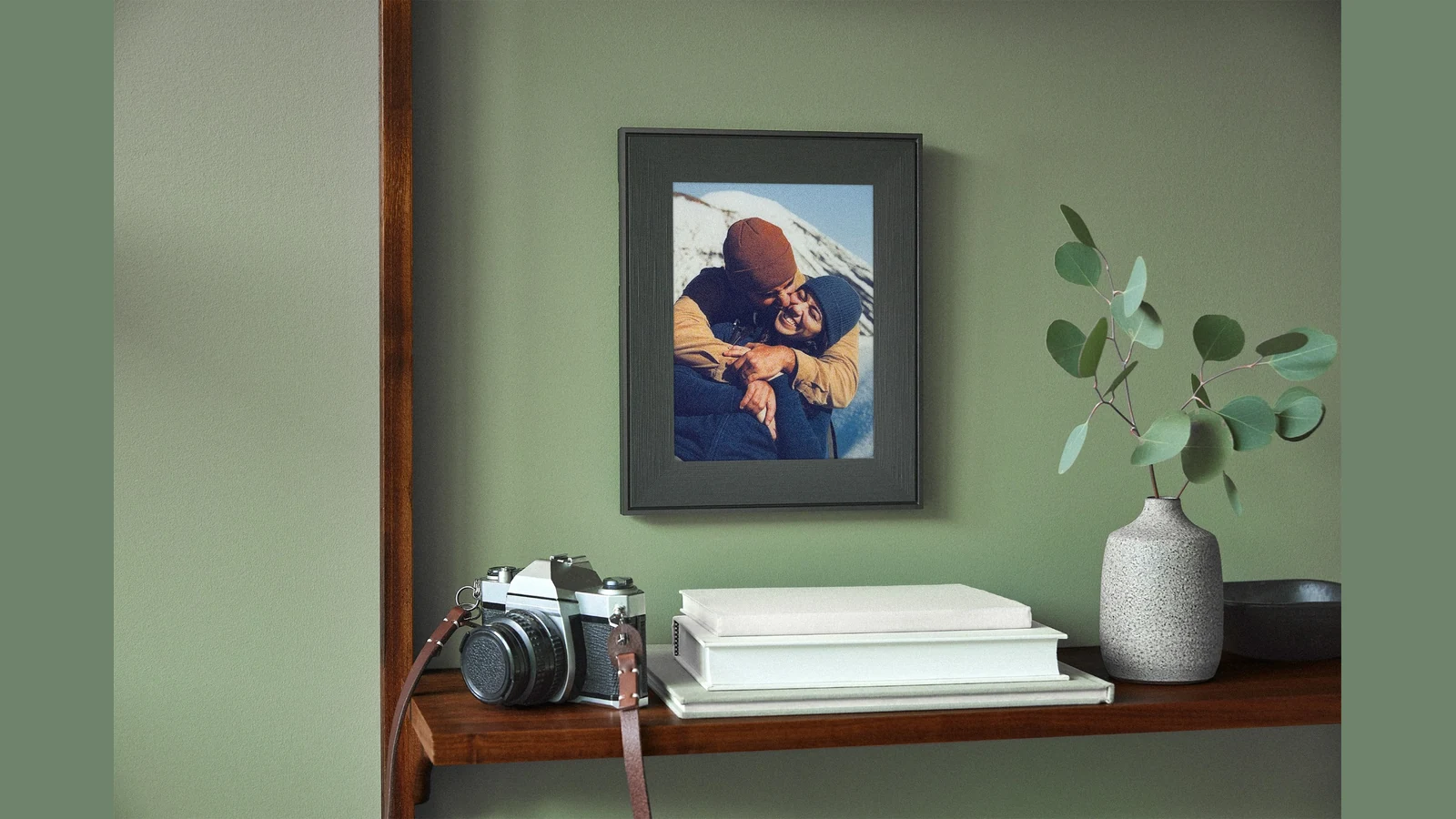
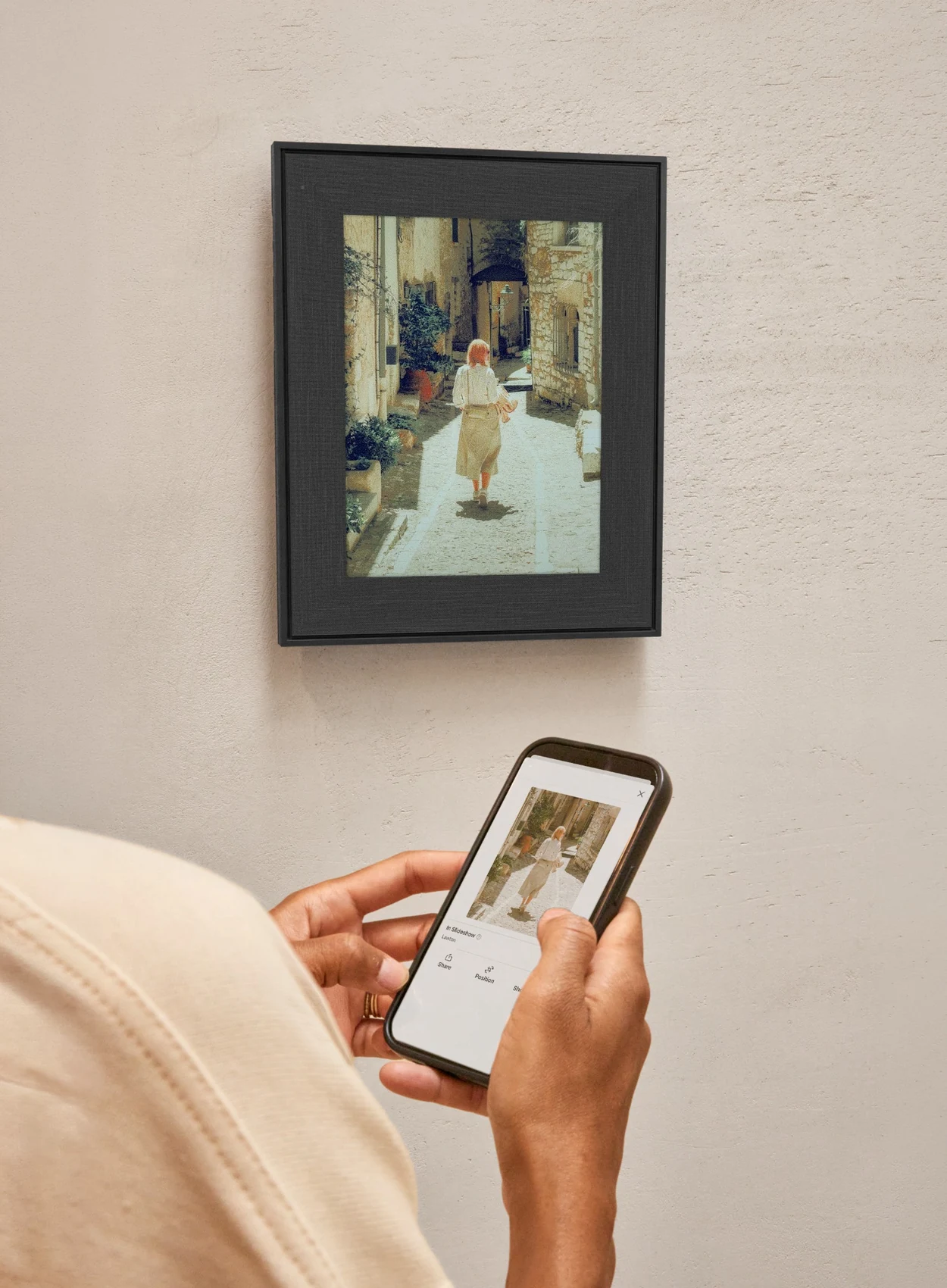
The frame has a graphite-toned fluted bezel and dark linen-textured mat. It works in portrait or landscape orientation and includes both a tabletop stand and wall-mounting hardware.
Ambient light does most of the work, supplemented by gentle front lighting. Motion and light sensors automatically adjust it, with scheduling also available. Aura claims up to three months on a charge when showing one new photo per day; more frequent updates and lighting use will affect battery life.
Photos from phones, email and the cloud
The default setting displays one new photo overnight, but owners can schedule up to 12 changes daily. Images can also be changed on demand through the app or the frame’s controls.
Using Wi-Fi and the Aura app for iOS and Android, photos can be added through a web uploader, Apple Photos, Google Photos, iCloud, email or text messages. Friends and relatives can contribute remotely. Aura provides unlimited photo storage without a subscription.
The company has come a long way since the original Aura frame in 2016, when cords and ease of use were major issues. Other approaches now exist too, including the AI-enabled Alexa Photo Frame, which targets a rather different experience.
More information here.
Price and availability
Aura Ink 10″ is available in the United States for $349, which is $150 less than the $499 Ink 13″. An official European price for this specific model could not be verified.
What we think
The appealing part is not being able to display hundreds of photographs — digital frames have done that for years. It is being able to put a picture on the wall without it looking like a screen that is switched on, or having a power cable hanging below it.
For photographers who love prints, the Ink 10″ is appealing because one image can have a place in the room for hours or days. A monochrome photograph, a portrait or a small family series can change over time without turning the room into a slideshow.
We would not use it to judge color accuracy or show a client what a finished print will look like. Its limited palette is part of its character, not a substitute for photographic paper. At $349, you are paying for a particular way of living with your photographs, rather than the biggest or most versatile screen.