

Summary
- Darryl Brown’s bodycam footage from the Delaney Hall protest has been released.
- The video shows him handling a bag containing what appears to be a professional camera.
- The recording stops before showing what subsequently happened to the bag.
- Some of Angelina Katsanis’ missing equipment had been recovered from Brown’s home.
- The officer is charged with third-degree theft and has not been found guilty.
- The footage was released following a legal challenge seeking access to public records.
The release of Darryl Brown’s bodycam footage adds crucial evidence to the case involving the disappearance of Greek American photojournalist Angelina Katsanis’ camera equipment.
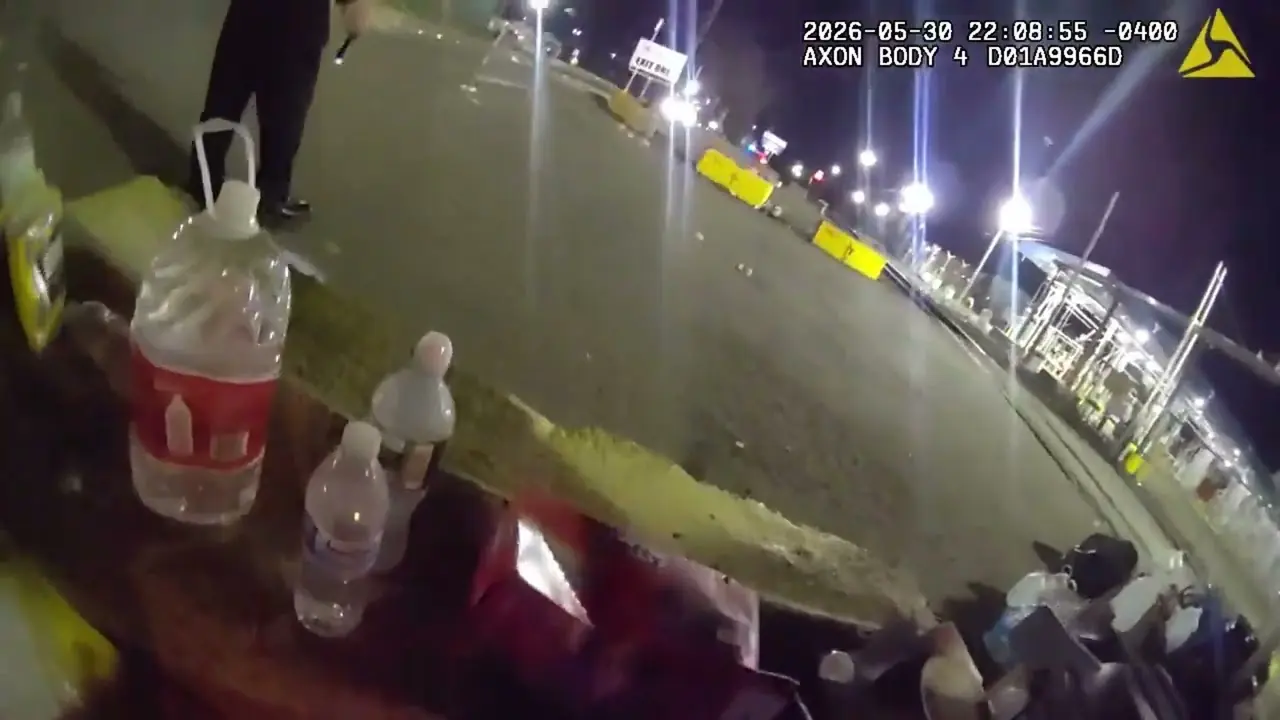
New Jersey authorities have released bodycam footage showing police officer Darryl Brown finding and handling a bag containing a professional camera at the Delaney Hall protest site, where Katsanis’ equipment had disappeared.
The development is particularly significant because the video was at the center of a legal dispute over access to public records. Although the footage shows Brown coming into contact with the bag, it ends before revealing what happened next, leaving a critical gap in the sequence of events.
The released footage
The footage was recorded on May 30, 2026, after protesters and journalists had been cleared from the area surrounding Delaney Hall in Newark. Brown and other officers are seen walking with flashlights among objects left on the ground, tables and chairs.
The officers examine backpacks, food, first-aid supplies and other personal belongings. During the recording, they comment on the quantity of items that had been left behind and discuss what should be done with them.
The video was released on July 30, weeks after The Jersey Vindicator filed a lawsuit against the Essex County Prosecutor’s Office over its initial refusal to provide it.
The moment the bag is discovered
At one of the most important points in the footage, the officers find an open bag among the belongings. What appears to be a professional camera can be seen inside it.
Brown asks whether the object is a camera and requests that the bag be handed to him. He then closes it, moves it to one side and continues examining other objects in the area.
A short time later, he picks up another item and asks whether it is a battery, with another officer replying that it is probably a charger. The presence of a camera, battery or charger is consistent with the contents of a professional camera bag.
The critical gap in the recording
Less than two minutes after the bag is discovered, Brown tells the other officers that they can stop recording. The video ends without showing what subsequently happened to the bag.
The footage therefore documents Brown handling a bag containing a professional camera, but it does not show the bag being removed from the area and does not, by itself, establish who took it.
This distinction is important because Brown is charged with third-degree theft, but criminal responsibility will be determined through the complete body of evidence and the judicial process.
How the equipment disappeared
Angelina Katsanis was covering protests outside Delaney Hall for the Associated Press. The facility is used to hold immigrants detained by U.S. Immigration and Customs Enforcement.
During clashes between police and protesters, she was struck in the knee by a wooden beam and moved away from the area to receive medical attention. Her equipment bag remained behind while the site was under the control of law enforcement.
When she later returned in a wheelchair to collect her belongings, the bag had disappeared. According to previously reported details, it contained equipment valued at approximately $10,000, including a Sony Alpha 1, a Sony 70-200mm lens and other photographic accessories.
From the AirTag to the officer’s home
An AirTag attached to an item inside the bag allowed Katsanis and investigators to track its movement. While the photojournalist was in hospital, the signal indicated that the equipment had reached a home in Sparta Township, New Jersey.
The address was linked to Darryl Brown, a sergeant with the Essex County Prosecutor’s Office. On June 3, investigators executed a search warrant at his home and recovered several of the missing items.
Some of the recovered objects carried Katsanis’ name and phone number. Brown was suspended without pay and charged with third-degree theft, which can carry a prison sentence of three to five years and a fine of up to $15,000.
The legal dispute over the bodycam footage
The Jersey Vindicator reporter Steve Janoski had requested Brown’s bodycam footage, along with documents, recordings and reports connected to the case.
The Essex County Prosecutor’s Office rejected the initial request, arguing that releasing the material could affect an active investigation. The news organization filed a lawsuit, maintaining that the video had been created before Brown became a suspect and did not fall under the limited exemptions contained in New Jersey’s body-worn camera law.
The Attorney General’s Office eventually released the footage as part of a revised response to a separate public records request. Authorities maintained that the original refusal had been justified because not all witnesses had been interviewed, but said those concerns no longer applied.
Why the case concerns all photojournalists
The case is not limited to the loss of equipment with a high financial value. It concerns the safety of journalists covering protests, police operations and events involving heightened tensions.
Cameras and lenses are the photojournalist’s essential tools of documentation. Their loss or removal can prevent an event from being recorded, deprive a journalist of the ability to work and affect the public’s right to information.
The release of the bodycam footage now allows the public to examine part of what happened, although it does not provide a definitive answer about the events following the end of the recording.
What we think
Releasing the footage was necessary, particularly in a case where the accused is a law enforcement officer and the victim is a photojournalist who was carrying out a professional assignment.
The video does not document the bag’s entire journey and should not be presented as independent proof of guilt. It does, however, show an important moment in the case and confirms why access to such recordings is essential for transparency, accountability and public trust.
Frequently asked questions
What does the bodycam footage show?
It shows Darryl Brown and other officers examining belongings left at the scene, with Brown handling a bag containing what appears to be a professional camera.
Does the video show the officer taking the bag?
No. The footage shows Brown closing and moving the bag, but it ends before revealing what happened next.
How was Brown connected to the missing equipment?
The bag’s AirTag indicated a property linked to Brown. A search of his home recovered several of Katsanis’ belongings, some carrying her name and phone number.
Why did it take so long for the video to be released?
Authorities initially refused to provide it, citing the need to protect an active investigation. The Jersey Vindicator filed a lawsuit seeking its disclosure.
What charge does Darryl Brown face?
He faces a charge of third-degree theft and has been suspended without pay. He has not been found guilty, and the case will be decided through the judicial process.