

Summary
- Spare lithium-ion batteries up to 100 Wh must be carried in the cabin and protected against short circuits.
- Regular equipment batteries above 100 Wh and up to 160 Wh require operator approval, while larger spare batteries are limited to two per person.
- Above 160 Wh, ordinary camera, drone and V-mount batteries cannot travel as normal passenger baggage.
- A 98 Wh V-mount is below the standard threshold, a 150 Wh model requires approval where accepted, and a 190 Wh model exceeds the passenger limit.
- The 2026 ICAO Addendum temporarily provides for 100-160 Wh power banks with operator approval, but current IATA passenger guidance marks them as forbidden and limits passengers to two power banks up to 100 Wh.
- AEGEAN, Olympic Air and Ryanair currently apply a 100 Wh maximum to the relevant batteries, with additional restrictions for power banks.
- The three factors that determine whether a battery can fly
- Up to 100 Wh: the standard category for cameras and drones
- Above 100 Wh and up to 160 Wh: approval is required
- Above 160 Wh: no longer normal passenger baggage
- Cameras and video cameras: what happens to the installed battery
- Drones: the aircraft and its batteries are separate issues
- V-mount batteries: why 98 Wh is so common for travel
- Power banks in 2026: a genuine transitional complication
- What must be declared to the airline
- How to calculate Wh correctly
- How spare batteries should be packed
- Damaged or overheating batteries
- Current AEGEAN and Olympic Air policy
- Current Ryanair policy
- What SKY express states
- What we think
- Frequently asked questions
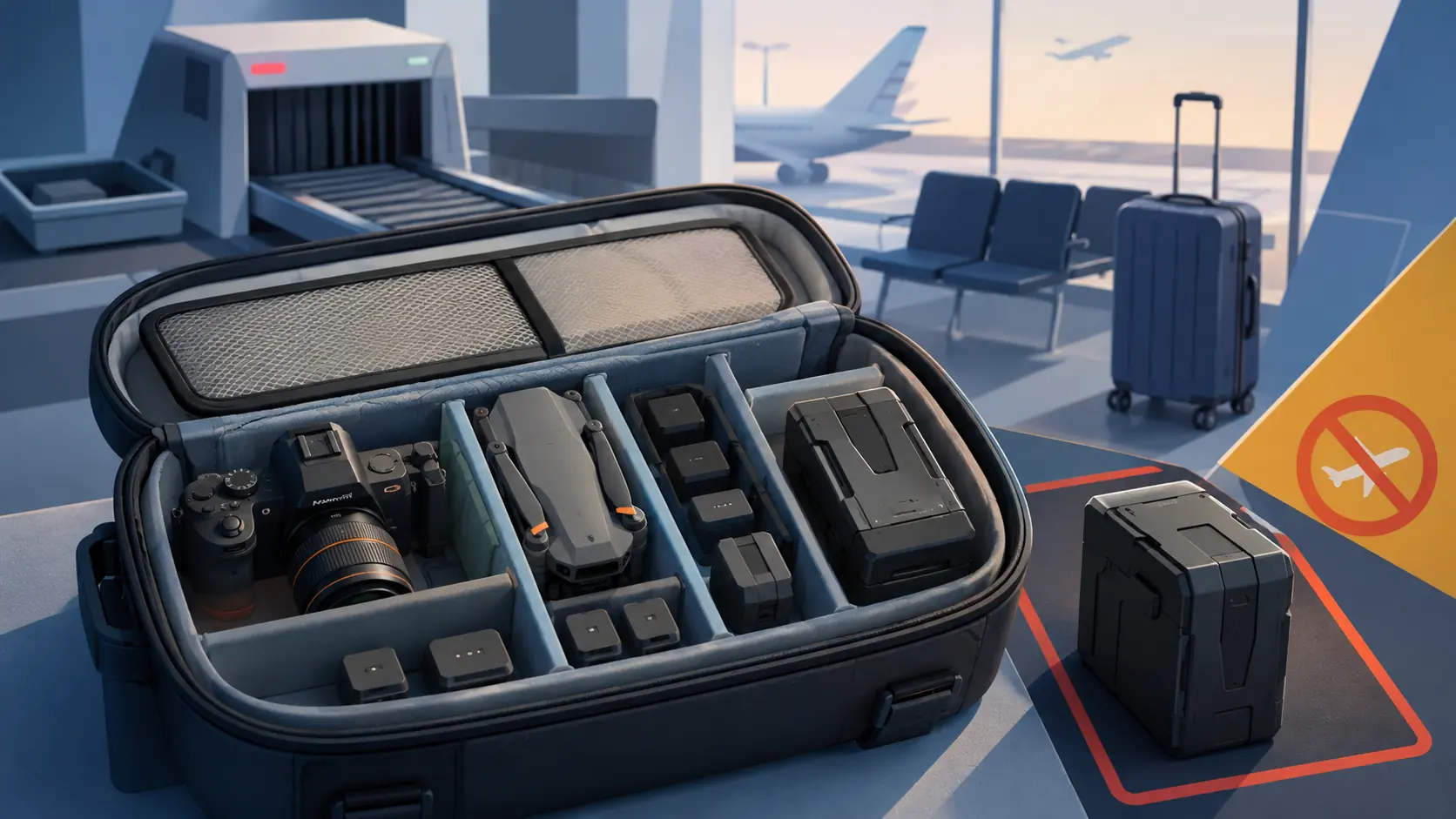
For cameras, drones and professional V-mount batteries, the critical checks before air travel are the Wh rating, whether the battery is installed or spare, and whether the airline requires or refuses operator approval.
Since 27 March 2026, additional ICAO changes specifically affect power banks, which are now more clearly separated from ordinary spare batteries: they are limited to two per passenger, must not be recharged on board and must be carried in the cabin.
This matters particularly to photographers and filmmakers because a typical small camera battery, a drone battery, a 98 Wh V-mount, a 150 Wh V-mount and a 190 Wh V-mount can fall under different requirements, while an airline is free to impose stricter limits than the general framework.
The three factors that determine whether a battery can fly
For rechargeable lithium-ion batteries, the main measurement is Watt-hours or Wh. IATA’s 2026 guidance states that Wh is calculated by multiplying capacity in Ah by nominal voltage, Wh = Ah × V, and that lithium-ion batteries are required to have their Wh rating marked on the battery case. If staff cannot verify the rating from the battery or documentation, the operator may refuse carriage.
The second factor is configuration. A battery installed in a camera or other portable electronic device is treated differently from a battery carried on its own. Once a removable battery is taken out of a device, it is treated as a removed or spare battery.
The third factor is the airline itself. IATA Table 2.3.A explicitly notes that the general provisions can be limited by State or operator variations. A battery being acceptable under the general framework therefore does not force every airline to accept it.
Up to 100 Wh: the standard category for cameras and drones
For lithium-ion batteries rated at no more than 100 Wh, the basic framework permits portable electronic devices such as cameras, phones, laptops and tablets without prior operator approval, with a general IATA limit of 15 PEDs per person without additional approval.
Spare or removed batteries up to 100 Wh may only be carried in cabin baggage. Each must be individually protected against short circuit, for example using its original packaging, insulated terminals, or a separate protective case or pouch. IATA passenger guidance provides for up to 20 spare batteries without additional operator approval, although the operator may approve more.
This category normally includes small mirrorless and DSLR batteries, many video-camera and drone batteries, and professional batteries deliberately designed to remain below the 100 Wh threshold. Physical size is not the deciding factor; the Wh rating is.
Above 100 Wh and up to 160 Wh: approval is required
For regular lithium-ion equipment batteries above 100 Wh but not exceeding 160 Wh, the general IATA framework requires operator approval. This applies to batteries installed in portable electronic devices and to larger spare batteries.
Spare batteries in this category must travel in the cabin, be protected against short circuit and are generally limited to two per person. They cannot be placed in checked baggage.
A 150 Wh V-mount, for example, falls within this range. That does not mean it is automatically accepted: operator approval is required, and an airline that imposes its own 100 Wh maximum can refuse it entirely.
Above 160 Wh: no longer normal passenger baggage
For ordinary camera, drone and filmmaking batteries above 160 Wh, IATA passenger guidance states that the battery must be prepared and transported as cargo in accordance with the Dangerous Goods Regulations rather than as normal carry-on or checked passenger baggage.
A 190 Wh, 220 Wh or 290 Wh V-mount therefore does not become acceptable simply because it is declared at check-in or belongs to professional production equipment. It exceeds the 160 Wh passenger threshold and requires a different dangerous-goods transport process.
Special provisions for mobility aids and certain medical equipment belong to different categories and do not turn a large cinema battery into permitted passenger baggage.
Cameras and video cameras: what happens to the installed battery
Under the basic IATA Table 2.3.A, a portable electronic device containing a lithium-ion battery up to 100 Wh can be carried in the cabin and, subject to conditions, in checked baggage. If checked, it must be protected against damage and accidental activation and completely switched off rather than left in sleep or hibernation mode. IATA passenger guidance nevertheless recommends keeping cameras and other battery-powered devices in cabin baggage.
A second camera battery does not follow the same rule as the battery installed in the camera. When carried separately, it is a spare battery and is therefore prohibited from checked baggage. The same principle applies to removable NP-F batteries, professional battery packs and other equipment batteries.
Drones: the aircraft and its batteries are separate issues
Removable lithium-ion drone batteries follow the spare-battery rules. Up to 100 Wh they are carried in the cabin with protected terminals; above 100 Wh and up to 160 Wh they require operator approval under the general framework. Above 160 Wh they are not treated as normal passenger baggage.
The drone itself may be subject to additional airline policy. Ryanair, for example, currently states that drones and quadcopters are not permitted in the hold, may be carried in the cabin if they meet cabin-baggage dimensions and their battery does not exceed 100 Wh, and that drone batteries above 100 Wh cannot be carried.
Permission to carry a drone on an aircraft is separate from the rules governing drone operation at the destination.
V-mount batteries: why 98 Wh is so common for travel
A professional 98 Wh battery sits below the critical 100 Wh threshold. When treated as a spare equipment battery, it can travel in cabin baggage under the general framework without the special operator approval triggered above 100 Wh, provided the terminals are protected and quantity limits are respected.
At 150 Wh the situation changes: the battery enters the 100-160 Wh category, requires operator approval and, as a spare, must remain in the cabin. At 190 Wh it has already exceeded the 160 Wh passenger threshold.
There is an additional detail in 2026. Updated IATA guidance defines a spare battery as one designed to be inserted into or directly attached to a specific device, while a power bank is an easily carried universal external power source capable of supplying multiple devices.
In practice, a conventional V-mount designed for V-lock equipment can be treated as a spare battery for professional equipment. However, because modern V-mount batteries may provide multiple outputs and universal external-power functionality, the term “V-mount” alone should not be treated as a guaranteed classification in borderline cases. This follows from IATA’s new distinction between dedicated spare batteries and universal power banks.
Power banks in 2026: a genuine transitional complication
On 27 March 2026, ICAO issued Addendum No. 1 to the 2025-2026 Technical Instructions. Under the new provisions, power banks must be carried in cabin baggage, must not be recharged on board, should not be used to recharge another portable electronic device on board under the applicable recommendation, are limited to two per person and must be protected against short circuit when not in use.
The 100-160 Wh range is genuinely more complicated, but the situation can now be documented directly from official material. The ICAO Addendum provides for a lithium-ion battery above 100 Wh and up to 160 Wh with operator approval and specifies that these limits apply to power banks as well. IATA’s Guidance Document for Operators explicitly acknowledges that the addendum allows passengers to carry 100-160 Wh power banks with operator approval.
At the same time, IATA’s updated passenger guidance dated 31 March 2026 is more restrictive: it states that passengers are limited to two power banks not exceeding 100 Wh, and its detailed table marks power banks above 100 Wh and up to 160 Wh as “Forbidden.”
IATA also formally explains the transitional difference. Its operator guidance says that ICAO’s 100-160 Wh power-bank allowance will not be carried into the 68th edition of the IATA DGR, which takes effect on 1 January 2027. The same document notes that implementation during 2026 can also depend on how individual States adopt the ICAO addendum into their legal framework.
The correct conclusion for 2026 is therefore not that nobody knows what applies. There is a documented transitional divergence: the ICAO addendum retains an approval route for 100-160 Wh power banks, while current IATA passenger guidance treats power banks above 100 Wh as forbidden and is already aligned with the direction of the 2027 regime. In practical passenger terms, a power bank above 100 Wh should not be assumed acceptable without explicit airline policy and approval permitting it.
What must be declared to the airline
For an ordinary lithium-ion battery up to 100 Wh within the standard quantity limits, IATA does not impose a general operator-approval requirement. The same applies to a device up to 100 Wh within the basic 15-PED limit and to ordinary spare batteries up to 100 Wh within the 20-battery limit.
Above 100 Wh and up to 160 Wh, when dealing with a normal equipment battery rather than a power bank affected by the 2026 transitional situation, operator approval is required. IATA states that the passenger seeking approval must be able to provide the Wh rating, the number of batteries and whether each battery is removable or non-removable. The operator may refuse approval when the information is insufficient.
Operator approval may also be needed when the normal numerical limits, such as 15 PEDs or 20 spare batteries, are exceeded. For multiple batteries, IATA notes that an airline may require additional separation or a lower state of charge as a condition of approval.
A declaration at check-in should not be confused with operator approval. Where formal approval is required, simply informing staff on the day of travel does not automatically make the battery acceptable.
How to calculate Wh correctly
IATA gives the official formula as Wh = Ah × V, using the battery’s nominal voltage. If capacity is stated in mAh, it is first converted to Ah by dividing by 1,000.
A 14.4 V, 6.8 Ah battery therefore equals 97.92 Wh and falls below 100 Wh. A 14.8 V, 10.1 Ah battery equals 149.48 Wh and falls within the range requiring operator approval when it is a normal equipment battery.
Similarly, a theoretical 20,000 mAh capacity at 3.7 V equals 74 Wh, while 27,000 mAh at 3.7 V equals 99.9 Wh. For aviation purposes, however, the important figure is the manufacturer’s official Wh rating on the battery or in its technical documentation rather than an arbitrary calculation using a different output voltage. IATA states that carriage may be refused if the rating cannot be verified.
How spare batteries should be packed
Spare lithium batteries must stay in the cabin and be individually protected against short circuit. IATA lists original packaging, insulation of exposed terminals or an individual plastic bag or protective pouch as suitable methods.
This is particularly important for V-mount and other professional batteries with large exposed contacts. Those contacts must not be allowed to touch keys, metal tools, other batteries or conductive items inside the bag.
If hand baggage is taken at the gate and transferred to the hold, IATA reminds passengers to remove lithium batteries and battery-powered devices before surrendering the bag.
IATA guidance also says airlines prefer a lower state of charge for spare batteries and power banks and that an operator may, particularly when approving multiple batteries, impose a charge level below 25% as an additional condition. This is not a universal mandatory limit for every ordinary camera or drone battery on every flight.
Damaged or overheating batteries
IATA guidance instructs passengers to alert airport staff or cabin crew immediately if a battery or device is damaged, unusually hot or smoking. The risk of thermal runaway is one of the main reasons behind restrictions on lithium batteries and particularly power banks.
Current AEGEAN and Olympic Air policy
AEGEAN and Olympic Air apply a stricter limit than the general 100-160 Wh approval route. Their current policy permits up to 20 spare lithium batteries per passenger, each no more than 100 Wh, and states that high-capacity batteries above 100 Wh are not accepted. The same 100 Wh maximum applies to lithium-ion batteries installed in devices.
For power banks, the two airlines are stricter still: only one per passenger is allowed, up to 100 Wh and in cabin baggage only. The power bank cannot be recharged from aircraft power and cannot be used to recharge another personal device on board.
A 150 Wh V-mount that could theoretically fall within the general 100-160 Wh equipment-battery approval category is therefore not currently accepted by AEGEAN or Olympic Air under their published policy.
Current Ryanair policy
Ryanair permits up to 15 personal electronic devices in the cabin and up to 20 spare lithium batteries, each no more than 100 Wh. Power banks are limited to two and count toward the overall limit of 20 spare batteries.
The airline also has a specific storage restriction: spare lithium batteries and power banks must be carried on the passenger or in the small underseat cabin bag and cannot be placed in baggage stored in the overhead locker. Devices and batteries above 100 Wh are not accepted in either cabin or checked baggage.
For drones, Ryanair separately states that they are not allowed in the hold, while cabin carriage is permitted if size restrictions are met and the battery does not exceed 100 Wh.
What SKY express states
SKY express currently lists spare or loose lithium-metal and lithium-ion batteries for portable electronic devices as permitted in carry-on baggage when they do not exceed 100 Wh.
The public page does not describe a 100-160 Wh approval procedure for professional batteries with the same level of detail, so it cannot by itself establish that the general IATA exception is automatically applied by the airline.
What we think
For photographers and filmmakers who travel frequently, professional 98 or 99 Wh batteries remain the most practical category from an airline-restriction perspective. They stay below the international 100 Wh threshold, avoid the operator approval triggered for normal 100-160 Wh equipment batteries and remain compatible with airlines that impose their own 100 Wh maximum.
The core rule is also straightforward: spare batteries belong in the cabin with protected terminals, 100-160 Wh equipment batteries require operator approval and must also be accepted by the particular airline, and batteries above 160 Wh do not travel as ordinary passenger baggage. Power banks require extra attention in 2026 because of the transitional ICAO-IATA divergence, with current IATA passenger guidance already treating 100 Wh as the practical maximum.
Frequently asked questions
Can I put spare camera batteries in my checked suitcase?
No. Spare or removed lithium batteries must be carried in cabin baggage and individually protected against short circuit.
Can I fly with a 98 Wh V-mount?
Under the general framework it remains below 100 Wh and, when classified as a spare equipment battery, does not require the special approval associated with the 100-160 Wh category. Airline-specific restrictions and the cabin-only rule for spare batteries still apply.
What about a 150 Wh V-mount?
It falls above 100 Wh and up to 160 Wh and, as a normal spare equipment battery, requires operator approval and cabin carriage. Airlines including AEGEAN, Olympic Air and Ryanair currently impose a 100 Wh maximum under their published policies.
Can I carry a 190 Wh V-mount if I declare it?
Not as normal passenger baggage. Above 160 Wh, IATA guidance directs carriage into regulated cargo procedures under the Dangerous Goods Regulations.
Is a 120 or 150 Wh power bank allowed in 2026?
The ICAO Addendum of 27 March 2026 retains a route for 100-160 Wh power banks with operator approval, and IATA operator guidance explicitly acknowledges that transitional provision. However, current IATA passenger guidance marks 100-160 Wh power banks as forbidden and limits passengers to two power banks up to 100 Wh, while IATA has already stated that the 100-160 Wh allowance will not continue into the 68th DGR edition in 2027. It should therefore not be assumed acceptable without explicit operator acceptance.