

Summary
- 22% of the UK survey sample leave a phone or camera unattended in public to photograph or film themselves.
- 49% cite capturing personal memories as a reason, while 38% do so for social media content.
- Gen X records the highest figure for social media at 41%, followed by Millennials at 40%.
- Aviva also reports damage, loss, and incidents involving devices being dropped or stolen even while in their owner’s hands.
- For photographers and creators, an equipment inventory, serial numbers and continuous supervision are key precautions.
More than one in five people leave a phone or camera unattended in a public place to photograph or film themselves, according to new UK research from Aviva.
The research finds that 22% of respondents have left a phone or camera unattended in public to take photos or videos of themselves, with capturing personal memories and creating social media content among the main reasons.
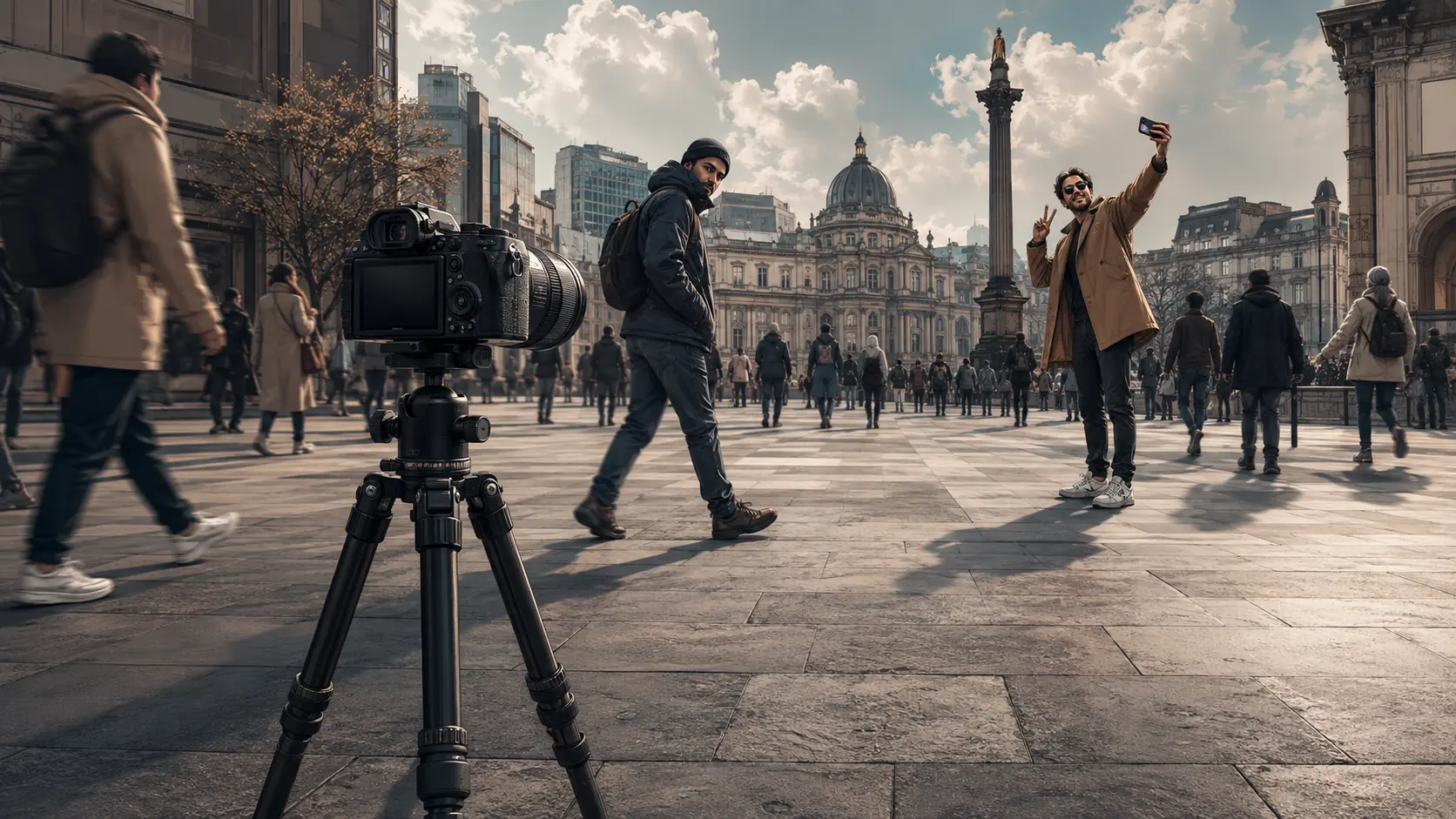
The finding is particularly relevant to photographers and creators because modern shooting increasingly requires one person to be both behind and in front of the camera. A camera body, lens and tripod can easily represent thousands of euros in equipment, while theft is not the only danger: accidental damage and outright loss also appear in the survey data.
22% leave their device unattended
The research was conducted for Aviva by Censuswide among a sample of 2,000 nationally representative UK consumers aged 18 and over between March 10 and March 13, 2026. The percentages therefore describe a UK sample and should not automatically be treated as representative of Greece or Europe as a whole.
Among the reasons given for leaving a phone or camera unattended, 49% cited capturing personal memories, 38% creating content for social media, 34% travel vlogs or photography, and 19% fitness videos.
In practice, these are familiar scenarios for modern creators: a camera on a tripod recording a travel reel, a smartphone positioned somewhere stable for a short video, or a solo shoot in which the creator has to move several metres away to enter the frame.
Gen X ranks first for social media
One of the most interesting findings concerns age groups. Using the survey’s own categories, Gen X, aged 45 to 60, had the highest figure for respondents saying they would leave a phone or camera unattended to create social media content, at 41%. The same group recorded 25% for professional content related to work.
Millennials aged 29 to 44 followed at 40% for social media content. For Gen Z, aged 18 to 28, the research reports a different finding: 38% said they had been distracted from their phone or camera while in public.
The research does not explain the reasons behind these generational differences, so it cannot establish that age itself causes riskier behaviour.
Theft is not the only risk
Aviva reports that 25% have experienced damage to a phone or camera, while a further 5% have lost their device completely. Meanwhile, 34% said they had either dropped or had their phone or camera stolen even while holding it.
Aviva claims data covering January 2022 to June 2026 includes incidents such as a camera falling from an open window and an entire tripod being knocked over, damaging the attached camera or lens.
For photographers, the latter example is particularly relevant. A tripod does not protect equipment on its own: in a busy location, a passer-by, child, animal or even a sudden gust of wind can turn a stable setup into an expensive repair.
What photographers and creators can change in practice
Aviva’s main recommendation is not to leave high-value items unattended in public. For shoots where the creator needs to be in front of the lens, it suggests bringing another person who can remain close to the equipment. It also stresses situational awareness and avoiding becoming absorbed in the screen for long periods.
The Metropolitan Police Film Unit provides more specific guidance for professional productions. Its guide to film-set theft says equipment should remain visible to crew and should not be left unattended. High-value gear should be recorded in an inventory with serial numbers, property-marked where appropriate and stored in a secure location when not in use.
For an individual photographer or small creator, this translates into a straightforward workflow: record models and serial numbers before travelling or going on location, keep purchase records and photos of the equipment somewhere separate, and avoid the habit of leaving a bag or second camera unattended “just for a minute.”
Insurance terms need careful attention
Aviva warns that leaving belongings unattended can affect an insurance claim and notes that many policies require customers to take reasonable care of their possessions. In the UK market, it also recommends checking single-item limits; for example, its own Signature policy states a £2,500 limit for an unspecified individual item.
That example applies to an Aviva product in the UK and cannot simply be transferred to the Greek market. Photographers using expensive gear professionally need to know whether their own policy covers use away from home, theft in public, equipment kept in a vehicle, accidental damage and professional use, as terms and exclusions vary between insurers and policies.
Recent cases show how quickly equipment can disappear
The issue is not theoretical. pttl recently covered the theft of $20,000 worth of camera equipment from a parked vehicle in Windsor, Canada, where a suspect was captured on security footage.
Only days later, a television crew in Brighton lost a bag containing a Sony camera, lenses and other equipment while preparing for a shoot on the seafront. Both incidents illustrate how little time may be needed for valuable equipment to disappear.
For lost or stolen equipment, PTTL Lost & Found Gear provides a registry where users can report missing or stolen photographic gear, as well as found equipment whose owner is being sought.
What we think
Aviva’s research does not demonstrate that creators suffer more theft today than in the past, and the UK percentages cannot simply be applied to Greece. It does, however, highlight a real change in how cameras are being used: an increasing number of shooting situations involve one person who must also become the subject of the image.
In that type of workflow, equipment security needs to become part of shoot preparation alongside batteries, memory cards and exposure settings. The simplest precaution remains the most effective: valuable camera gear in a public place should not be left without someone watching it.
Frequently Asked Questions
What exactly does the 22% figure mean?
It means that 22% of the UK sample in Aviva’s research said they leave a phone or camera unattended in a public place in order to photograph or film themselves.
Why does Gen X rank first?
The research reports that 41% of Gen X within the study’s category said they would leave equipment unattended for social media content. It does not investigate the causes of that difference, so it cannot be attributed to a specific characteristic or behaviour of the generation.
Does insurance cover a camera left unattended?
There is no universal answer. Aviva notes that leaving valuables unattended may affect a claim and that reasonable-care conditions can apply. Actual coverage depends on the individual insurance policy.
What equipment information should photographers record?
For high-value gear, the Metropolitan Police Film Unit recommends an inventory containing descriptions and serial numbers. In the event of theft, model, value and serial-number information can help with accurate reporting and identification.
Is the research representative of Greece?
No. The sample consists of 2,000 adult consumers in the United Kingdom. The findings are useful as an indication of behaviour but are not Greek statistics.