

Summary
- Canon released firmware 1.0.7.1 for the EOS C400 free of charge on August 19, 2026.
- The new Cinema Exposure mode allows the dynamic range balance between highlights and shadows to change according to ISO sensitivity.
- The EOS C400 gains Auto Exposure Ramping Compensation for selected Cine-Servo lenses and support for the new CN30×40 models.
- External audio output through SDI, HDMI and headphones is also added during Slow & Fast Motion shooting.
- Downgrading is not supported after installation and the camera's settings are reset during the update.
- The new Cinema Exposure mode and what changes
- Auto Exposure Ramping Compensation for Cine-Servo zooms
- Support for the new CN30×40 Cine-Servo
- Audio output during Slow & Fast Motion
- Changes to remote workflows
- What owners should know before installing
- The EOS C400 continues to evolve through firmware
- What we think
- Frequently asked questions
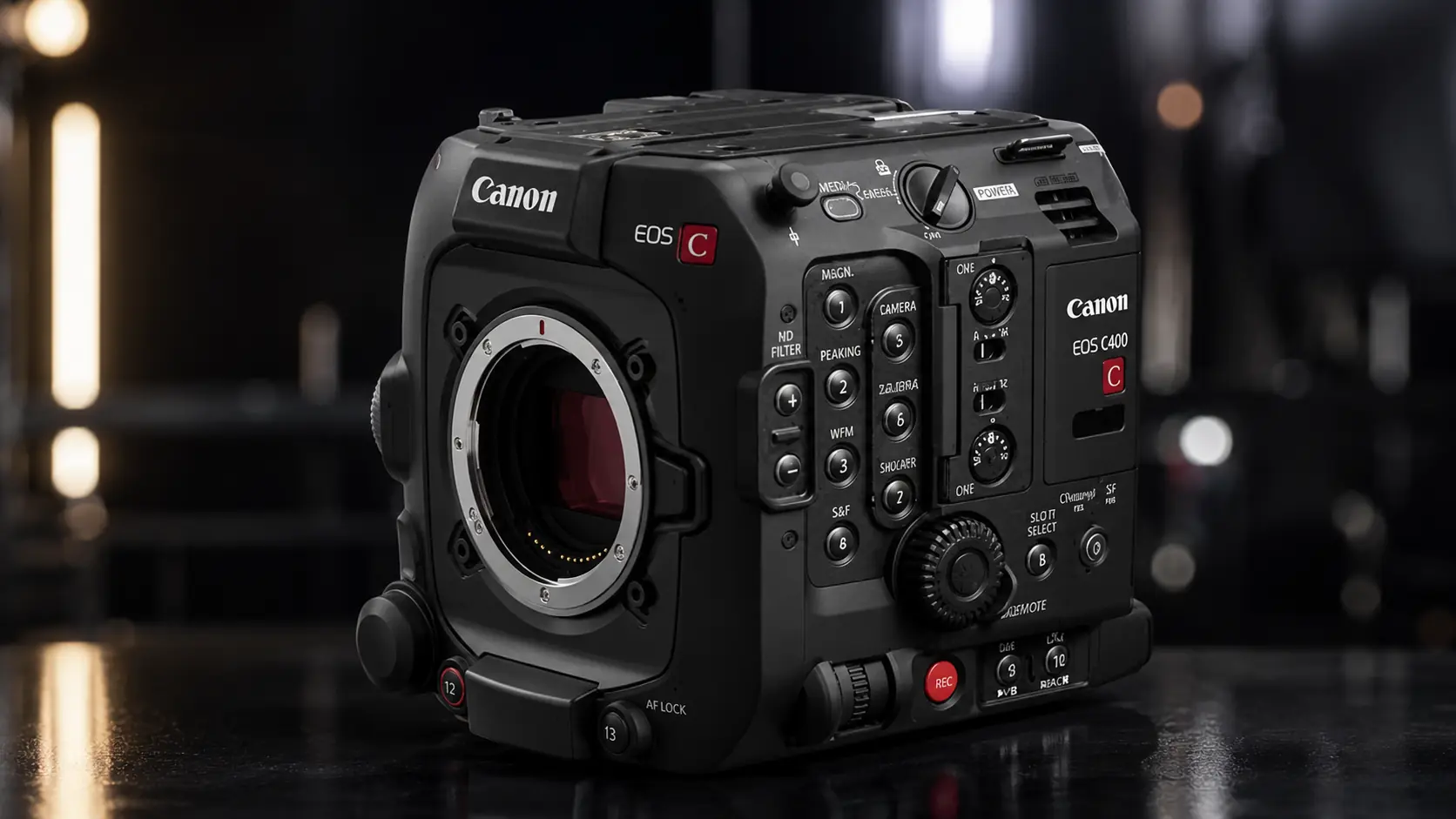
Canon has released firmware 1.0.7.1 for the EOS C400, adding the new Cinema Exposure mode, Auto Exposure Ramping Compensation for selected Cine-Servo lenses and significant improvements to professional workflows.
The new firmware became available free of charge on August 19, 2026 and is the latest major functional upgrade for the EOS C400, introducing changes that affect both image handling and the use of the camera in cinema, broadcast and live productions.
The most important addition is Cinema Exposure, as Canon now provides operators with a different way to manage dynamic range depending on ISO sensitivity. At the same time, the EOS C400 gains features aimed directly at professional productions using Cine-Servo zooms and Slow & Fast Motion.
The new Cinema Exposure mode and what changes
Firmware 1.0.7.1 introduces a new Capture Mode on the EOS C400. Users can now select Cinema Exposure as an alternative to the existing Custom Picture mode.
According to Canon, Cinema Exposure allows adjustment of the dynamic range balance, meaning the way the available range is allocated between highlight and shadow areas, based on the selected ISO sensitivity.
This is particularly interesting on the EOS C400, which uses a 6K full-frame BSI sensor and a Triple Base ISO system at ISO 800, 3,200 and 12,800. Cinema Exposure essentially provides a more direct way to take advantage of the sensor’s behaviour when a cinematographer selects different sensitivities in order to protect particular parts of the tonal range.
Canon information published by British Cinematographer states that the feature can improve highlight performance by up to 2 stops when shooting above base ISO levels, while also providing a more streamlined menu for Log shooting.
The important distinction is that Canon describes a different allocation of the available dynamic range rather than an increase in the sensor’s total dynamic range.
Auto Exposure Ramping Compensation for Cine-Servo zooms
The EOS C400 specifically gains an Auto Exp. Ramping Comp. function designed for productions using professional Cine-Servo zoom lenses.
As focal length changes, some zoom lenses can exhibit a change in maximum light transmission. The new function automatically applies gain compensation according to zoom position, helping maintain more consistent image brightness throughout the zoom.
Canon lists compatibility with:
- CN7×17 KAS S/E1
- CN10×25 IAS S/E1
- CN20×50 IAS H/E1
- CN8×15 IAS S/E1
- CN7×17 KAS T/R1
- CN5×11 IAS T/R1
- CN30×40 IAS J/R1
This can be particularly useful in sports broadcasts, concerts, television productions and other live environments where zoom movements frequently take place within a single shot and unwanted exposure changes are immediately visible.
Support for the new CN30×40 Cine-Servo
The firmware also adds compatibility with the CN30×40 IAS J/R1 RF-mount and CN30×40 IAS J/P1 PL-mount versions.
This Cine-Servo is Canon’s new 30x zoom, and its deeper integration with the EOS C400 clearly reflects the company’s positioning of the camera not only as a cinema production tool but also as a body designed for high-end broadcast and live workflows.
Audio output during Slow & Fast Motion
A smaller but practical addition is the new S&F External Audio Output option.
When enabled, the EOS C400 can provide audio output through SDI, HDMI or headphones while shooting in Slow & Fast Motion. Canon specifically describes external audio output and does not state that the way audio is recorded in S&F clips has changed.
For crews that require monitoring or reference audio while working with variable frame rates, the feature can simplify on-set workflows.
Changes to remote workflows
Canon has also updated its Remote Camera Control Application to support firmware 1.0.7.1 on the EOS C400 and EOS C80.
There is an important limitation, however: when the camera is operating in Cinema Exposure mode, Custom Picture settings are not available through the Remote Camera Control Application.
This is worth noting for studio installations and multi-camera productions that rely on remote control of the C400.
What owners should know before installing
Firmware 1.0.7.1 can be installed on EOS C400 cameras running any version from 1.0.0.1 through 1.0.6.1. The update requires an SD, SDHC or SDXC memory card with a capacity of at least 512 MB.
Canon also warns that downgrading to a previous firmware version is not possible after installation. In addition, the update resets menu settings, Custom Picture settings and Cinema Exposure settings. Camera settings can be saved to a separate SD card before the update and reloaded after installation is complete.
Version 1.0.7.1 is available free of charge through the Canon support website.
The EOS C400 continues to evolve through firmware
The EOS C400 was introduced in 2024 with a 6K full-frame BSI sensor and Triple Base ISO, features covered in detail in PTTL’s original Canon EOS C400 announcement coverage.
Since then, Canon has added several meaningful functions through firmware. PTTL also covered the addition of full-frame 3:2 Open Gate to the EOS C400, which was later incorporated into firmware 1.0.4.1.
More recently, firmware 1.0.6.1, released on June 25, 2026, added USB control of key camera functions, automatic reconnection for SRT streaming and other connectivity improvements.
Version 1.0.7.1 therefore arrives less than two months later, shifting the focus from connectivity toward exposure, image handling and integration with professional Cine-Servo lenses.
What we think
Cinema Exposure is the most important addition in firmware 1.0.7.1, not because it nominally increases the EOS C400’s dynamic range, but because it gives cinematographers greater control over where that available range is used within the scene.
At the same time, Auto Exposure Ramping Compensation reinforces the C400’s position at the intersection of cinema and broadcast production. For users working with compatible Cine-Servo lenses, this capability may have more practical value than many more eye-catching specification upgrades.
Frequently asked questions
What is the latest Canon EOS C400 firmware version?
The latest version is 1.0.7.1, released on August 19, 2026.
What is Cinema Exposure?
It is a new Capture Mode that allows the dynamic range allocation between highlights and shadows to change according to ISO sensitivity.
Does the firmware add Auto Exposure Ramping Compensation?
Yes. On the EOS C400, the feature uses gain compensation to counter brightness changes that may occur while zooming with selected compatible Cine-Servo lenses.
Are camera settings lost during installation?
Canon states that menu, Custom Picture and Cinema Exposure settings are reset. They can be saved to a separate SD card before updating and restored afterwards.
Can the EOS C400 be downgraded to an older firmware version?
No. Canon states that returning to a previous firmware version is not supported after installing 1.0.7.1.