

Summary
- Doug Mills photographed Donald Trump exiting a presidential aircraft in the UK without knowing that the president had flown from Turkey aboard a different plane
- Trump was secretly transferred in a catering vehicle to a smaller C-32A following information about a serious security threat
- The older presidential aircraft flew to Britain carrying government officials, staff and journalists who did not know Trump had departed aboard another aircraft
- Mills' photograph was authentic and not digitally manipulated, but the true context of the scene remained unknown
- A later Reuters report said U.S.
- intelligence agencies had not independently verified information about a specific Iranian attack plot
- The secret route from Ankara to Britain
- How Doug Mills’ photograph was created
- What we know about the threat — and what we do not
- The detail Mills noticed but could not explain
- It was not a fake image: context was the issue
- Doug Mills has been at the center of history before
- Why this directly matters to modern photojournalism
- What we think
- Frequently asked questions
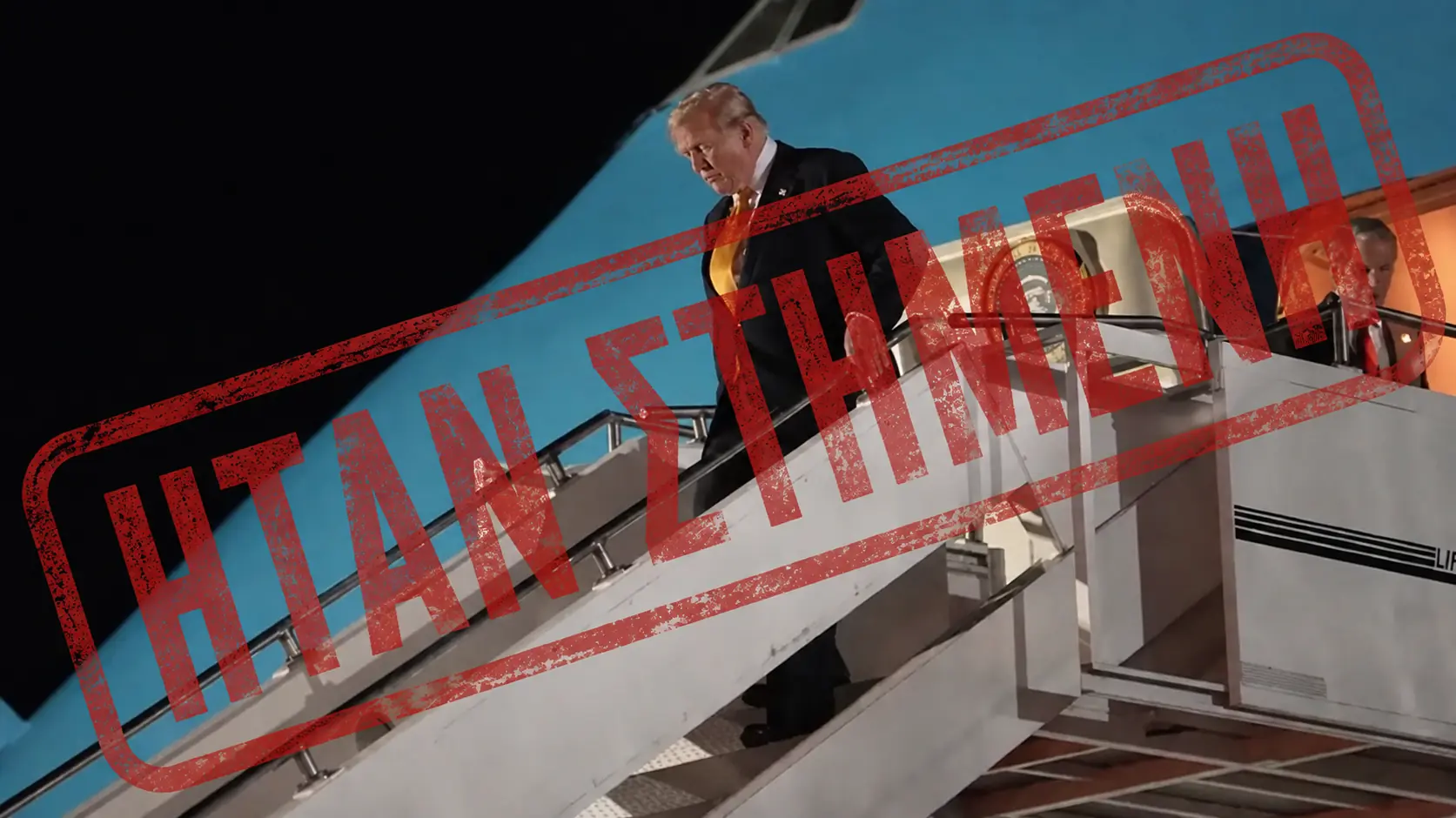
New York Times photographer Doug Mills photographed Donald Trump exiting a presidential aircraft in Britain and learned roughly a month later that the president had arrived there from Turkey aboard a different plane.
On July 8, 2026, following the NATO summit in Ankara, Trump publicly boarded one of the older presidential Boeing VC-25A aircraft but was then secretly transferred in a catering vehicle to a smaller U.S. Air Force C-32A. The older aircraft departed carrying government officials, White House staff and journalists while Trump flew separately to Britain.
The case is particularly significant for photojournalism because Mills’ image was neither fake nor digitally manipulated. The camera documented a real event, but the critical context preceding the photograph was unknown to the photographer and could create a completely different impression of what had actually happened.
The secret route from Ankara to Britain
The story actually involves three different aircraft.
Trump had arrived in Turkey aboard the new modified Boeing 747-8 that had been provided by Qatar and is being used as an interim presidential aircraft. Before leaving, he announced that he would use an older VC-25A “for old time’s sake,” while the new aircraft would travel to RAF Mildenhall in Britain.
In front of cameras, he did indeed board the older aircraft. According to Reuters and AP, however, a covert transfer then took place using a catering vehicle, moving Trump to a smaller C-32A. That was the aircraft used for the actual Ankara-to-Britain flight.
The older presidential aircraft also departed Ankara. It carried senior administration officials, staff and the normal 13-member press pool. Reuters reported that Secretary of State Marco Rubio had been briefed on the maneuver, while the journalists did not know Trump had been moved elsewhere.
How Doug Mills’ photograph was created
The crucial moment came when the aircraft reached RAF Mildenhall in Britain.
According to AP, Trump secretly returned to the older presidential aircraft after arriving in Britain. He then appeared to descend normally from its stairs before boarding the newer Boeing 747-8 for the remainder of the journey to the United States.
Doug Mills, Senior Washington Photographer for The New York Times, was there and photographed the exit. He believed Trump had flown with the press corps aboard that aircraft from Turkey.
When details of the operation emerged roughly a month later, Mills realized that he had documented a real but arranged photographic moment. He described it as probably the only staged moment of this kind he had photographed during his career: a president stepping off a plane aboard which he had not actually completed the previous flight.
What we know about the threat — and what we do not
An important distinction is required between the fact that security services acted on a threat and whether that threat had been independently confirmed.
Reuters reported on August 12 that a source briefed on the operation said the Secret Service considered a possible shoulder-fired missile threat against the presidential aircraft credible and imminent. Officials had very little time to change the departure plan.
A day later, however, a newer Reuters report added critical context: U.S. intelligence agencies had been unable to independently verify warnings received from Israel about alleged Iranian plans to assassinate Trump, including the warning ahead of the Ankara summit. According to the same report, Turkish intelligence had also found no evidence supporting the specific claim.
The confirmed fact, therefore, is that U.S. security services treated the information seriously enough to secretly alter the president’s travel arrangements. It has not been independently confirmed that a specific and operationally ready Iranian missile attack plan existed.
Trump later confirmed that the Secret Service and military had asked him to travel aboard a different aircraft because of a threat, saying that he followed their instructions.
The detail Mills noticed but could not explain
Mills and the other passengers aboard the older Air Force One had one indication that something unusual was happening: they were instructed to lower the window shades.
For a photographer with extensive experience in presidential travel, that alone was not enough to suggest that the president had left the aircraft.
Mills had encountered a similar procedure in 2014 during Barack Obama’s secret flight to Afghanistan, when the shades were closed so the aircraft could remain dark for security reasons.
This time, however, the closed windows helped conceal Trump’s transfer to the C-32A.
It was not a fake image: context was the issue
The word “staged” can easily create the wrong impression.
There is no evidence that Doug Mills’ photograph was digitally altered or generated using artificial intelligence. Trump genuinely was aboard the aircraft at the time of the photograph and genuinely walked down its stairs in front of photographers.
What had been arranged was the real-world situation surrounding the image. A viewer could reasonably assume that the photograph showed Trump arriving from Turkey aboard that particular aircraft, when in fact he had completed that leg of the journey on another plane.
The case also demonstrates the limits of image-authentication technology. PTTL has previously covered Sony Camera Verify for authenticating journalistic images as well as Adobe Content Credentials for recording an image’s provenance and history. Such systems can help demonstrate that a file came from a real camera and has not undergone certain types of manipulation, but they cannot by themselves reveal what happened outside the frame before the shutter was pressed.
In other words, the technical authenticity of an image and the journalistic completeness of its context are two different issues.
Doug Mills has been at the center of history before
Mills has covered U.S. presidents since the Ronald Reagan era and has made thousands of trips aboard presidential aircraft, traveling more than one million miles, according to PetaPixel.
His name is already familiar to PTTL readers. In 2024, PTTL covered Doug Mills’ photograph from the assassination attempt against Trump in Butler, in which the apparent path of a projectile can be seen close to the then-presidential candidate’s head.
The comparison is particularly interesting for the nature of photojournalism. In Butler, Mills recorded in a fraction of a second something the human eye could barely perceive. In Britain, by contrast, his camera accurately recorded what was directly in front of it, but neither the camera nor the photographer could know what had happened outside the frame beforehand.
Why this directly matters to modern photojournalism
Discussion about image credibility in recent years has focused heavily on Photoshop, deepfakes and generative artificial intelligence. The Mills case is a reminder that visual deception does not necessarily require manipulated pixels.
An authentic photograph can be entirely accurate as a record of a fraction of a second while still being insufficient to understand the complete event.
That is why captions, source identity, chronology, journalistic investigation and the ability to subsequently correct or expand context remain just as important as the technical verification of a file.
PTTL has also previously discussed fake news and methods for verifying photographs, emphasizing the importance of checking an image’s origin and history before drawing conclusions. The Mills case adds another layer: the file’s origin was legitimate, but the story surrounding the moment remained hidden.
What we think
Doug Mills’ case is an excellent example of why “authentic photograph” does not automatically mean “complete picture of reality.”
There is no indication that Mills did anything wrong or that his photograph was manipulated. He accurately recorded what happened in front of his lens without having access to the secret security operation that had preceded it.
At a time when significant attention is rightly being given to detecting AI imagery and digital manipulation, this story is a reminder of something older but fundamental to journalism: context can be just as important as the pixels themselves.
Frequently asked questions
Was Doug Mills’ photograph fake or manipulated?
No. There is no evidence of digital manipulation. Trump genuinely exited the presidential aircraft in Britain. The “staged” element concerns the fact that he had arrived aboard a different aircraft and returned to the older presidential plane before appearing in front of photographers.
Why did Trump switch planes?
The Secret Service and military changed his travel arrangements because of information concerning a serious security threat. A Reuters source said the Secret Service treated the threat as credible and imminent.
Has it been confirmed that Iran planned a missile attack?
Not independently. A later Reuters report said U.S. intelligence agencies had been unable to independently verify the relevant Israeli warnings, while Turkish intelligence also had no evidence confirming them.
Did Doug Mills know Trump was on another aircraft?
No. Mills said he and the traveling press corps did not know what was really happening when they departed Turkey.
Which aircraft did Trump ultimately use?
Trump arrived in Turkey aboard the new modified Boeing 747-8, was secretly transferred to a C-32A for the flight to Britain, returned to the older presidential aircraft for the exit at RAF Mildenhall and then boarded the new 747-8 again for the journey to the United States.