

Summary
- Frenchman Julien Anton is Ocean Photographer of the Year 2026 with a black-and-white seahorse frame
- Seven categories with first, second and third place, plus the Ocean Portfolio Award and Female Fifty Fathoms Award
- The Ocean Unseen: Hidden Worlds is new this year, for the least-seen inhabitants of the ocean
- The Female Fifty Fathoms Award went to Britain's Jenny Stock, for a ten-image portfolio
- More than 15,000 entries a year and 118 photographs recognised in total
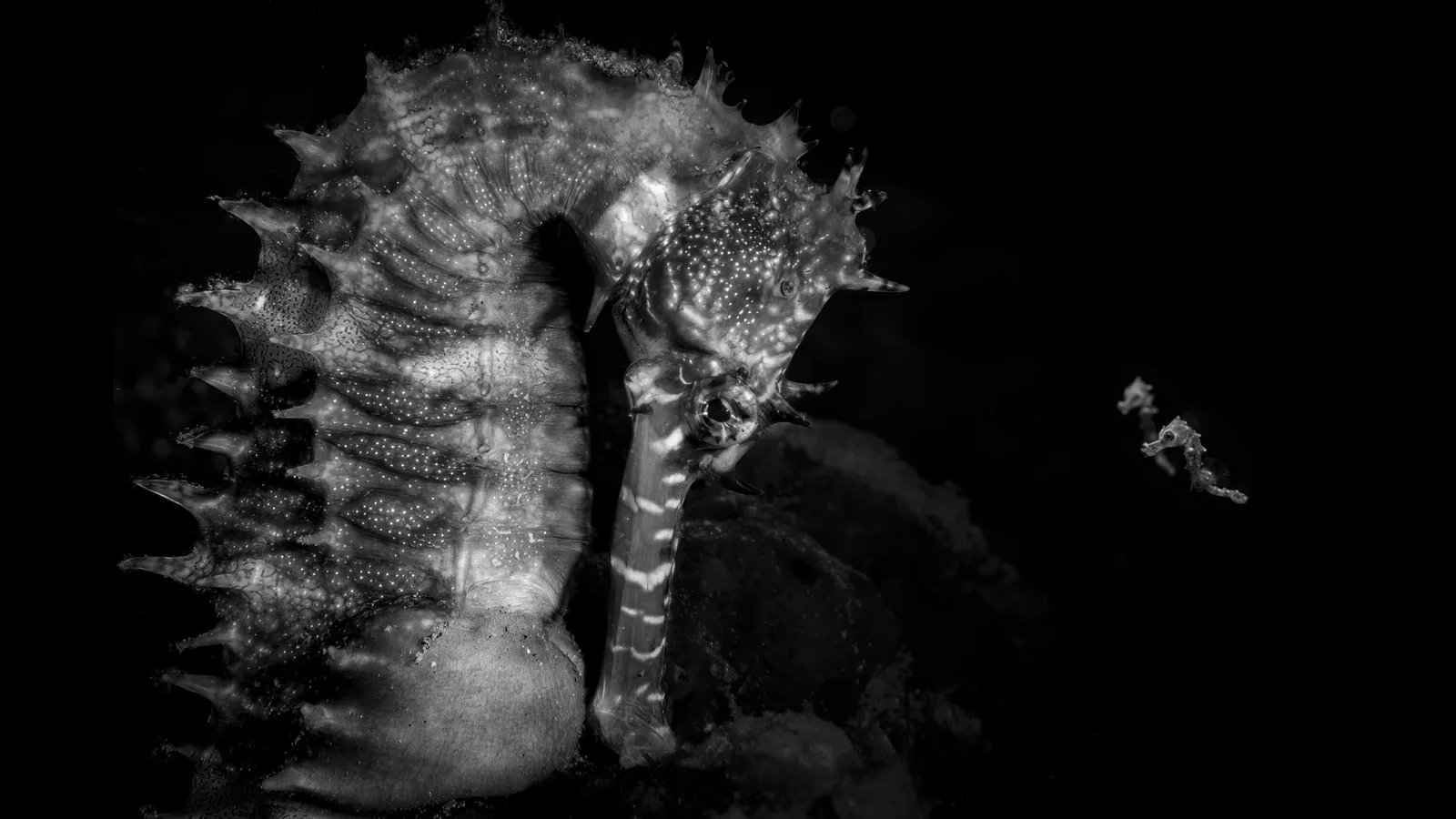
French photographer Julien Anton is Ocean Photographer of the Year 2026, for a black-and-white frame of an adult seahorse and two newborn juveniles in the shallows off Mo’orea.
Britain’s Oceanographic Magazine and Swiss watchmaker Blancpain announced this year’s winners on 9 September. Anton’s photograph first won the Ocean Wildlife category before being elevated to the overall title. Announced alongside it were the winners of six further categories, the Ocean Portfolio Award and the Female Fifty Fathoms Award, which went to British photographer Jenny Stock.
The competition draws more than 15,000 entries a year and recognises 118 photographs in total across winners and finalists, according to the organisers. That makes it one of the largest annual showcases of ocean photography anywhere. This year carries extra weight, because a category devoted entirely to what almost nobody sees below the surface appeared for the first time.
The overall winner: two newborns and a question
Anton shot the scene on a rebreather dive in the shallow, seaweed-filled waters of Mo’orea in French Polynesia. In seahorses it is the male that carries and gives birth to the young. In the frame the two newborns appear to pause and turn back towards the adult, a coincidence that reads like a farewell. Seahorses have become rare in French Polynesia and the picture came after long hours of searching through the weed.
“We spent countless hours searching in difficult conditions, with no guarantee of finding a single seahorse. That is what made the moment so extraordinary: when the juveniles turned back towards the adult, it felt like something far beyond what I had dared to hope for,” Anton said. “I am not a professional photographer. For me, photography is simply how I share what I see and feel.”
Competition founder and director Will Harrison described the judging: “When Julien Anton’s image first appeared on screen, the judging panel fell silent.” The photograph, he said, asks “what kind of ocean are we leaving for those who come after us”.
The winners of the seven categories
Each category awards first, second and third place. In the lists below, the location in brackets is where the picture was taken, not the photographer’s home country.
Ocean Wildlife
- 1st place — Julien Anton (Mo’orea, French Polynesia)
- 2nd place — Rafael Fernández Caballero (Mexico)
- 3rd place — Ariel Mei Gliboff (Seattle, USA)

Ocean Fine Art
- 1st place — Matty Smith (Maldives)
- 2nd place — James Ferrara (Florida, USA)
- 3rd place — Ben Thouard (Tahiti, French Polynesia)

Adventure
- 1st place — Gergo Rugli (Tamarama Beach, Sydney, Australia)
- 2nd place — Ben Thouard (Teahupo’o, French Polynesia)
- 3rd place — Romona Robbins Reynolds (Mexico)


Conservation (Impact)
- 1st place — James Ferrara (Raa Atoll, Maldives)
- 2nd place — Karsten Michels (Tórshavn, Faroe Islands)
- 3rd place — Lu Minqiang (Malé, Maldives)


Conservation (Hope)
- 1st place — Thomas Pavy (Rangiroa, French Polynesia)
- 2nd place — Francesca Page (Padstow, United Kingdom)
- 3rd place — Yuta Shigeno (Kagoshima, Japan)

Human Connection: People & Planet Ocean
- 1st place — Rui Duarte (Boa Vista, Cape Verde)
- 2nd place — Sirachai Arunrugstichai (Lamalera, Indonesia)
- 3rd place — Gergo Rugli (Bronte Ocean Pool, Sydney, Australia)

The Ocean Unseen: Hidden Worlds
- 1st place — Mitsuna Kawai (Osezaki, Japan)
- 2nd place — Andrea Michelutti (Anilao, Philippines)
- 3rd place — Suliman Alatiqi (North Sulawesi, Indonesia)

Female Fifty Fathoms Award: Jenny Stock
The Female Fifty Fathoms Award does not work like the other categories. It was created in 2021 by Oceanographic and Blancpain to honour women who have pushed boundaries in ocean photography, and the winner does not submit an entry: she is nominated by her peers. Judging is handled by the competition jury, including French photographer Laurent Ballesta, Oceanographic’s editorial staff and a Blancpain delegation led by president and CEO Marc A. Hayek.
This year the award went to British photographer Jenny Stock, a wildlife documentary filmmaker and underwater photographer who in 2023 became the first and only woman to win British Underwater Photographer of the Year. The award does not cover a single photograph: the official presentation is a portfolio of ten images, from humpback whales and turtles to a crocodile in the mangroves of Cuba and a fish sheltering inside a discarded glass bottle in Canada.
“To be nominated by fellow photographers means more to me than I can easily put into words — this community is everything,” Stock said. “I hope this recognition inspires more women to pick up a camera and discover the magic that’s beneath the surface.”

Ocean Portfolio Award: Miguel Serrano Ruiz
The Ocean Portfolio Award judges a body of work rather than a single frame. Miguel Serrano Ruiz won it with ten photographs from Baja California Sur, Mexico, following the people who protect olive ridley sea turtle nests: night patrols under red light, moving eggs threatened by the tide, recording and releasing hatchlings.

What changed this year
The biggest change is The Ocean Unseen: Hidden Worlds, introduced for the first time this year and aimed at the ocean’s smallest and least-seen inhabitants. At the same time, the Young Photographer of the Year category, which awarded prizes in 2025, does not appear in this year’s winners list.
The 2026 timetable was tight: submissions opened on 1 April and closed on 30 June, judging began on 1 July, the panel met in person on 8 July, finalists were announced on 13 August and the winners on 9 September. Judging is carried out by a panel of photographers, editors and museum and gallery curators.
Where to see the photographs
The full winner and finalist galleries, with official captions, shooting coordinates and technical details for every image, are on oceanographicmagazine.com. The winning photographs also travel as an exhibition: during 2026 the 116 winning images of the previous edition were shown at The Historic Dockyard Chatham near London from 28 March, aboard the SS Great Britain in Bristol from 2 April and in Alameda in the San Francisco Bay Area from 22 April. Dates for the exhibition of this year’s winners have not yet been announced.
What we think
Anton’s win says something about where the competition is heading. It was not the most spectacular or the rarest frame that took the title, but a quiet, technically simple picture of two centimetres of life against a black background, made by someone who says himself that he is not a professional. At the same time, the Conservation categories show the award is not afraid to place images that are hard to look at right next to the elegant ones.
For anyone who photographs, the most useful part is not the list of winners but the official page behind each image: camera, lens, lighting, settings, how the site was reached and the coordinates. Very few competitions, even ones the size of Wildlife Photographer of the Year, publish that much, and that is where the real value of this year’s gallery sits.
Frequently asked questions
Who is the Ocean Photographer of the Year 2026?
French photographer Julien Anton, for a black-and-white photograph of an adult seahorse with two newborn juveniles in the shallow waters of Mo’orea, French Polynesia. The same picture also won 1st place in the Ocean Wildlife category before being elevated to the overall title.
What categories does the competition have in 2026?
Seven categories, each with a first, second and third place: Ocean Wildlife, Ocean Fine Art, Adventure, Conservation (Impact), Conservation (Hope), Human Connection: People & Planet Ocean and The Ocean Unseen: Hidden Worlds. The Ocean Portfolio Award and the Female Fifty Fathoms Award are awarded on top of those. The overall title is chosen from the entries as a whole.
What is the Female Fifty Fathoms Award?
A special award created in 2021 by Oceanographic and Blancpain for women who have pushed boundaries in ocean photography. The winner does not submit an entry but is nominated by her peers and judged by the competition jury. This year it went to British photographer Jenny Stock, with a portfolio of ten photographs.
How many entries does the competition get and how many photographs are recognised?
According to the organisers, the competition draws more than 15,000 entries a year and recognises 118 photographs in total across winners and finalists. The exhibition of the previous edition showed 116 winning images.
Where can I see all the award-winning photographs?
In Oceanographic Magazine’s official winner and finalist galleries. Every image has its own page with the full caption, the shooting location with coordinates, the equipment and settings used, and a short biography of the photographer.