

Summary
- Associated Press photojournalist Sal Veder has died at 99
- Burst of Joy was made on March 17, 1973, at Travis Air Force Base
- The image shows Robert L.
- Stirm’s children running to him after his captivity
- Veder won the 1974 Pulitzer Prize for Feature Photography
Sal Veder, the Associated Press photojournalist who created the Pulitzer Prize-winning “Burst of Joy,” has died at the age of 99.
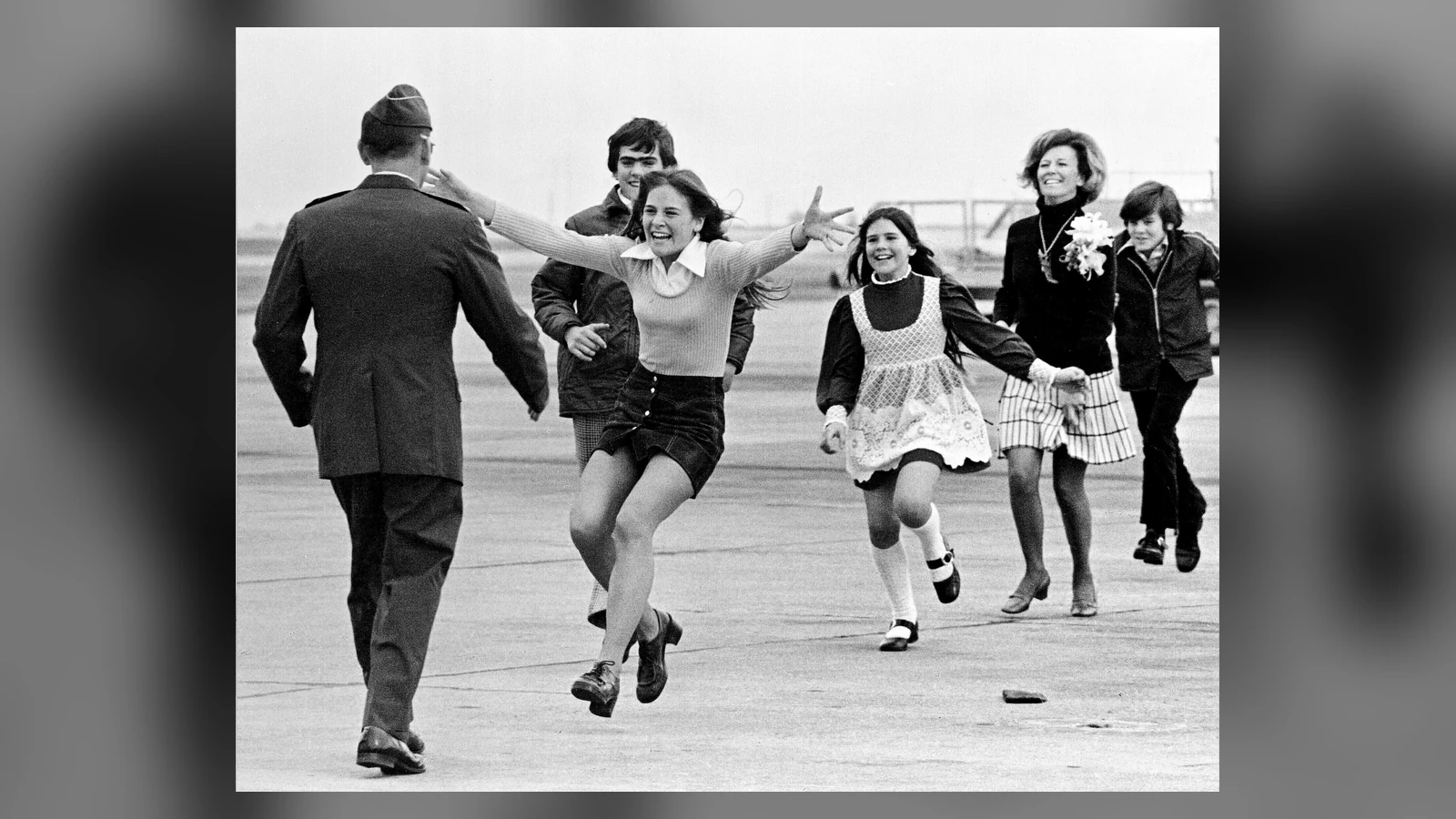
Veder died in his sleep on August 22 in California’s El Dorado County, eight days before his 100th birthday. The image that placed him in photography history was made on March 17, 1973, at Travis Air Force Base, recording Lieutenant Colonel Robert L. Stirm returning to his children after more than five years as a prisoner in Vietnam.
“Burst of Joy” became one of the most powerful symbols of returning American POWs and the end of a painful phase of the war. The real history behind the frame was more complex than the spontaneous happiness it shows, and that contrast is part of its lasting power.
The moment at Travis Air Force Base
On March 17, 1973, Robert L. Stirm stepped from a plane carrying released American prisoners to California. He had spent more than five years as a prisoner of war in North Vietnam. His four children were waiting on the runway.
Fifteen-year-old Lorrie Stirm began running with her arms open, followed by her younger siblings. Veder was inside a crowded press pool with no ability to arrange the frame or ask for a second take. He reacted and made a short sequence of six frames.
In the selected picture, Stirm is seen from behind, almost a dark anchor on the left. Lorrie moves toward him in the centre with open arms, and the other children create a diagonal line of motion. The father’s face is hidden, allowing viewers to read the scene first as a universal reunion.
Six frames and an improvised darkroom
The work did not end at the shutter. Veder needed to process and transmit his film rapidly for the Associated Press. He used an improvised darkroom in a women’s restroom on the base, a practical solution that captures the working reality of analogue wire-service photojournalism.
He selected the strongest frame and AP distributed it worldwide. It won the 1974 Pulitzer Prize for Feature Photography, recognising not only an important event but the ability to turn seconds of movement into a complete visual narrative.
Why the photograph became iconic
“Burst of Joy” communicates its central emotion without depending on the caption. Open arms, moving clothes, closing distance and the father’s back create a clear action from right to left. There is no handshake, podium or official pose; only the moment before an embrace.
The picture became associated with Operation Homecoming and the return of prisoners to the United States. For an audience exhausted by war, a family reunion offered an immediate human reference. It did not explain the political and military reality of Vietnam, but condensed the personal consequences of absence and return.
Its imperfections are part of its strength. The central figure faces away from the camera, bodies are not symmetrical and motion creates blur and disorder. These details make the scene feel real rather than arranged for a photograph.
The harder truth behind the joy
The reunion did not lead to a simple family continuation. While Stirm was still a prisoner, his wife Loretta had sent a letter asking to end their marriage. The couple divorced about a year after his return.
This does not cancel the children’s joy or make the photograph false. It shows the limit of every image: a frame can be completely true for the fraction of a second it records while still omitting the larger story before and after.
Robert L. Stirm died in 2025. For decades, his family watched the photograph circulate as a national symbol while it remained, for them, a personal moment with far more complex emotional weight.
From Berkeley to the Associated Press
Slava “Sal” Veder was born on August 30, 1926, in Berkeley, California. He joined the Associated Press bureau in Sacramento in 1961 and worked for the agency for more than three decades.
His assignments included Ronald Reagan, campus and antiwar protests, the Patty Hearst trial and the killings of George Moscone and Harvey Milk in San Francisco. That breadth shows that “Burst of Joy” was not a random isolated achievement but part of a long career in daily news photography.
Veder retired from AP in 1993. His family said he is survived by three children, eight grandchildren and 12 great-grandchildren. He died days before turning 100 after living through nearly the entire century in which photography moved from film, darkrooms and wire transmission to instant digital distribution.
What Burst of Joy teaches photojournalists
The first lesson is preparation. Veder was in position with equipment ready before the movement began. The second is sequence: six frames allowed him to choose the instant when bodies, gestures and distances formed the clearest narrative.
The third is caption and context. Without names, date, location and the history of captivity, the picture would retain emotion but lose journalistic meaning. Without the later family history, it would remain an oversimplified version of events.
Finally, the photograph shows that photojournalism does not always need the main subject’s face. Body language, relationships between figures and the direction of motion can communicate more than a close expression.
What we think
Sal Veder became known for a fraction of a second, but the frame’s value rests on the professional work around it: presence, reflexes, selection, processing, transmission and an accurate caption. “Burst of Joy” remains a great photograph because it holds both the genuine happiness of one instant and the knowledge that no image contains the entire lives of its subjects.
Frequently asked questions
When was Burst of Joy made?
March 17, 1973, at Travis Air Force Base in California.
Who is the man in the photograph?
Lieutenant Colonel Robert L. Stirm, returning after more than five years as a prisoner in North Vietnam.
Which Pulitzer did Sal Veder win?
The 1974 Pulitzer Prize for Feature Photography.
How many frames did he shoot?
AP’s account describes a short sequence of six frames, from which the iconic picture was selected.