

Summary
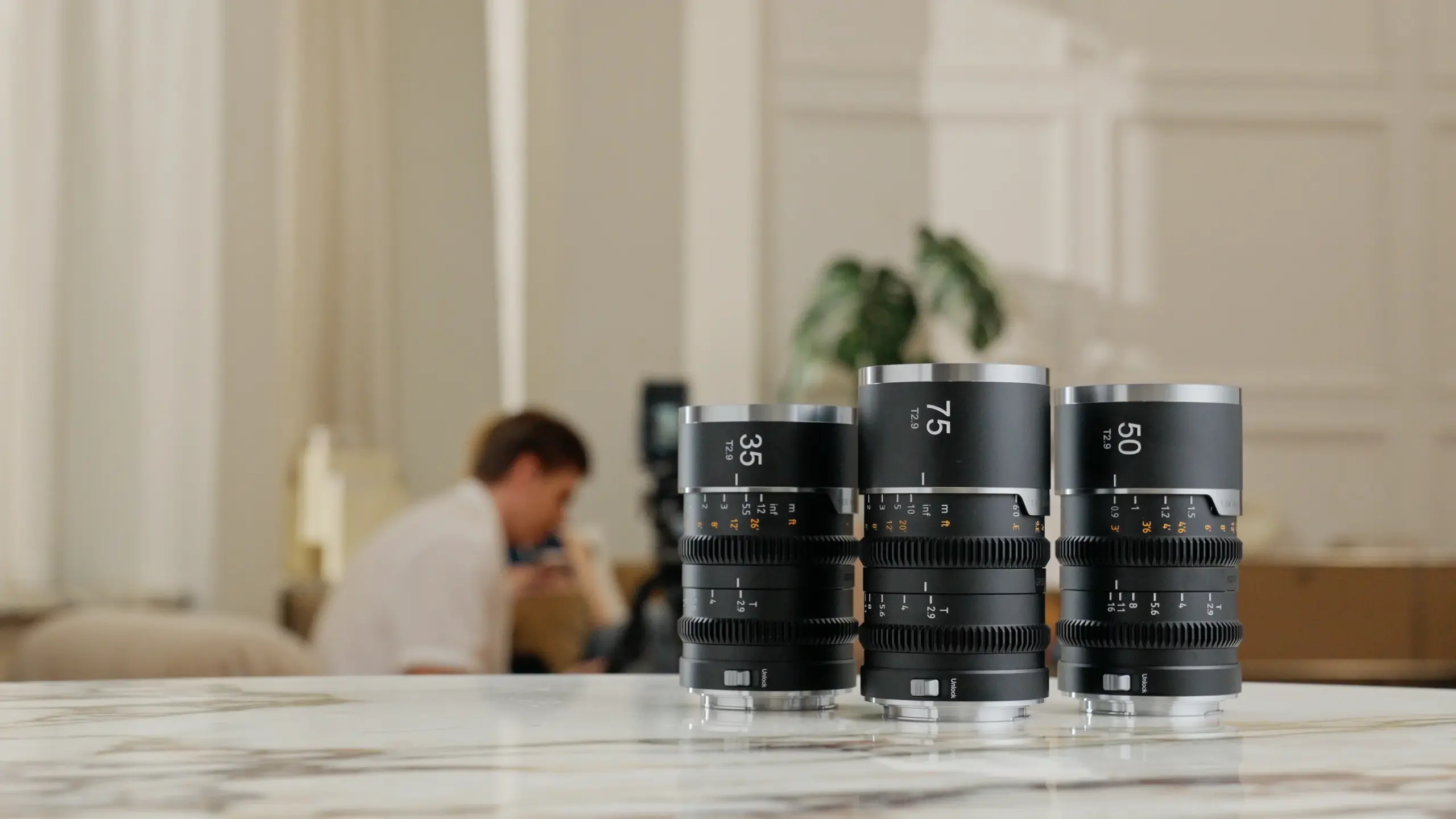
- SIRUI Saturn V2 lenses are available in 35mm, 50mm and 75mm with full-frame coverage
- All three feature a T2.9-T16 aperture range and a constant 1.6x anamorphic squeeze
- A built-in mechanism rotates the optical assembly by 90° for horizontal and vertical shooting
- A 16:9 recording becomes approximately 2.84:1 after de-squeeze, while vertical 9:16 becomes approximately 0.9:1
- The lenses are offered in Sony E, L-Mount, Canon RF and Nikon Z mounts
- Published versions weigh approximately 437 to 494 grams
- Official international pricing is $599 per lens and $1,699 for the three-lens kit
- SIRUI's European store lists a single lens at €649 including tax
The new SIRUI Saturn V2 lenses are 35mm, 50mm and 75mm T2.9 full-frame anamorphic cine primes with a constant 1.6x squeeze and a built-in 90-degree rotation mechanism that allows the same optical system to work correctly for both horizontal and vertical video.
SIRUI has introduced the second generation of its Saturn series with three manual-focus full-frame lenses at 35mm, 50mm and 75mm, all featuring a T2.9-T16 range, 1.6x squeeze and Sony E, L-Mount, Canon RF and Nikon Z mounts. The most important change, however, is not a new focal length: Saturn V2 incorporates a mechanism that unlocks and allows the internal anamorphic optical assembly to rotate by 90 degrees without removing the lens from the camera.
This capability is particularly relevant to filmmakers and creators who increasingly need to deliver both conventional 16:9 or cinematic widescreen material and vertical versions for Reels, TikTok and YouTube Shorts from the same production. Instead of simply rotating the entire camera with a conventional anamorphic lens — which also rotates the squeeze direction, oval bokeh and streak flare orientation — Saturn V2 reorients the anamorphic optics themselves.
How the horizontal/vertical rotation works

SIRUI has integrated an unlocking mechanism into the Saturn V2 barrel. The operator activates the switch, rotates the optical assembly by 90 degrees and then locks it in its new position. The lens does not need to be detached from its mount and no separate anamorphic adapter is required.
The important distinction is that this is not simply a rotation of the camera or mount. The internal anamorphic assembly changes its orientation relative to the sensor. This allows the lens to maintain the correct squeeze direction, oval bokeh and characteristic horizontal light streaks during vertical capture.
In practice, a production can record its main shot for horizontal distribution, switch the Saturn V2 to vertical mode and capture another version for social media without changing lenses. This is also useful on gimbals and rigs because no lens swap is required, simplifying the transition between the two shooting orientations.
What happens to the aspect ratios
The squeeze remains constant at 1.6x. After de-squeezing, SIRUI states that a horizontal 16:9 recording produces approximately 2.84:1, while a 3:2 capture results in a cinematic 2.4:1 ratio.
In vertical mode, a 9:16 recording becomes approximately 0.9:1 after de-squeeze, while vertical 2:3 produces approximately 1.07:1. This does not mean that the final output automatically remains 9:16 after de-squeeze. The key advantage is that the anamorphic character remains correctly oriented when the camera is being used for vertical-first production.
On cameras supporting open-gate recording, the larger available sensor area can also leave more room for different reframing options in post, which can be particularly useful when one production needs to generate deliverables for several platforms.
The three Saturn V2 models
All three anamorphic lenses cover full-frame sensors with a 45mm image circle and use manual focus. Minimum focusing distance is 0.9 metres across the range, while the focus ring has a 120-degree throw. All three also use the same M62×0.75 front filter thread.
| Specification | Saturn V2 35mm | Saturn V2 50mm | Saturn V2 75mm |
|---|---|---|---|
| Coverage | Full Frame | Full Frame | Full Frame |
| Focal length | 35mm | 50mm | 75mm |
| Horizontal FOV according to SIRUI | approx. 22mm | approx. 31mm | approx. 47mm |
| Squeeze | Constant 1.6x | Constant 1.6x | Constant 1.6x |
| Aperture | T2.9-T16 | T2.9-T16 | T2.9-T16 |
| Optical construction | 18 elements / 13 groups | 17 elements / 12 groups | 15 elements / 11 groups |
| Cylindrical elements | 5 | 5 | 5 |
| Aspherical elements | 1 | 1 | 1 |
| Iris blades | 10 | 10 | 14 |
| Minimum focus | 0.9m | 0.9m | 0.9m |
| Focus | Manual | Manual | Manual |
| Focus throw | 120° | 120° | 120° |
| Filter | 62mm | 62mm | 62mm |
| Sony E length | 102.9mm | 109.1mm | 114.2mm |
| L / RF length | 100.9mm | 107.1mm | 112.2mm |
| Sony E weight | 439g | 485g | 489g |
| L weight | 437g | 483g | 487g |
| Canon RF weight | 445g | 490.5g | 494g |
| Mounts | E, L, RF, Z | E, L, RF, Z | E, L, RF, Z |
Weights and dimensions for the Nikon Z versions had not been filled in on SIRUI’s official specification table at the time of checking, even though Z is listed as an available mount option.
35mm, 50mm or 75mm?
The 35mm provides the widest framing in the series, with SIRUI describing its horizontal field of view as roughly equivalent to 22mm because of the 1.6x squeeze. It is the most versatile option for establishing shots, confined spaces, handheld work and vertical content where both the subject and surroundings need to remain in frame.
The 50mm provides a horizontal field of view comparable to roughly 31mm and sits in the middle of the set, making it useful for documentary, street and general narrative coverage. The 75mm provides a horizontal perspective of around 47mm and is better suited to portraits, close-ups and character-driven shots.
These equivalences refer specifically to the expanded horizontal field of view produced by the anamorphic squeeze. They do not mean, for example, that a 75mm behaves identically to a conventional spherical 47mm in every dimension of the image.
Full frame, T2.9 and the anamorphic look
The series covers full-frame sensors with a 45mm image circle. Every lens opens to T2.9 and closes to T16, using a stepless iris suitable for cinema operation.
Each focal length uses five cylindrical elements and one aspherical element. According to SIRUI, the cylindrical optics generate the anamorphic compression, while the aspherical element helps control optical aberrations.
The visual character includes oval bokeh and more neutral, natural-looking flares instead of strongly blue streaks. SIRUI also says all three focal lengths have been designed to maintain consistent rendering across the set, an important factor when they are used together in one production.
Designed for rigs, gimbals and small crews
The published variants weigh approximately 437 to 494 grams depending on focal length and mount, placing them on the lighter side of full-frame anamorphic cine primes.
The geared-ring positions are consistent across all three focal lengths, reducing the amount of adjustment required when switching lenses on follow-focus systems and other cine rigs. The entire set also shares the same 62mm filter thread.
Compared with the first Saturn generation, the most important functional change is clearly the horizontal/vertical mechanism. PTTL previously covered the expansion of the original SIRUI Saturn lineup with the 50mm and 75mm T2.9 lenses in 2023. That line already offered full-frame coverage and a 1.6x squeeze but did not include the V2’s rotating mechanism.
Availability and pricing
SIRUI announced an international price of $599 for each individual Saturn V2 lens and $1,699 for the three-lens 35mm, 50mm and 75mm kit.
On SIRUI’s official European store, checked on September 13, 2026, an individual Saturn V2 was listed at €649 including tax. The default 35mm Sony E variant was shown as unavailable/backordered at that time. No separate official Greek price or clearly published European price for the complete three-lens kit was available on the same page.
The series is offered in Sony E, L-Mount, Canon RF and Nikon Z. The official SIRUI Saturn V2 product page lists the available focal lengths and mounts.
What we think
The most significant idea behind the Saturn V2 is not simply that SIRUI has created another accessible set of full-frame anamorphic primes. The rotation mechanism addresses a genuine change in modern production workflows: many jobs now require a horizontal master alongside dedicated vertical material that does not simply look like a hurried crop of the main shot.
For productions that want a genuine anamorphic character in both formats, the ability to reorient the optics without changing lenses is substantially more useful than a minor handling convenience. These remain manual-focus cine lenses with a 0.9-metre minimum focusing distance, so they will not suit every creator. For crews comfortable with focus pulling, gimbals or compact cinema rigs and expected to deliver both 16:9 and 9:16 material, however, the Saturn V2 concept is particularly relevant.
Frequently asked questions
How does the SIRUI Saturn V2 switch from horizontal to vertical?
The operator releases the lens mechanism, rotates the internal anamorphic optical assembly by 90 degrees and locks it again. The lens does not need to be removed from the camera.
What is the squeeze ratio of the Saturn V2 lenses?
All three anamorphic lenses use a constant 1.6x squeeze. A horizontal 16:9 recording becomes approximately 2.84:1 after de-squeeze, while 3:2 becomes approximately 2.4:1.
What happens when recording vertically in 9:16?
According to SIRUI, after a 1.6x de-squeeze, vertical 9:16 capture produces an aspect ratio of approximately 0.9:1. Vertical 2:3 capture produces approximately 1.07:1.
Which mounts are available?
The Saturn V2 series has been announced for Sony E, L-Mount, Canon RF and Nikon Z. They are manual-focus anamorphic cine lenses.
How much do the SIRUI Saturn V2 lenses cost?
Official international pricing is $599 per lens and $1,699 for the three-lens set. SIRUI’s European store listed an individual lens at €649 including tax when checked on September 13, 2026.