


Summary
- Sony rejected a partnership proposal from a company that was ahead in mirrorless cameras and decided to develop its own system.
- The company behind the proposal was not named, and Panasonic and Olympus remain only possible candidates.
- Sony's project began in 2009 and led to the E-mount NEX cameras in 2010 and the full-frame a7 and a7R in 2013.
- Sony began sharing basic E-mount specifications with licensed manufacturers in 2011, gradually creating a broader lens ecosystem.
Sony rejected a partnership proposal from a company that already had a head start in mirrorless cameras and decided to develop its own system, a choice that ultimately led to E-mount, the NEX series and later full-frame Alpha cameras.
The previously unknown story was revealed by Shigeki Ishizuka, former vice chairman of Sony Group, in an interview with Nikkei Business. According to Ishizuka, while Sony was preparing to enter the mirrorless market, a group that was already ahead in the category approached the company about working together. After internal discussions, Sony declined and decided to create a compact mirrorless camera with its own distinctive identity.
The importance of that decision becomes clearer in hindsight. Sony retained complete control over the development of its own system, which began commercially with NEX and expanded in 2013 to the full-frame a7 and a7R. At the same time, rather than keeping E-mount entirely closed, Sony started making its basic specifications available to lens and adapter manufacturers through a licensing process as early as 2011.
An Invitation That Remains Anonymous
Ishizuka did not reveal which company or “camp” made the proposal, and that distinction is important. Any specific identification of Panasonic or Olympus is an informed assumption rather than confirmed information.
The timing, however, significantly narrows the possibilities. Panasonic and Olympus had announced the Micro Four Thirds standard on August 5, 2008, creating a shared platform designed around smaller cameras without the mirror mechanism of DSLRs. On September 12, 2008, Panasonic unveiled the Lumix DMC-G1, which the company describes as the world’s first digital mirrorless interchangeable-lens camera.
Panasonic and Olympus are therefore the two obvious candidates based on the market’s history. There is no confirmation, however, that either was actually the company that approached Sony, nor did Ishizuka say that the proposal specifically involved Sony joining Micro Four Thirds.
From the 2009 Project to NEX
According to Ishizuka, Sony’s mirrorless project began in early 2009, with the first commercial generation arriving roughly a year and a half later. In May 2010, Sony announced the NEX-3 and NEX-5, using APS-C sensors and the new E-mount.
The initial focus was clearly on compact size and design. Ishizuka describes a process in which designers set extremely ambitious dimensional targets, leaving engineers to find ways to make those concepts technically possible.
Sony eventually discovered, however, that a small and technologically interesting camera body was not enough on its own to reshape the market. Ishizuka acknowledges that the company’s early approach was heavily product-driven and that a broader strategic change was required.
E-mount Became an Ecosystem, Not a Shared Standard
Interestingly, rejecting a possible shared path did not mean that Sony chose to build an entirely isolated system.
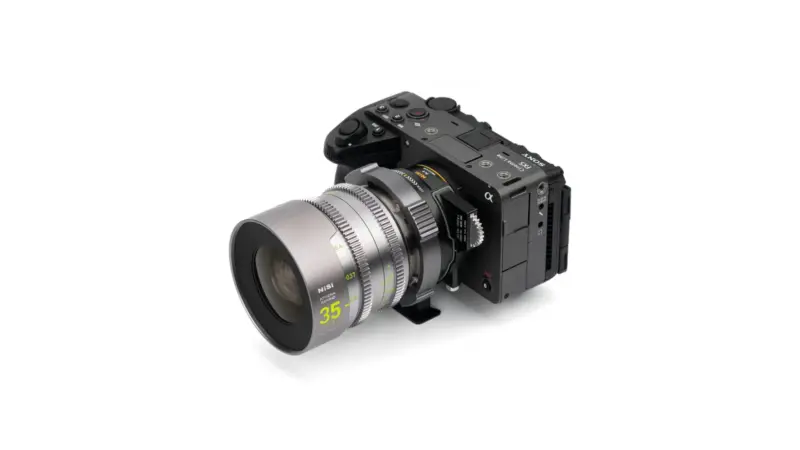
In February 2011, Sony announced that it would provide the basic E-mount specifications to lens and adapter manufacturers without a fee, following a predefined approval process and licensing agreement. Carl Zeiss, Cosina, Sigma and Tamron were among the companies that supported the move from the beginning.
The distinction is important: rather than joining a common camera standard, Sony kept control of its own mount while allowing third parties to develop products for it.
That decision still has visible consequences today. As PTTL has previously reported, Sony’s official list in July 2026 included nine companies with access to the basic E-mount specifications, including Zeiss, Sigma, Samyang, Tamron, Cosina and Fujifilm Holdings.
E-mount Changed Scale in 2013
The next defining moment arrived in 2013, when E-mount expanded from APS-C NEX cameras to Sony’s first full-frame mirrorless interchangeable-lens models, the a7 and a7R. PTTL covered their official presentation in Greece at the time, together with the system’s first full-frame FE lenses.
That transition gave E-mount a very different role from the one it had during the first NEX generation. The same mount could now serve both APS-C and full-frame bodies, allowing Sony to develop a comprehensive Alpha lineup without changing platforms.
It is impossible to prove what would have happened if Sony had accepted the earlier partnership proposal. It would therefore be wrong to assume that the a7 series or full-frame E-mount could never have existed. What is known is that the independent path allowed Sony to evolve its mount according to its own technical and commercial priorities.
Sony Did Not Rely on Technology Alone
Ishizuka says that in 2013 Sony internally set a goal of reaching the top market-share position within five years, and he states that the objective was achieved in 2018. According to him, the company’s strategy was no longer limited to product development but expanded across manufacturing, sales, marketing and after-sales support.
Sony also placed considerable emphasis on professional photographers and photojournalists, while improving autofocus, which Ishizuka identifies as one of Sony’s major early weaknesses. In his assessment, advances in autofocus and image quality around 2016 helped the company cross a critical commercial threshold.
Another revealing point from the interview concerns lenses. The former executive explains that interchangeable lenses were the most profitable part of the business and that establishing a sustainable business model around them became a central part of Sony’s strategy.
Today’s Context Makes the Story Even More Interesting
The story takes on additional significance in 2026 because Sony is now far from being a company that simply avoids partnerships. E-mount is supported by a broad network of licensed manufacturers, while Sony has submitted a non-binding proposal that would make Tamron a wholly owned subsidiary of Sony Group. The proposal remains under review and does not represent a completed acquisition.
This suggests that the real choice at the beginning of the mirrorless era was probably not “cooperation or no cooperation.” Sony chose to control its core platform and then build partnerships around it on its own terms.
What We Think
The most important revelation is not necessarily the mystery surrounding the company that made the proposal, but what the story reveals about how E-mount took shape.
Sony declined the opportunity to follow an already established mirrorless direction, accepted the greater risk of creating an independent platform and then selectively opened that platform to third parties. The journey from the NEX cameras of 2010 to full-frame Alpha and today’s broad lens ecosystem shows how consequential that choice became for Sony’s imaging business.
The only point that requires caution is the identity of the company behind the original invitation. Until specific evidence emerges, Panasonic and Olympus remain plausible candidates and nothing more.
Frequently Asked Questions
Which company proposed a mirrorless partnership to Sony?
It has not been revealed. Shigeki Ishizuka only referred to a group that was already ahead in mirrorless cameras. Panasonic and Olympus are the obvious candidates because of Micro Four Thirds, but this has not been confirmed.
When did Sony begin developing its own mirrorless cameras?
According to Ishizuka, the project began in early 2009. The NEX-3 and NEX-5 arrived in 2010 with APS-C sensors and E-mount.
Had Micro Four Thirds already launched?
Yes. Panasonic and Olympus announced Micro Four Thirds in August 2008, and Panasonic unveiled the Lumix G1 in September of the same year.
Is E-mount a closed system limited to Sony lenses?
No. Since 2011, Sony has provided basic E-mount technical specifications to approved manufacturers through a licensing process.
Does rejecting that partnership mean Sony avoids working with other companies today?
No. E-mount has numerous licensed partners, and in 2026 Sony has also submitted a non-binding proposal concerning Tamron that remains under review.