

Summary
- A Falcon 9 upper stage impacted the Moon on August 5, 2026.
- Danuri captured images before and immediately after the collision during eight observation sessions.
- The stage struck at roughly 8,700 km/h, creating a new crater and traces of ejected material.
- The rocket stage came from the January 2025 mission that carried Blue Ghost and Resilience.
- NASA is expected to study the site with the Lunar Reconnaissance Orbiter.
The first before-and-after images of the impact of a discarded Falcon 9 upper stage reveal the fresh scar created on the lunar surface.
A used SpaceX Falcon 9 upper stage struck the Moon on August 5, 2026, and images from South Korea’s Danuri lunar spacecraft now clearly show the change caused at the collision site.
The observations are scientifically significant because they provide rare data from an artificial impact involving an object of known origin, allowing researchers to compare the area before and immediately after the event and study both the crater and the material ejected by the collision.
[다누리, 달 궤도에서 인공물 충돌 전후 포착!] 다누리가 8월 5일, 한국시간 15시 34분에 발생한 스페이스X 팰컨9 로켓 상단부의 달 표면 충돌 전후를 촬영했습니다! 다누리는 충돌 약 30분 전부터 관측을 시작해, 궤도 제어를 통해 충돌 지점 상공을 여러 차례 통과하며 총 8회에 걸쳐 촬영을… pic.twitter.com/qdJ6vXhKqQ
— 한국항공우주연구원 (@kari2030) August 6, 2026
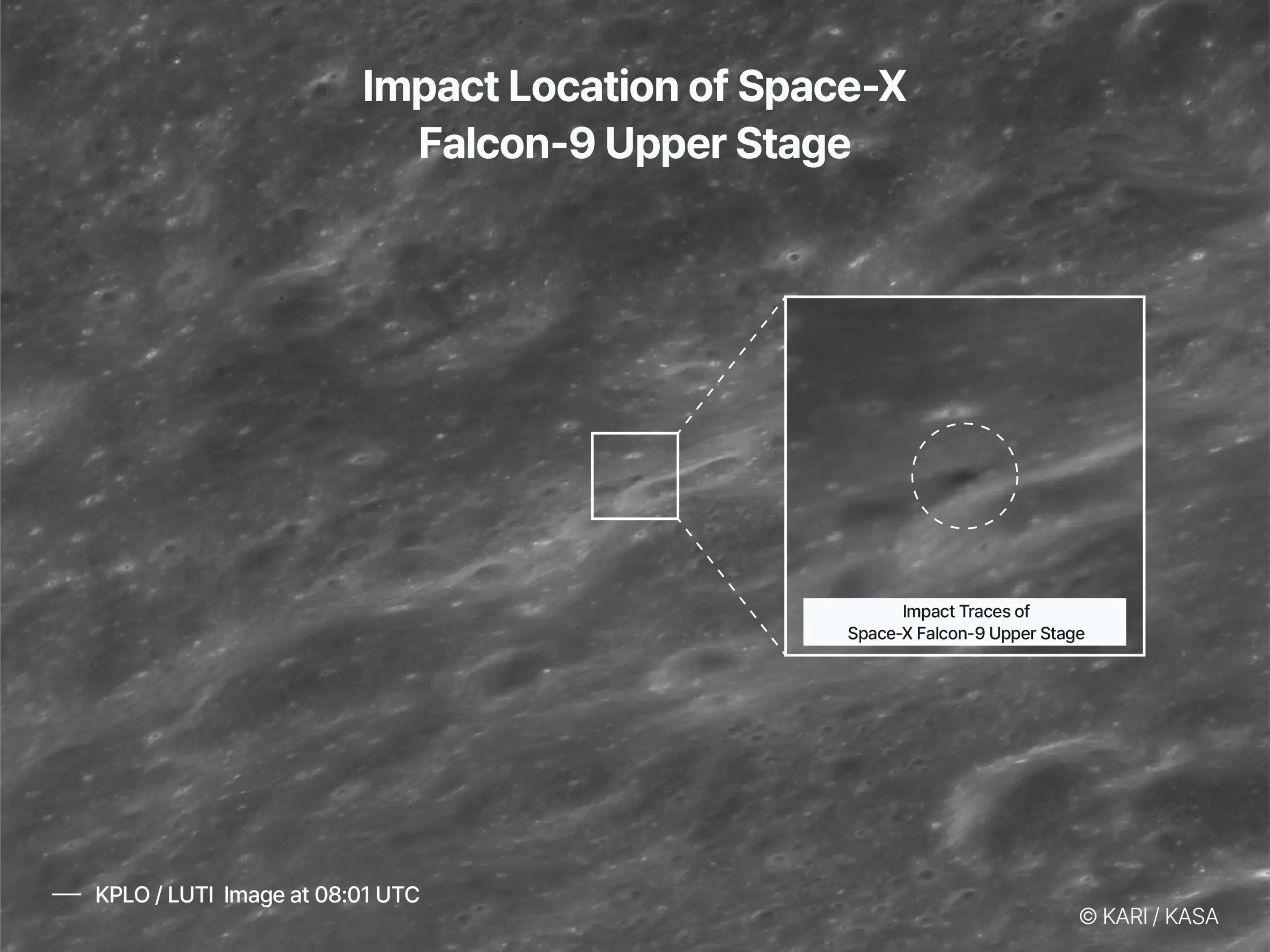
Danuri’s before-and-after images
Danuri, also known as the Korea Pathfinder Lunar Orbiter, began observing the area about 30 minutes before impact. By adjusting its orbit, it passed over the site several times and conducted a total of eight imaging sessions.
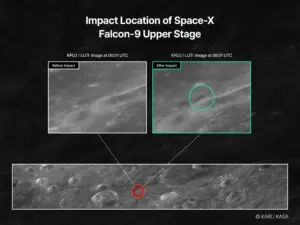
The images confirm changes in the terrain and traces of ejecta around the impact point. Comparisons with earlier observations, including a 2015 image from NASA’s Lunar Reconnaissance Orbiter, show that the new impact area appears noticeably darker.
Danuri operates in lunar orbit at an altitude of roughly 100 kilometers, allowing it to image the area from relatively close range shortly after the event.
The impact at roughly 8,700 km/h
The Falcon 9 upper stage hit the Moon at around 06:34 UTC on August 5, traveling at an estimated 2.43 kilometers per second, or about 8,700 km/h. Its mass was approximately four metric tons.
Pre-impact calculations suggested that the collision could create a crater tens of meters across. One prediction placed its diameter at up to roughly 27 meters, while other simulations produced estimates of around 20 to 30 meters. The new imagery confirms that a crater was formed, although higher-resolution observations will be needed for more precise measurements.
How the Falcon 9 ended up on a collision course
The upper stage came from the January 15, 2025 launch that sent two private robotic lunar spacecraft toward the Moon: Firefly Aerospace’s Blue Ghost and ispace’s Resilience. Blue Ghost successfully landed, while Resilience crashed during its own landing attempt.
Unlike the Falcon 9 first stage, which is commonly recovered for reuse, the second stage is expendable. On this particular mission it had used most of its fuel and remained in a distant Earth orbit for more than a year. Gravitational forces from Earth, the Moon and the Sun, together with smaller effects associated with solar activity, gradually changed its trajectory until it was sent into the lunar surface.
The impact occurred near the Einstein crater, close to the edge of the lunar disk as viewed from Earth. The collision posed no threat to our planet.
Why the images matter scientifically
This case is especially useful because researchers know the approximate origin, mass, trajectory and velocity of the impactor. That makes it possible to compare real observations with models of crater formation and lunar dust behavior following an impact.
The data may also improve understanding of the risks posed by artificial objects in cislunar space, an issue that is becoming more important as the number of missions and planned infrastructure around and on the Moon continues to grow.
What scientists expect next
NASA plans to observe the same area with the Lunar Reconnaissance Orbiter so that LRO imagery can be combined with Danuri’s observations to provide a more detailed view of the fresh crater and the distribution of material around it.
The Korea Aerospace Research Institute said Danuri’s data will be combined with follow-up NASA observations and used in international collaborative research.
The Korea AeroSpace Administration also warned that some videos circulating on social media and claiming to show the actual collision were not authentic, making the official orbital imagery the most reliable visual record of the impact site.
What we think
The importance of these images goes beyond the striking before-and-after comparison. Because scientists have detailed information about the object that struck the Moon, the event provides a rare opportunity to test impact and ejecta models against real observations. As activity around the Moon increases, understanding the behavior of abandoned space hardware will become increasingly important.
Frequently asked questions
When did the Falcon 9 hit the Moon?
The impact occurred on August 5, 2026, at approximately 06:34 UTC.
How fast was the upper stage traveling?
Its estimated impact speed was around 2.43 km/s, or approximately 8,700 km/h.
Which spacecraft photographed the new crater?
The first before-and-after images were captured by South Korea’s Danuri, the country’s first lunar spacecraft.
Why did the Falcon 9 stage not return to Earth?
The expendable upper stage had used nearly all of its fuel during the 2025 mission and remained in a distant orbit whose trajectory was gradually altered by gravitational and solar effects until it struck the Moon.
Will there be more detailed images?
Additional observations are expected from NASA’s Lunar Reconnaissance Orbiter and will be analyzed together with Danuri’s data.