


Summary
- Uber Teen live video uses the driver smartphone’s front-facing camera
- Only the linked parent or guardian can watch during an active trip
- Driver and teen are notified when viewing begins
- The recording is retained for 14 days unless linked to a safety report
- The feature launched in nine US markets
- When and how it activates
- Who can watch
- What is stored and for how long
- Encryption does not necessarily mean end-to-end
- Consent: notification exists, but not everyone has a separate opt-out
- Where it is available
- What changes in practice for families and drivers
- What we think
- Frequently asked questions
Uber has activated live video for teen rides, allowing a linked parent or guardian to see inside the vehicle in real time through the driver’s smartphone front-facing camera.
The feature launched on August 25, 2026 in nine US markets and will expand nationwide over the coming weeks. It is not active on every Uber Teen Trip: the ride must be in progress, the driver must have enabled live video, and the viewer must be the parent or guardian already linked to the teen’s account.
The new tool adds an in-cabin picture on top of existing location tracking, PIN verification and RideCheck, but creates a clear privacy trade-off. The stream is encrypted and limited to the linked guardian, yet an encrypted recording is also created, remains on Uber’s servers and can be reviewed during a safety investigation.
When and how it activates
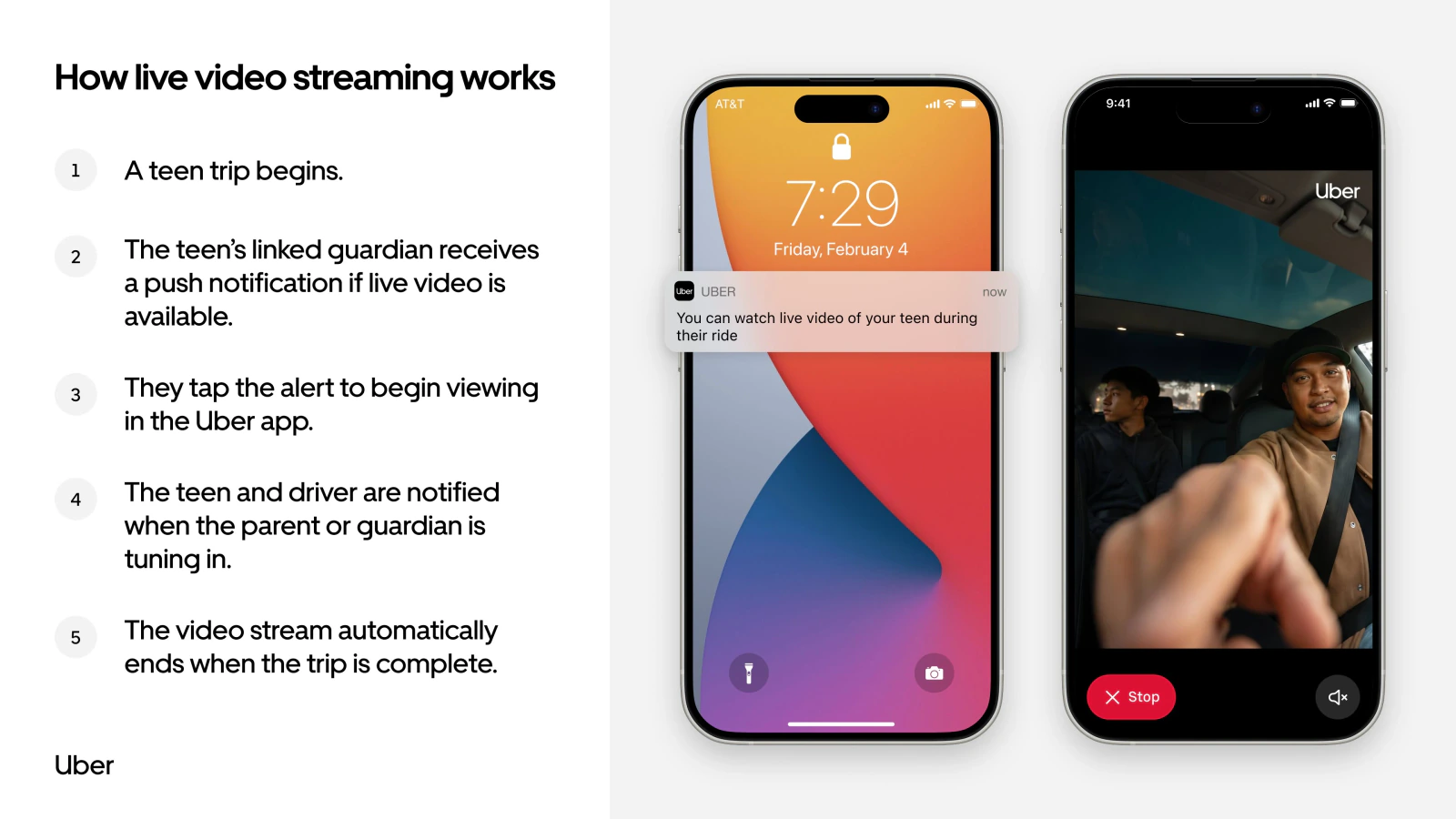
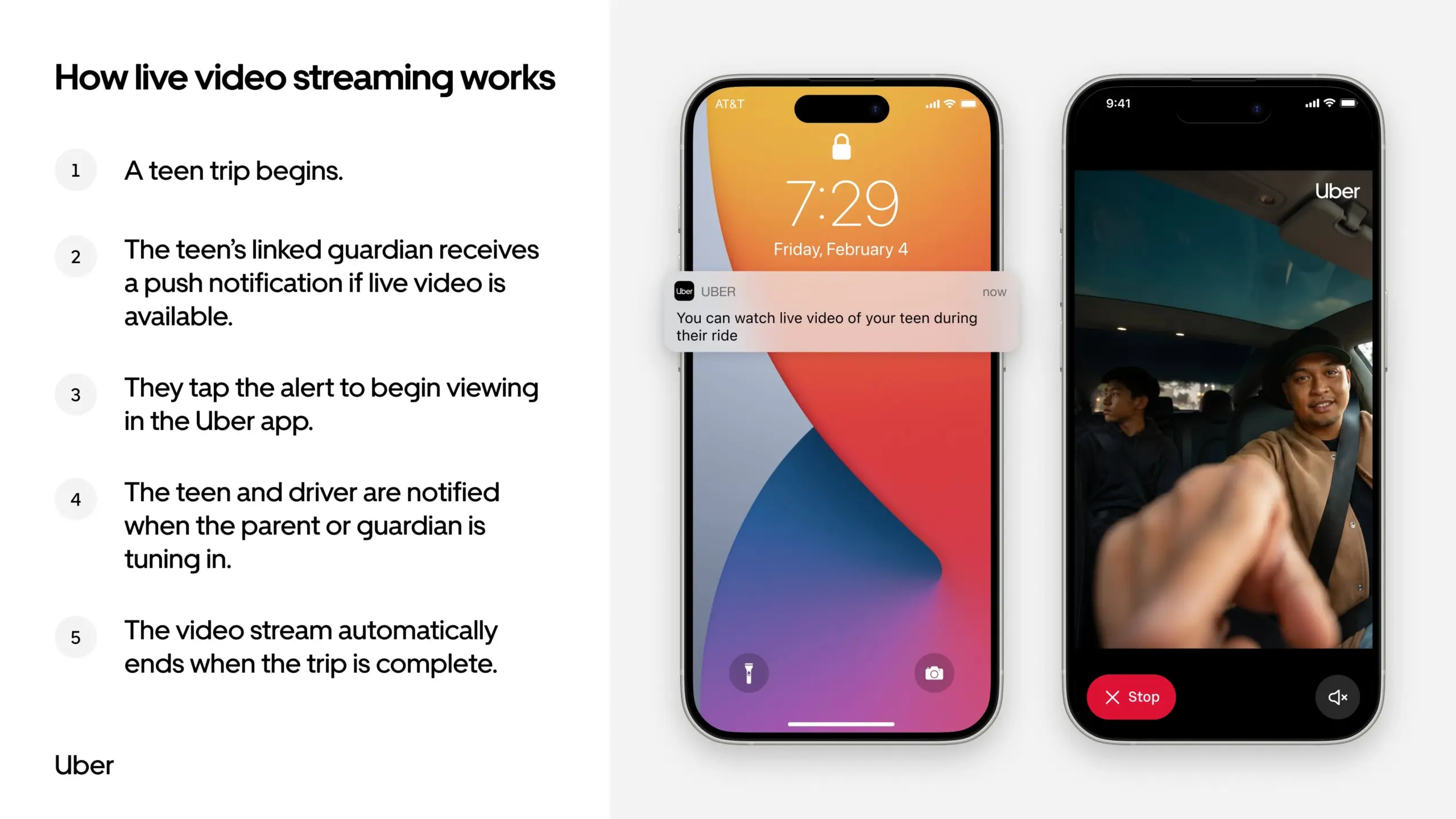
Three conditions are required: an active trip from a Teen Account, a linked parent or guardian account, and a driver who has enabled live video. When all three apply, the guardian receives a push notification at the start of the trip saying that live video is available.
Viewing does not begin automatically. The parent or guardian taps the alert and opens the stream inside the Uber app. Video comes from the driver phone’s selfie camera, positioned to capture the driver and rear seat. The stream ends automatically when the trip is completed.
Who can watch
During an active trip, Uber says only the parent or guardian linked to the Teen Account can open the live feed. The driver does not watch a separate moving stream of themselves, and the teen does not gain access as a viewer.
Guardian access is on demand rather than continuously active by default. They may open the feed after the notification and stop before the trip ends. Whenever they start watching, both driver and teen receive an alert, so viewing is not hidden.

What is stored and for how long
Uber’s official announcement says the video is encrypted and that after the trip neither driver, teen nor guardian can play the recording. The company says it will review the encrypted file only if a safety incident is reported as part of an investigation.
Uber does not publish the retention period in its original announcement. TechRepublic, citing company information and comments from product director Ashu Manohar, reports that the encrypted recording is stored for 14 days and then automatically deleted if it has not been linked to a safety report.
If a safety report is filed, the 14-day deletion no longer applies and the file is retained under Uber’s broader retention policies. No specific fixed retention period has been announced for that category of recordings.
Encryption does not necessarily mean end-to-end
Uber describes the stream and recording as encrypted but has not clarified whether the live transmission uses end-to-end encryption. The distinction matters: true end-to-end encryption prevents the service provider from decrypting content in transit.
TechCrunch asked the company to clarify this point and did not receive a specific answer. Uber’s ability to obtain a decryption key for a safety investigation also means that at least the stored recording is not technically inaccessible to the company in every circumstance.
Consent: notification exists, but not everyone has a separate opt-out
A driver participates only after enabling the feature, providing a choice on the driver side before a stream becomes available. Both teen and driver are notified whenever a guardian starts watching. The announcement, however, does not describe a separate consent action by the teen at the moment viewing begins.
Additional passengers create another issue. TechCrunch reports that someone travelling with the teen may appear in the live feed without a separate opt-out mechanism. The in-app alert covers the driver and Teen Account holder, but not necessarily a friend or relative riding in the same vehicle.
Where it is available
The first rollout covers Atlanta, Phoenix, Orlando, Raleigh-Durham, Portland in Oregon, San Antonio, Cleveland, Rhode Island and El Paso. The wording “nine markets” treats Rhode Island as a regional market rather than a city.
Uber says nationwide US expansion will follow over the coming weeks, without a fixed date for every area. Teen Accounts operate in more than 50 countries, but live video has not yet been announced outside the US or for Greece.
What changes in practice for families and drivers
For a parent, monitoring is no longer limited to a map, arrival time and route deviations. They can visually check whether the teen is in the correct car and whether the situation inside appears normal.
For the driver, activation turns a personal smartphone into a safety camera for the platform. Uber says it provides onboarding for placement and a Safety Toolkit preview of the camera angle when no trip is active. The practical burden includes a proper phone mount, cabin visibility and a deliberate choice to participate.
What we think
Live video can provide genuine reassurance, especially when a teen travels alone, but it is not simply “monitoring without storage.” A recording is created, company access is possible in a defined investigation, and gaps remain around end-to-end encryption, other passengers and post-report retention. A fair assessment must hold both facts together: practical family safety and a larger surveillance footprint inside a private space.
Frequently asked questions
Can any parent open the live video?
No. They must be the parent or guardian linked to that Uber Teen Account, the trip must be active and the driver must have enabled live video.
Are the teen and driver notified?
Yes. Both receive an alert when the linked guardian starts viewing the live feed.
Can they watch the video after the trip?
No. The driver, teen and guardian lose access when the trip ends.
How long does Uber keep the recording?
TechRepublic reports automatic deletion after 14 days unless the encrypted recording is linked to a safety report. No fixed limit has been published for incident files.
Is it available in Greece?
Not under the current announcement. The initial rollout covers nine US markets, with nationwide expansion to follow.