

Summary
- A UK Home Office guide said people must not photograph or film someone without consent.
- The National Union of Journalists called the blanket wording misleading and demanded an immediate correction.
- There is no general UK law requiring permission to photograph in a public place.
- Specific restrictions apply to harassment, voyeurism, upskirting and places where there is a reasonable expectation of privacy.
An official UK guide claimed that photographing or filming people without consent is not allowed, prompting a response from the National Union of Journalists.
The Home Office published Understanding Behaviours and Expectations in the UK for asylum seekers on 19 August 2026. In its photography section, it links respect for privacy to a blanket instruction not to take photographs or videos of someone without consent. Six days later, the NUJ called for a correction because the wording presents something as a general legal rule when UK law is more nuanced.
The distinction is practical, not theoretical. Public photography is a basic tool for photojournalists, filmmakers, documentary creators and citizens recording events. An official but oversimplified instruction can lead people to believe they may demand deletion of lawful images, or that every camera in a public place automatically breaks the law.
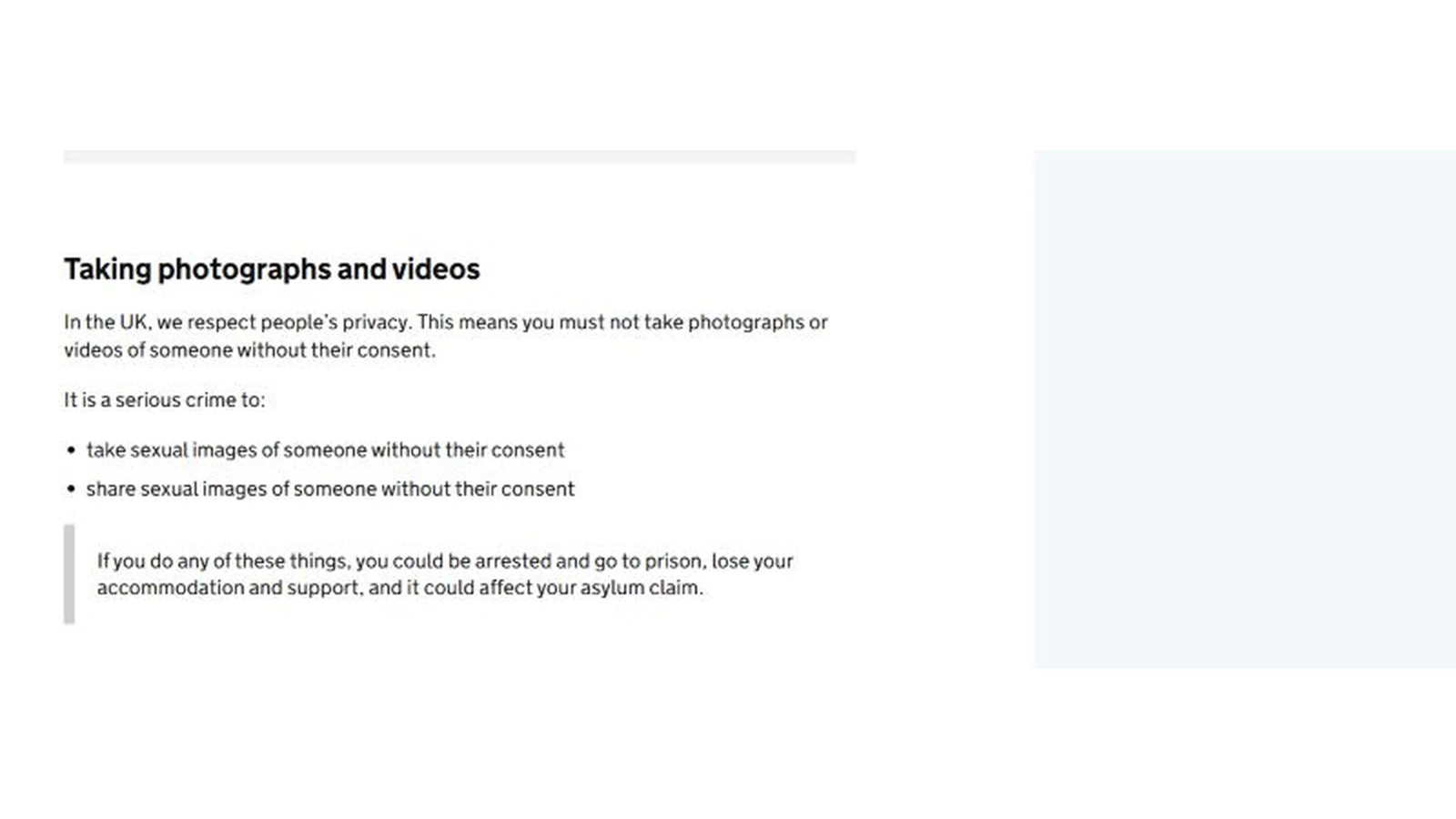
The disputed section of the official Understanding Behaviours and Expectations in the UK guide. Crown copyright, Open Government Licence.
What the Home Office guide says
The guide aims to explain everyday behaviour and basic legal obligations to people arriving in the UK. Its “Photographs and videos” section begins with a sound general principle — respect for privacy — but turns it into a universal ban on taking images without consent. It then refers to serious offences involving sexual images and their distribution without permission.
Placing these different issues together increases confusion. Courtesy, privacy rights and specific criminal offences are not the same thing. Presented in a single flow without a clear distinction, they can reasonably lead a reader to conclude that every photograph of a person taken without prior consent is illegal.
The NUJ response
On 25 August 2026, the National Union of Journalists said the advice was misleading and should be corrected immediately. The union stressed that photographing people in public places without prior permission is not in itself unlawful in the United Kingdom.
For the NUJ, the issue concerns both the accuracy of official information and press freedom. Photojournalists cannot practically seek individual permission from every person visible at a public gathering, protest, sporting event or street scene. A blanket consent requirement would make much of the documentation of public life impossible.
The general position on photography in public
The UK has no general law prohibiting the photography or filming of a person in a public place without permission. That does not mean every shot and every use of an image is lawful regardless of circumstances. Location, the photographer’s behaviour, the content and how the image is published can all affect the legal assessment.
Photography may create legal problems when it forms part of persistent harassment or causes fear and serious distress. Specific offences cover voyeurism and upskirting. Rules differ in private places or circumstances carrying a reasonable expectation of privacy. An owner of private property open to the public may also impose conditions and ask photography to stop.
These points are general information about the United Kingdom, not individual legal advice. Particular cases may engage additional rules involving data protection, defamation, court proceedings, children or commercial use.
Why “consent” does not settle every case
Consent is often good practice, particularly for close portraits, sensitive situations and environments where a person may feel exposed. Ethics, however, are not always identical to a blanket legal obligation. A street photographer may choose to ask permission out of respect, while a photojournalist may need to record an event precisely because it is public and newsworthy.
Clear guidance should explain both sides: respect for privacy remains important, and public photography without prior permission is not automatically unlawful. That is the focus of the NUJ’s official intervention. The accessible Home Office guide remains the primary text containing the disputed wording.
What we think
The attempt to write a simple guide does not justify a legally misleading generalisation. Privacy, consent and the freedom to record public life require clear distinctions, especially in a document issued by a government authority. The correction requested by the NUJ would protect both the guide’s readers and people lawfully working with cameras in public spaces.
Frequently asked questions
Is permission always required for photography in a UK public place?
No. There is no general rule requiring prior consent for every photograph or video made in a public place.
Can someone ask a photographer to stop?
They can ask, but that does not automatically create a legal duty to comply. The circumstances, location and behaviour matter.
When can taking an image be unlawful?
Among other circumstances, when it is linked to harassment, voyeurism, upskirting or intrusion into a place or situation carrying a reasonable expectation of privacy.
What did the NUJ request?
It called on the Home Office to correct the guide’s blanket and misleading wording immediately.