

Summary
- The Carl Zeiss Mirotar 1000mm f/5.6 weighs approximately 16.5 kilograms
- Map Camera mounted it on a Sony α7R V with a mechanical adapter
- Focusing uses a bellows and the minimum distance is 12 metres
- Its mirror design creates distinctive ring-shaped bokeh
- Only about 28 examples are believed to have been made
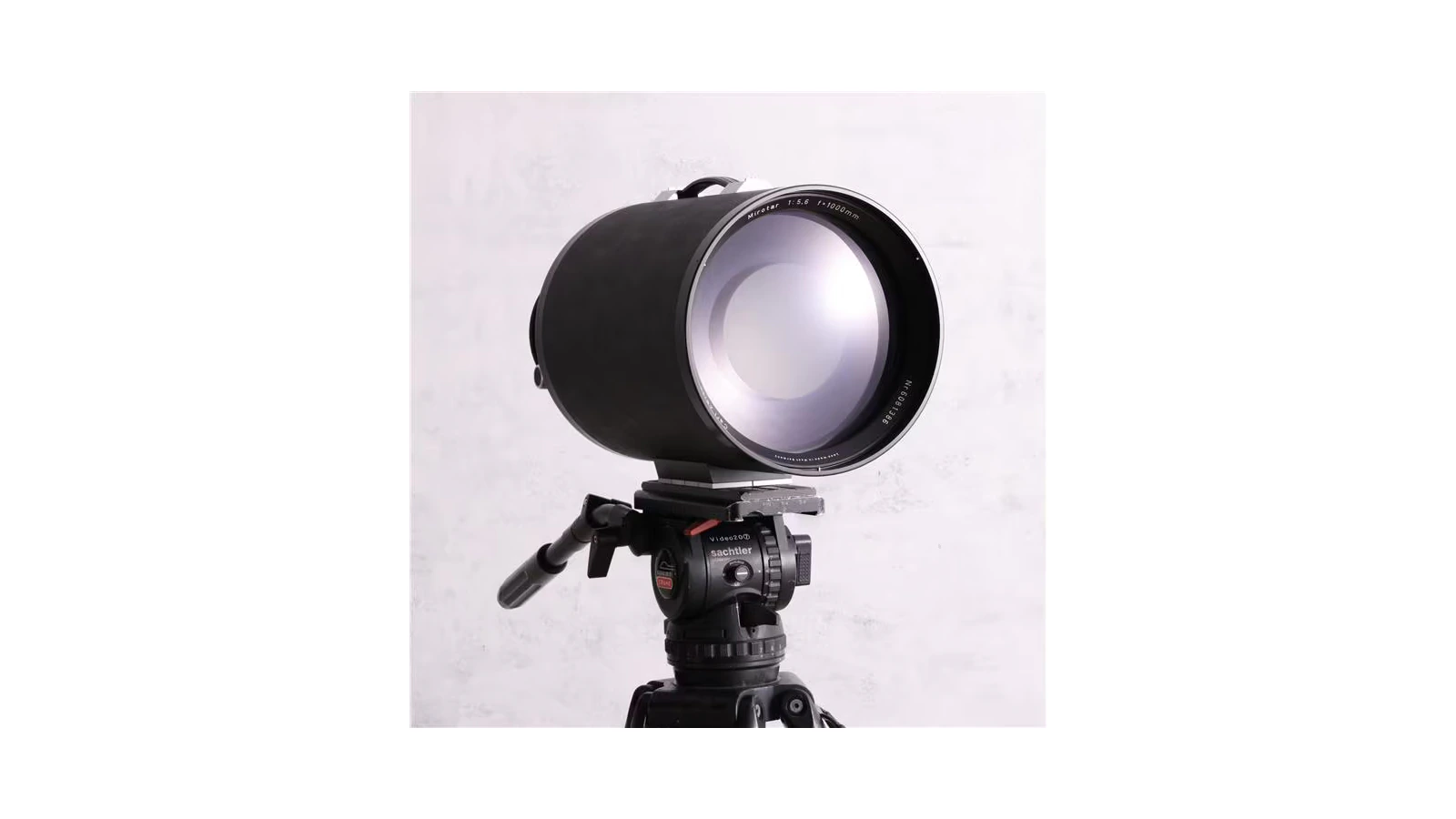
Map Camera mounted a 16.5-kilogram Carl Zeiss Mirotar 1000mm f/5.6 on a Sony α7R V — proving that one of the rarest lenses of the 1970s can still be used for real photography.
The Japanese retailer used a mount adapter, a cinema-style professional tripod and a two-person team to operate the manual system. This particular copy had internal haze and a stiff focusing mechanism, yet the samples retained impressive sharpness, contrast and the distinctive ring-shaped bokeh of a mirror lens.
The appeal extends beyond its absurd size. Mirotar combines a 1000mm focal length with f/5.6 speed, where many mirror telephotos are f/8 or f/11. Zeiss designed it as an uncompromising optical tool for press and wildlife photography in difficult light, at the cost of weight and procedure that make it closer to a telescope than a modern camera lens.
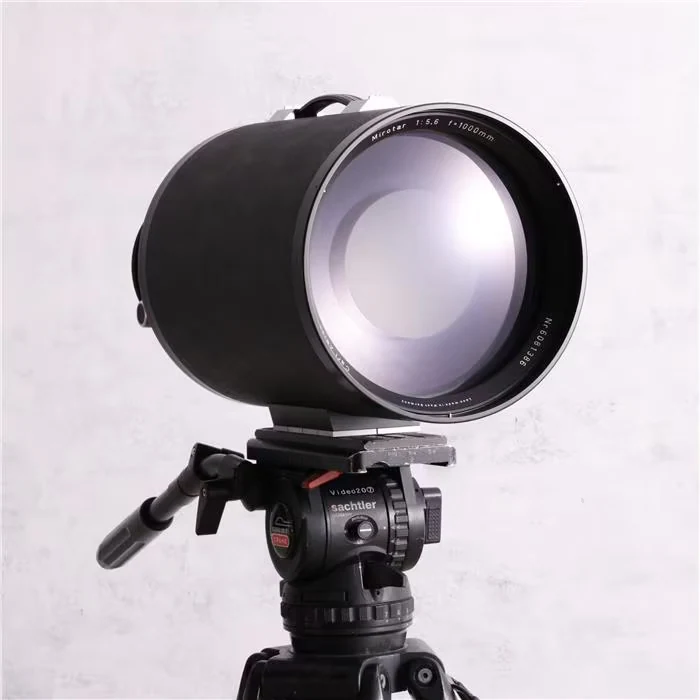
A 1000mm lens that weighs as much as a complete camera kit
Zeiss’s official datasheet specifies an actual focal length of 1020.6mm, a maximum aperture of f/5.6, a 212mm diameter and a weight of approximately 16.5 kilograms. Map Camera measures an overall length of roughly 47 centimetres and says the complete set with its wooden case exceeds 20 kilograms.
The optical construction contains five elements in five groups, including the primary mirror. Minimum focusing distance is 12 metres and the diagonal field of view reaches 4.5 degrees. The design covers negatives up to 60×60mm, explaining an image circle and physical dimensions far beyond the requirements of a full-frame camera.
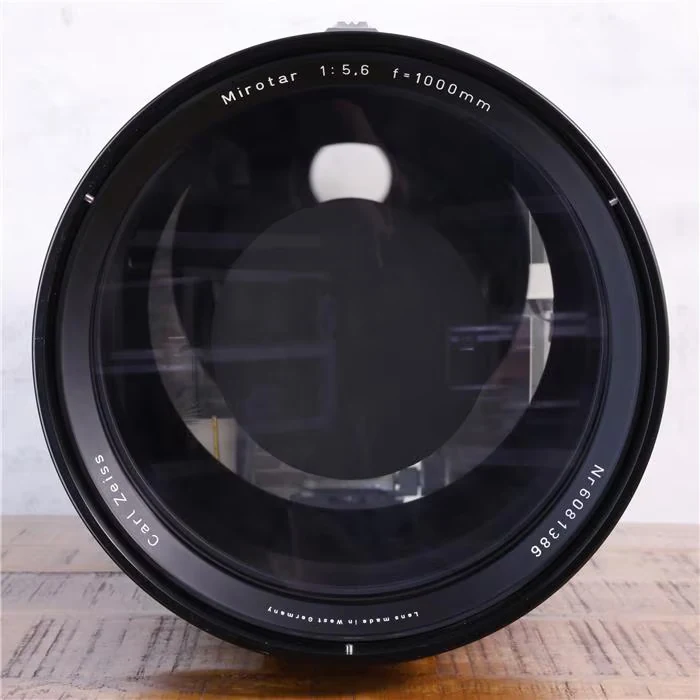
Why it produces ring-shaped bokeh
Mirror, or catadioptric, lenses fold the light path with mirrors, reducing length compared with a conventional refractive telephoto of the same focal length. The central obstruction, however, turns bright out-of-focus points into rings — the familiar “donut bokeh”.
Mirotar uses low-refractive-power optical elements to correct aberrations. Zeiss said the chromatic correction and high contrast allowed significant enlargement of negatives, while f/5.6 opened applications in press and wildlife photography under limited light.
Focusing is done with a bellows
The lens does not focus with a normal rotating ring. Its rear section moves through a bellows and camera adapter. At 1000mm, even a minute movement shifts the plane of focus significantly, so Map Camera considers it best suited to subjects that allow slow and exact adjustment.
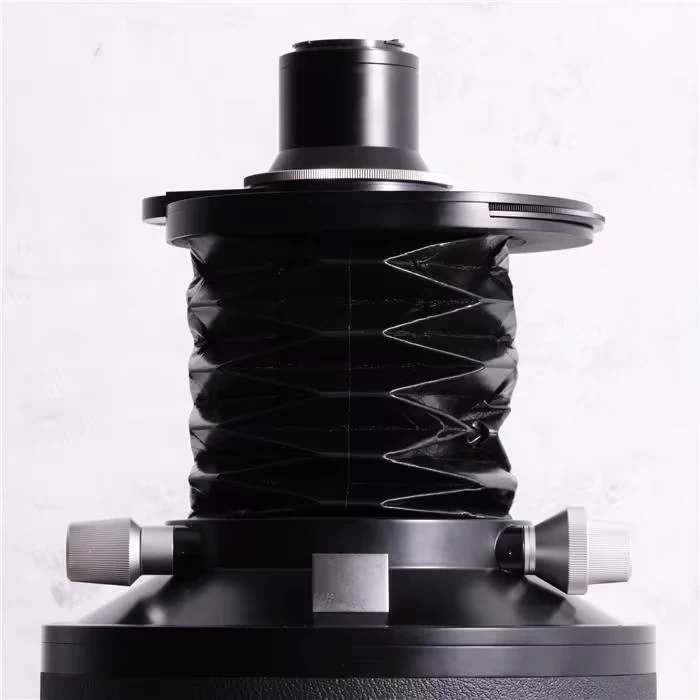
This particular copy had a stiff focusing knob, and the team recommends gloves during extended use. That is the condition of this used unit, not an inherent characteristic of every Mirotar. Its internal haze was also specific to the copy and described as unrepairable.
There is no conventional aperture iris
Instead of an iris that closes down, the datasheet describes a filter turret using neutral-density filters corresponding to f/5.6, f/8 and f/11. The physical opening and bokeh geometry remain effectively fixed while exposure is reduced with denser filters.
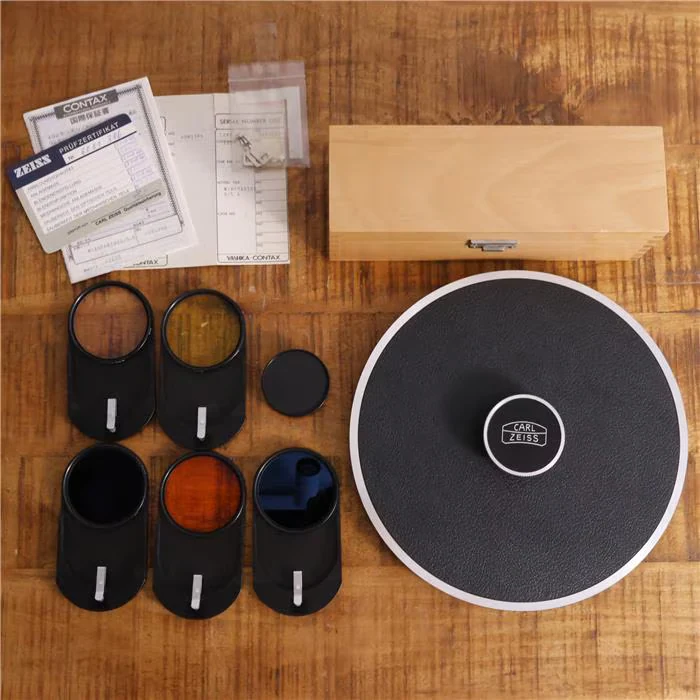
Map Camera’s set included a wooden case, front and rear caps, five drop-in filters — normal, IR, ND 8x, G2x and O5x — a filter case and documents. Zeiss listed a tube mount with adapters for Contax/Yashica and Rollei SL 66, with further adapters available on request.
The Sony α7R V test
Adapting the lens to a mirrorless body is mechanically straightforward because no electronic communication is required, but operation is far removed from a normal adapted lens. The lens and support must carry the entire load; it must never hang from the Sony mount. Even the bellows can transmit micro-vibrations, so every adjustment should be completed before exposure and the rig allowed to settle.
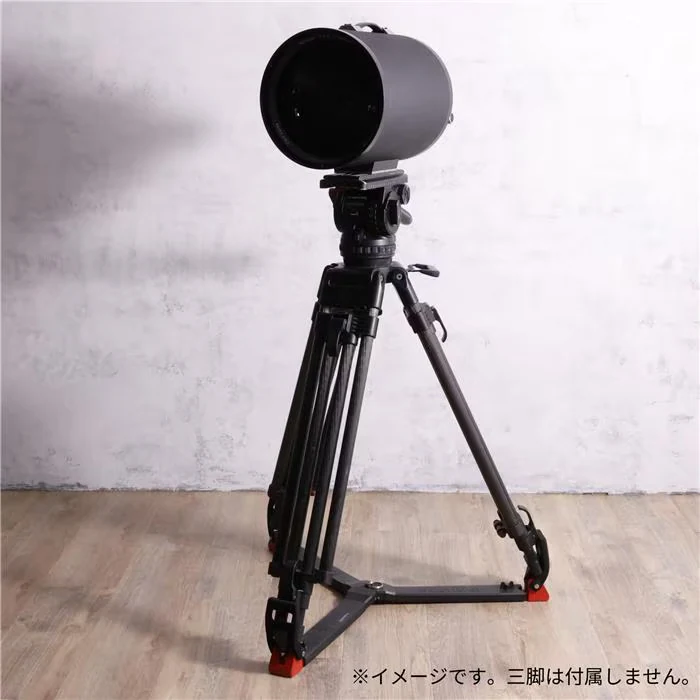
Despite the haze, Map Camera reports only a modest reduction in contrast and colour intensity. Detail and dimensional rendering remained strong, while the bokeh produced images that are difficult to reproduce with a modern super-telephoto. The official video shows the setup and Sony α7R V samples.
Availability and price
Map Camera says that roughly 28 examples were made and that the original price was around 4.7 million yen. This used copy is now listed as sold out. More information, condition details and the complete official image set are available on Map Camera’s official listing.
What we think
Mounting such an old lens on a modern mirrorless camera is more than a technology stunt. It shows that optical quality can survive for half a century, while also demonstrating that handling, support and precision matter as much as MTF. Mirotar remains a photographic tool, but in practice it is a tool for very few, thoroughly prepared operators.
Frequently asked questions
How much does the Zeiss Mirotar 1000mm f/5.6 weigh?
Its official weight is approximately 16.5 kilograms, excluding the wooden case and complete accessory set.
How was it mounted on the Sony α7R V?
Map Camera used a mechanical adapter while supporting the lens independently on a large cinema-style tripod.
Does it have autofocus or stabilisation?
No. It is fully manual and focuses by means of a bellows. Stability depends primarily on the support system and operating technique.
Why does the bokeh form rings?
The central obstruction in the mirror design turns bright out-of-focus points into characteristic circles.
How many were made?
Map Camera says the total production is believed to have been approximately 28 units.