

Summary
- Air conditioning helped American movie theaters attract audiences during the summer
- Historic photographs from the 1930s and 1940s show theaters prominently advertising cool interiors
- New York’s Rivoli Theatre became an important milestone for modern air conditioning in 1925
- Jaws established the template for the modern summer blockbuster decades later in 1975
- In Greece, outdoor film screenings had already begun by the summer of 1900
- When summer was the worst season for a movie theater
- The change began in 1917, but the Rivoli made the difference
- The word “COOL” became almost as important as the movie title
- Jaws did not invent summer cinema — but it changed the blockbuster
- Greece followed a different summer-cinema path
- What we think
- Frequently asked questions
Historic photographs of American movie theaters reveal that, decades before “Jaws,” air conditioning had already transformed a summer trip to the cinema from an ordeal into an escape from the heat.
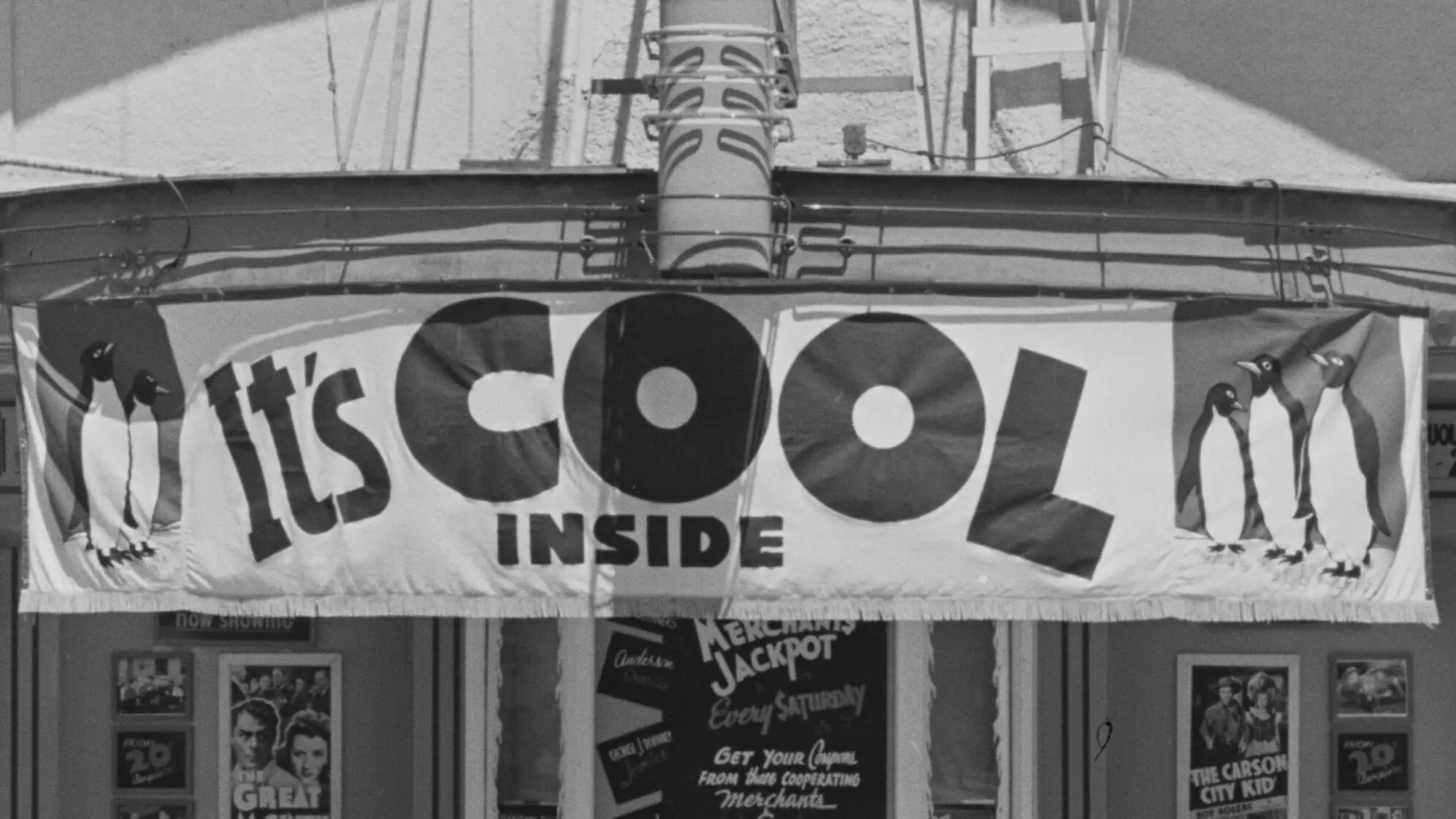
A new retrospective featuring historic images of movie theaters from the 1930s and 1940s has brought a lesser-known chapter of Hollywood history back into focus: theaters displayed large signs reading “COOL,” “Newly Air Conditioned” and “Relax in Cool Comfort,” because cool air itself could be a reason to buy a ticket. The Library of Congress collection of historic photographs shows how central that message had become to theater promotion.
The importance of the story extends beyond air conditioning itself. Making enclosed theaters comfortable during the hottest months helped change the seasonality of moviegoing and created conditions that, many decades later, films such as “Jaws” would build upon when establishing the modern summer blockbuster model.
When summer was the worst season for a movie theater
Today, the idea of an enclosed movie theater without air conditioning seems unusual. In the early 20th century, however, dark, windowless auditoriums could become extremely uncomfortable in hot weather.
During the 1920s, some theaters in the United States reduced operations or even closed during the hottest months. The problem was not a lack of movies but the viewing environment itself: large numbers of people gathered in an enclosed space without the temperature control that audiences now take for granted.
Summer, rather than being a premium period for the box office, could therefore become one of the most difficult parts of the year.
The change began in 1917, but the Rivoli made the difference
The Library of Congress identifies 1917 as a major milestone, when Balaban and Katz opened Chicago’s Central Park Theatre, which it describes as the world’s first mechanically cooled movie theater. The technology was still pioneering and far from being an industry standard.
The larger commercial shift came a few years later. In 1922, Willis Carrier unveiled the centrifugal refrigeration machine, which helped extend modern air conditioning from industrial applications into spaces designed around human comfort.
In the summer of 1925, the technology was installed at New York’s Rivoli Theatre. Carrier records that the Rivoli advertised “Cool Comfort” and “Carrier Manufactured Weather”, and that the line outside stretched for an entire city block. Cooling technology was becoming part of the moviegoing experience itself.
The word “COOL” became almost as important as the movie title
The historic photographs provide perhaps the clearest evidence of the shift.
In a 1940 image from Chicago, an entire theater ticket booth is decorated to emphasize that the venue is “Newly Air Conditioned” and invites audiences to “Relax in Cool Comfort.” In another photograph taken near Lancaster, Ohio, in 1938, a single giant word hangs below the marquee: “COOL.”
That mattered because residential air conditioning was still uncommon. The Library of Congress notes that very few U.S. homes had air conditioning in 1940. For part of the audience, then, a movie ticket did not buy only a film; it also bought a few hours away from the heat.
The architecture and technology of the theater were beginning to influence when people were willing to go to the movies.
Jaws did not invent summer cinema — but it changed the blockbuster
Roughly five decades passed before the model now associated with the term “summer blockbuster” emerged.
Steven Spielberg’s “Jaws” was released in 1975, and the British Film Institute describes it as the film that laid the template for the modern summer blockbuster. The key word is “modern”: summer screenings and commercial hits already existed, but “Jaws” helped turn the season into a major window for large, mass-market theatrical releases.
The path from the “COOL” signs of early theaters to Spielberg is therefore not a story in which air conditioning single-handedly “invented” the blockbuster. It is a chain of changes: theaters became viable and attractive during summer, audiences became accustomed to going to the movies in hot weather, and Hollywood later transformed the season into one of the most important release windows of the year.
PTTL has also recently covered the complete National Geographic documentary “Jaws @ 50”, which examines how Spielberg’s difficult production evolved into one of the films that changed the movie industry.
Greece followed a different summer-cinema path
The Greek story offers an interesting contrast.
While artificial cooling made enclosed American theaters attractive during hot weather, cinema in Greece moved outdoors. According to the Official Athens Guide, the first outdoor movie screenings in the city date back to the summer of 1900, in cafés around Syntagma Square. Organized open-air cinemas followed shortly afterward.
By the 1960s, more than 500 open-air cinemas were operating in Attica alone, according to the same source. Rather than a fully controlled indoor environment, the Greek version of the summer moviegoing experience became associated with courtyards, rooftops, jasmine and films projected under an open sky.
They are essentially two different cultural responses to the same practical problem: how to keep watching movies when temperatures rise.
What we think
The history of the summer blockbuster is more complicated than a single movie or technological invention. Air conditioning did not create “Jaws” or modern Hollywood by itself, but it removed a very real obstacle that had kept audiences away from theaters during summer.
The old photographs are especially valuable because they make that transition visible. When the word “COOL” could occupy almost as much space on a theater marquee as the film itself, it becomes clear that theater technology influenced not only how people watched movies, but also when.
Frequently asked questions
Did air conditioning create the summer blockbuster?
Not by itself. It did, however, make enclosed movie theaters far more comfortable and practical during hot months, helping create a reliable summer audience. The modern commercial model of the summer blockbuster developed much later.
Which movie theater is considered the first mechanically cooled cinema?
The Library of Congress identifies Balaban and Katz’s Central Park Theatre in Chicago, opened in 1917, as the world’s first mechanically cooled movie theater.
Why is Jaws so important to the history of summer blockbusters?
The 1975 film is widely regarded as a turning point because it established the template for the large, mass-market summer theatrical release that Hollywood would follow in subsequent decades.
When did open-air cinema begin in Greece?
Outdoor movie screenings in Athens are documented from the summer of 1900, with organized open-air cinemas appearing soon afterward.