

Summary
- From November 15, 2026, possessing and storing drones will be prohibited across Beijing
- Transporting or bringing drones and key components into the Chinese capital will also be prohibited
- Existing owners must sell, recycle, ship or move their equipment outside Beijing
- Illegal possession can lead to confiscation and fines of up to 5,000 yuan for individuals
- Special exemptions remain available for certain government, research, educational, manufacturing and agricultural uses
- The ban applies to Beijing and is not a nationwide ban on drone possession across China
- What exactly will be banned from November 15
- What changes compared with the May rules
- What existing drone owners must do
- How the buyback and subsidy programme works
- Confiscation and fines
- Are there exemptions?
- This is not a nationwide drone ban in China
- Why Beijing is tightening the rules so dramatically
- What we think
- Frequently asked questions
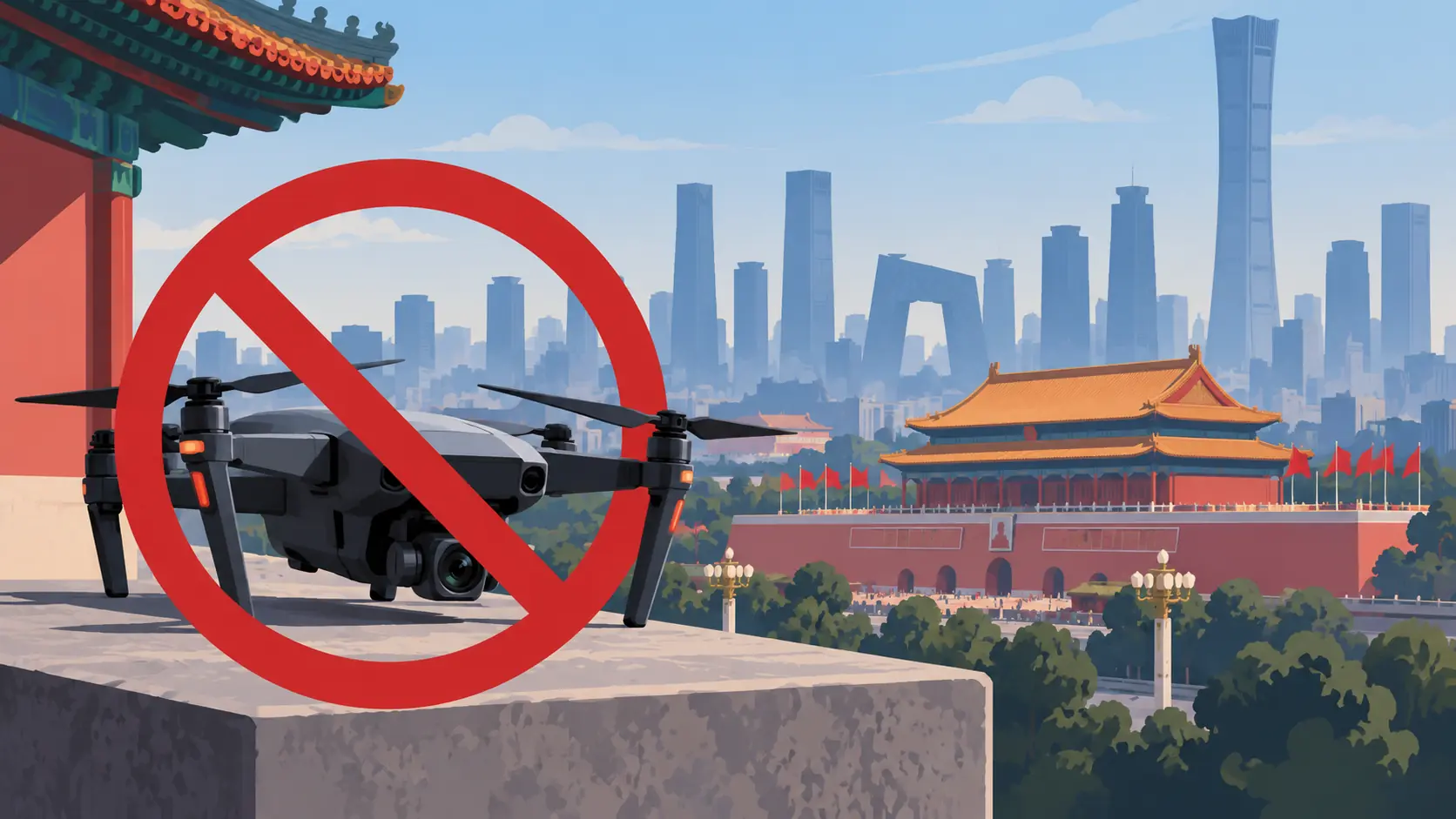
From November 15, 2026, Beijing will prohibit not only drone flights but also the possession, storage and transportation of drones and their key components throughout the Chinese capital’s administrative area.
The revised Beijing Regulation on the Management of Unmanned Aircraft, approved on September 11, 2026, means individuals and businesses will no longer be able to legally keep a drone in the city simply by leaving it at home or in storage. Drones already located in Beijing must be removed before the new framework enters into force on November 15.
The change is particularly significant because it turns possession of the equipment itself into an offence, going far beyond conventional flight restrictions or no-fly zones. Authorities are temporarily offering buyback, recycling and free shipping options outside Beijing, while confiscation and fines are предусмотрены after the deadline.
What exactly will be banned from November 15
The new version of the regulation designates Beijing’s entire administrative area as controlled airspace for unmanned aircraft.
Article 3 explicitly prohibits drone flights, but it now adds two much broader restrictions: possession or storage of drones and key components, and the transportation or carrying of such equipment into Beijing.
This means an owner cannot comply simply by deciding not to fly a drone. After November 15, even keeping the device at home will fall under the ban unless the owner or organisation qualifies for one of the specified special exemptions.
The sale and rental of drones or key components to people and organisations within Beijing are also prohibited, while e-commerce operators are required to enforce the restrictions.
What changes compared with the May rules
Beijing had already introduced a highly restrictive regime from May 1, 2026. The earlier version limited flights, purchases, transportation and storage but still provided a route for retaining existing drones after real-name registration and information verification had been completed.
PTTL had already reported on Beijing’s earlier restrictions covering drone purchases, transportation and flights, which took effect in May. The September revision effectively closes the remaining route for simply possessing an already registered aircraft.
The verification programme established under the previous rules was completed on July 31, and that system will cease to operate when the revised regulation takes effect.
What existing drone owners must do
Authorities are giving existing owners several options before November 15.
They can sell their drone to a buyback company approved by local authorities, surrender it for scrapping and recycling, ship it via EMS to an address outside Beijing or personally move it outside the administrative area by air, rail or road.
The final option must be completed before the regulation takes effect on November 15. Authorities say inspections and enforcement action will follow against equipment that remains illegally stored in Beijing after the deadline.
How the buyback and subsidy programme works
The financial scheme applies to privately owned drones that have already completed police information verification. It is not a fixed government purchase price for each aircraft. Instead, a subsidy is added to the transaction price agreed with an approved buyback company.
For buybacks completed between September 12 and October 31, 2026, the subsidy equals 30% of the transaction value, capped at 3,000 yuan per drone. At the September 14 exchange rate, that maximum is approximately 387 euros.
Between November 1 and November 14, the subsidy falls to 15% of the transaction value, with a maximum of 1,500 yuan, or approximately 194 euros at the same exchange rate.
Owners choosing scrapping instead of a sale can receive 200 yuan per aircraft until October 31, approximately 26 euros, and 100 yuan from November 1 to November 14, approximately 13 euros.
Those choosing to send their drone outside Beijing via EMS can do so without shipping charges until November 14 after the required verification.
Confiscation and fines
Penalties vary depending on the offence.
Illegal possession, storage, transportation or carrying of a drone or its key components can result in confiscation. Individuals can additionally face fines ranging from 500 to 5,000 yuan, approximately 65 to 645 euros at the September 14 exchange rate.
For companies and other organisations, the equivalent fine ranges from 5,000 to 50,000 yuan, approximately 645 to 6,450 euros.
For an illegal flight, police can order the flight to stop, confiscate the drone and impose a fine of between 1,000 and 10,000 yuan, approximately 129 to 1,290 euros.
Are there exemptions?
The regulation provides special exemptions, but these are not general permissions for hobbyists or content creators.
Authorisation to purchase, transport and store drones may be granted after a security assessment for activities linked to counterterrorism, emergency and disaster response or major events.
Exemptions may also be granted to schools, research institutions and manufacturers for education, technological research and production, as well as for specified agricultural and forestry activities.
Even in these cases, approved organisations must establish specific systems covering the safe purchase, transportation, storage and use of drones and their key components.
This is not a nationwide drone ban in China
The prohibition applies to Beijing’s administrative area and does not mean China has introduced a nationwide ban on drone ownership.
The Associated Press notes that drone use outside the Chinese capital remains possible under China’s broader regulatory framework and registration requirements, while Beijing operates a significantly stricter regime because of the capital’s security requirements.
This also has practical consequences for visitors: because transporting or bringing the equipment into the area is prohibited, a traveller cannot simply carry a drone into Beijing even without intending to fly it.
Why Beijing is tightening the rules so dramatically
Chinese authorities officially justify the revision as necessary to strengthen security in the capital, improve airspace management and reduce potential risks involving unmanned aircraft.
The Associated Press places the change within a broader climate of heightened concern about airspace security following a fatal incident in June in which a small crewed aircraft struck a Beijing skyscraper. That aircraft was not a drone, so the event should not be described as an unmanned aircraft accident.
What we think
Beijing’s new framework is notable because it goes far beyond a simple flight ban. By shifting enforcement from use to possession of the equipment itself, authorities effectively eliminate the possibility of privately keeping a drone in the capital without a specific exemption.
For photographers, videographers, travellers and professionals, the most important practical point is precisely this: from November 15, it does not matter whether the drone is switched off inside a bag. Transporting and possessing it are themselves covered by the prohibition.
At the same time, the buyback and free shipping programme indicates that authorities recognise the rule change leaves a significant number of previously lawfully registered owners with equipment they will soon no longer be allowed to keep in the city.
Frequently asked questions
When will drone possession become illegal in Beijing?
The revised regulation takes effect on November 15, 2026. Existing owners must have sold, scrapped, shipped or moved their drone outside Beijing’s administrative area by then.
Can I keep a drone at home if I never fly it?
No, unless one of the specified special exemptions applies. The revised regulation explicitly prohibits possessing and storing drones and their key components within Beijing.
Can a tourist bring a drone to Beijing without using it?
The revised framework prohibits transporting or carrying drones and key components into the administrative area. The restriction therefore goes beyond actually flying the aircraft.
What happens to drones already located in Beijing?
Owners can use approved buyback locations, surrender the aircraft for recycling, ship it outside Beijing through EMS or personally move it out of the city before the deadline.
Does the ban apply across China?
No. It is a Beijing municipal regulation and does not constitute a nationwide ban on owning drones in China.