

Summary
- A Florida camera trap captured a bobcat attacking an adult eastern diamondback rattlesnake.
- The sequence contains 38 photographs recorded on August 20, 2022.
- The snake appears overturned and severely wounded, but its death was not confirmed.
- The study provides rare direct evidence of a mammal attacking a large venomous reptile.
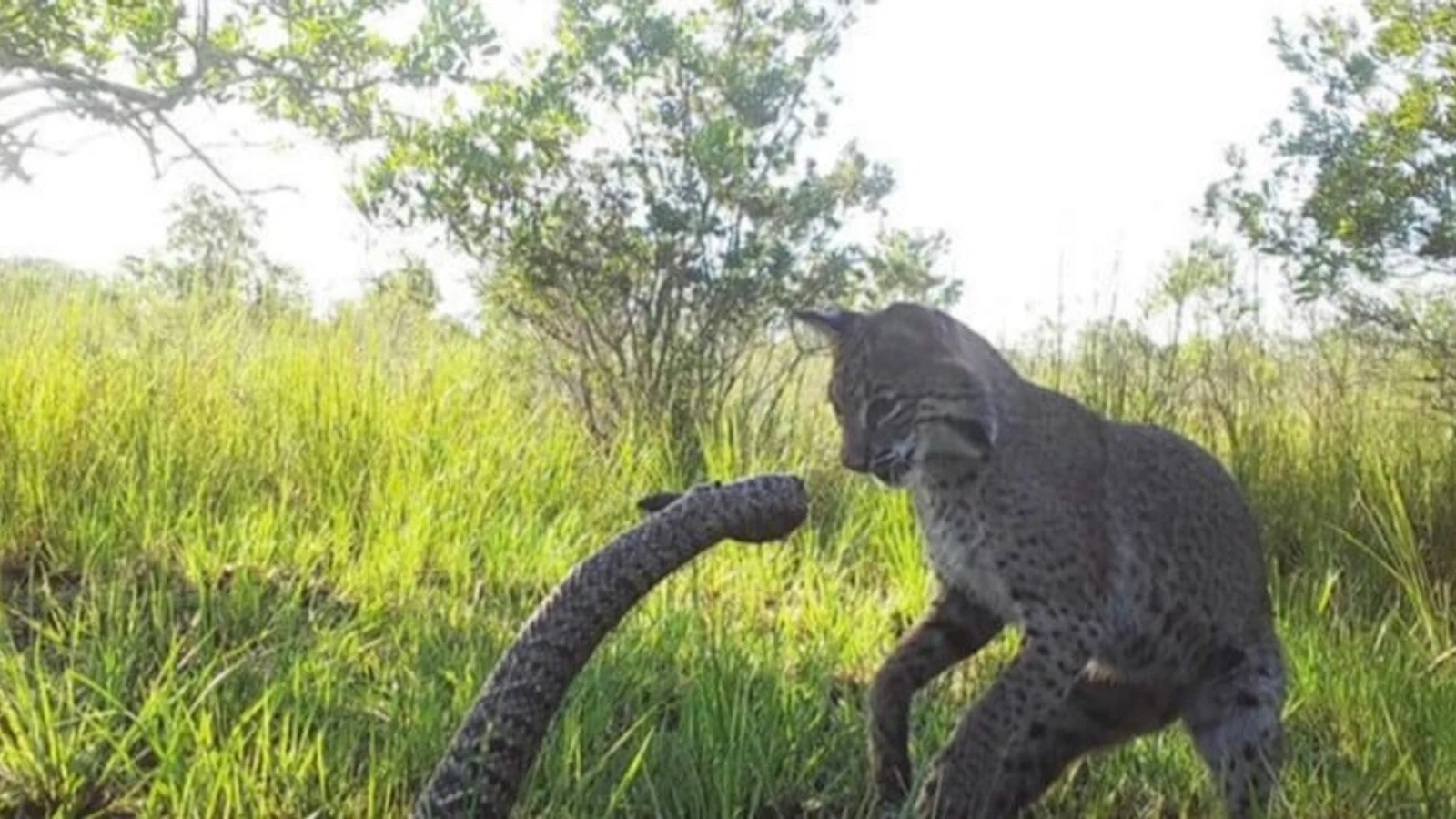
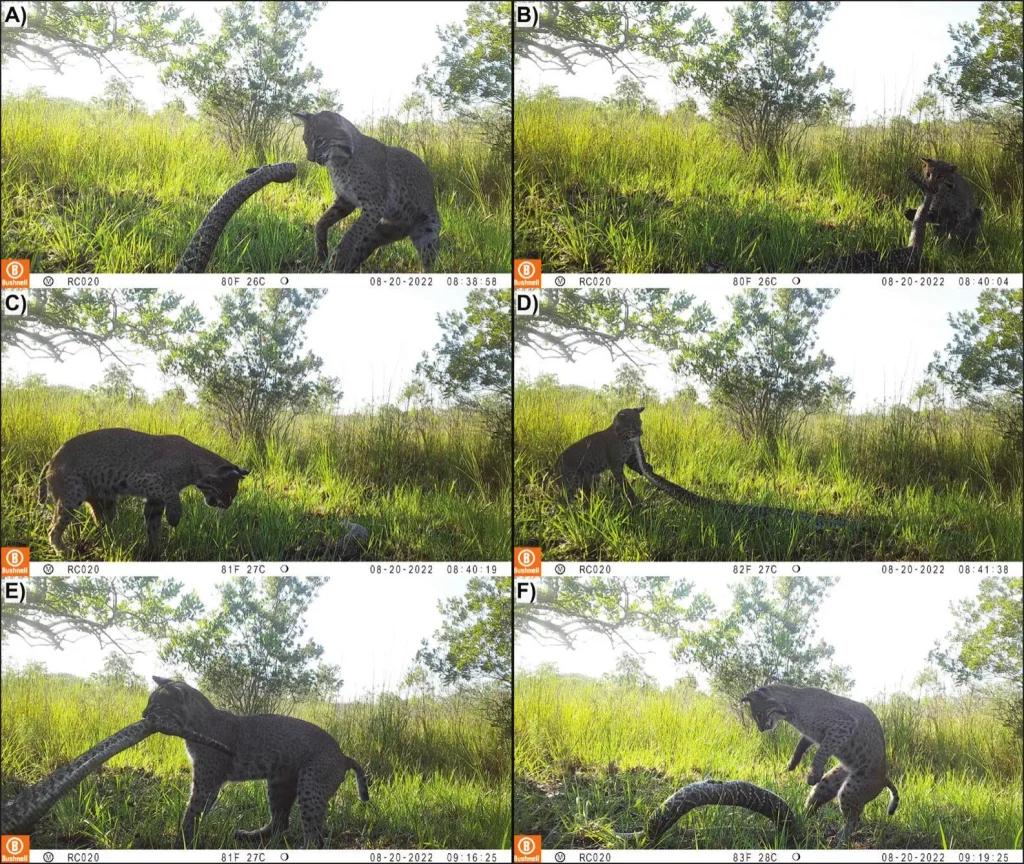
A camera trap in Florida captured 38 photographs of a bobcat confronting and severely injuring an adult eastern diamondback rattlesnake, providing rare scientific documentation of an encounter that would normally remain unseen.
The sequence was recorded on August 20, 2022, at the University of Florida Range Cattle Research and Education Center in Hardee County. The remote camera operated from 8:38 a.m. to 10:14 a.m., showing the bobcat avoiding the snake’s tail, repeatedly attacking its body and eventually biting its head.
The images have now been published in a scientific paper in Southeastern Naturalist. Their value goes beyond the dramatic scene: they provide direct photographic evidence that bobcats can attack very large venomous reptiles, behaviour that has rarely been documented.
What the 38 frames show
In the early frames, the bobcat approaches carefully and appears to avoid the tail. It then bites the tail, claws the body and repeatedly moves toward the head while the rattlesnake attempts to defend itself.
Later photographs show the snake overturned with visible wounds to its head, midbody and tail. The duration indicates that this was not a momentary contact but a prolonged interaction in which the cat returned to the attack several times.
Why the eastern diamondback is a dangerous opponent
The eastern diamondback rattlesnake, Crotalus adamanteus, is generally considered the largest rattlesnake species by overall size and weight. It is a venomous snake with a powerful defensive bite, making a medium-sized mammal’s decision to approach it particularly dangerous.
The bobcat, Lynx rufus, is an opportunistic predator with a wide range of prey. Its agility, rapid reactions and use of the front paws can help it maintain distance from a snake’s head. The photographs do not, however, prove that bobcats are immune to venom or that such attacks carry little risk.
The scientific importance of the sequence
Adult rattlesnakes are rarely documented as prey, while direct observations of mammals attacking large venomous vipers are limited. Researchers usually find tracks, injured animals or remains and attempt to reconstruct what happened.
Here, the camera trap provides a timed sequence showing specific behaviour: tail avoidance, biting, clawing and an attack on the head. That allows biologists to examine not only the result but also the predator’s tactics.
The connection with attacks on other large reptiles
Earlier evidence from Florida has linked bobcats with attacks on Burmese pythons, an invasive species that has seriously affected local ecosystems. The new record strengthens the picture of a predator capable of confronting reptiles larger and more dangerous than its usual prey.
This does not mean that bobcats alone can control python populations or that they routinely hunt adult rattlesnakes. It shows that food-web relationships are more complex than direct human observation normally reveals.
What the photographs cannot tell us
The sequence ends with the rattlesnake injured, but it does not confirm its death or whether the bobcat consumed it. It also cannot establish with certainty whether the snake managed to bite the attacker. The absence of an image must not be turned into a conclusion about events outside the camera’s field of view.
Why camera traps matter
Automatic cameras can remain for months in places where a human presence would change animal behaviour. They record rare encounters without a researcher behind the camera and can produce material that gains scientific value years later, as happened with this 2022 sequence.
What we think
This record is a strong example of the difference between one striking image and a scientifically useful sequence. The 38 frames reveal how the behaviour developed, but they do not justify claims of the snake’s certain death or general bobcat immunity to venom. Their real value lies in rare, direct documentation.
Frequently asked questions
Where was the attack recorded?
At the University of Florida Range Cattle Research and Education Center in Hardee County, Florida.
How long did the sequence last?
The camera recorded 38 photographs between 8:38 a.m. and 10:14 a.m. on August 20, 2022.
Did the bobcat kill the rattlesnake?
That has not been confirmed. The final images show the snake overturned and injured, not the ultimate outcome.
Why were the photographs published four years later?
The record became part of a scientific study published in 2026 after the incident had been analysed and documented.