

Summary
- The event was recorded on July 17, 2025 at Palm Beach Reef in Australia.
- The mother repeatedly approached and touched the stillborn calf on the seafloor.
- Researchers use the term post-mortem attentive behaviour rather than claiming proven human-like grief.
- The study was published in Discover Animals on September 16, 2026.
Rare underwater footage has documented a female humpback whale remaining beside her dead newborn calf, in what researchers describe as the first detailed record of this kind of behaviour in humpback whales.
The observation took place on July 17, 2025 at Palm Beach Reef near the Gold Coast in Queensland, Australia. The scientific study by Jan-Olaf Meynecke and Andrew Mulville was published on September 16, 2026 in Discover Animals.
The researchers are cautious about the word “grief.” The behaviour may reflect a strong maternal bond, confusion or instinctive caregiving, which is why they use the more neutral term “post-mortem attentive behaviour.”
A GoPro revealed the newborn on the seafloor
Andrew Mulville of the Sea World Foundation was on a private vessel when he noticed two adult humpback whales moving unusually slowly near the surface. Shortly afterward, an amniotic membrane was seen in the water, indicating that a birth had just taken place.
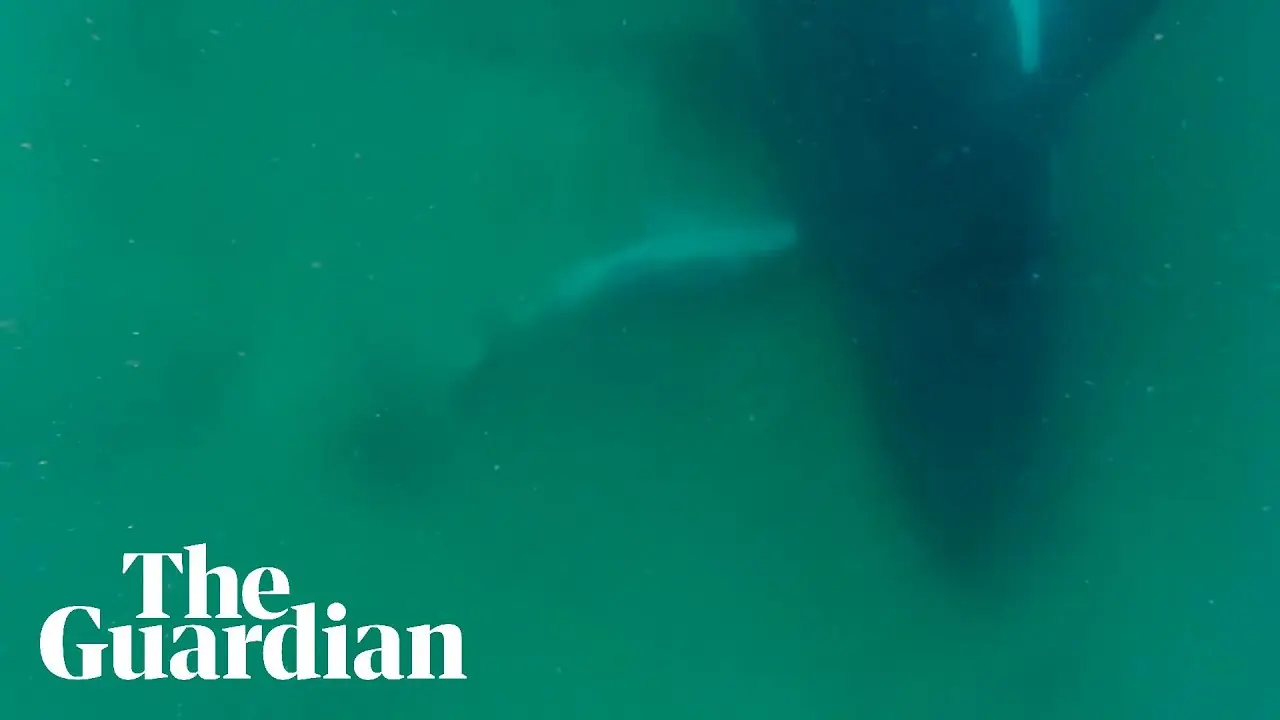
With no calf visible at the surface, a handheld GoPro was used for underwater recording. The footage revealed a newborn, estimated at under four metres long, lying motionless on the seafloor with no visible movement or respiration.
According to the study, 15 minutes of underwater footage were recorded between 8 a.m. and 10 a.m., with around 12 minutes showing the stillborn calf.
The mother repeatedly returned to the calf
The female repeatedly approached the newborn, touched it with her head and pectoral fin, and remained motionless beside it, including periods in which the two animals were positioned eye-to-eye.
The behaviour continued until observations ended at 10 a.m. Researchers also note that two adult humpbacks were reported in the same area on the following two days, although it could not be confirmed that they were the same individuals.
A second adult remained in the area during the event. The researchers describe it as an “escort” accompanying the female, but its sex was not confirmed.
Why the observation is so rare
Prolonged attention toward dead calves has been documented more often in toothed cetaceans such as dolphins and killer whales. Scientific observations are far scarcer among baleen whales, including humpbacks.
One practical reason may be that newborn humpback whales have relatively little blubber and can sink quickly after death. That makes it extremely difficult to observe what a mother does afterward.
The study describes this event as the first detailed documented case of prolonged post-mortem attendance by a humpback whale mother toward a stillborn calf. It does not claim that human-like grief has been proven.
What the footage shows — and what it cannot prove
The video clearly documents repeated proximity, physical contact and prolonged attendance beside the dead calf. Those behaviours are consistent with caregiving responses and strong maternal attachment described in other socially complex mammals.
However, an animal’s internal emotional state cannot be measured directly from video alone. The researchers note that the behaviour could represent grief, but could also reflect maternal attachment, confusion or instinctive caregiving.
What we think
The importance of this footage does not depend on anthropomorphic interpretation. A simple GoPro captured an exceptionally rare behaviour that would have been almost impossible to observe from the surface alone, giving researchers material from a poorly understood part of the lives of large whales.
Frequently asked questions
When and where was the event recorded?
On July 17, 2025 at Palm Beach Reef, roughly one kilometre off the Gold Coast in Queensland, Australia.
What camera was used underwater?
The study states that the underwater footage was recorded with a handheld GoPro.
Do scientists say the whale was grieving?
They discuss the possibility of grief-related behaviour but do not present the emotion as proven. They use the term “post-mortem attentive behaviour.”
Why are observations like this so rare?
One reason is that dead newborn humpback whales can sink quickly, sharply reducing the chance of observing a mother’s behaviour after the calf dies.