

Summary
- HOVERAir VERSA works as both a handheld camera and an autonomous drone
- It features a three-axis mechanical gimbal and a detachable flight module
- It supports AI tracking, automatic framing and more than ten flight modes
- Pricing, availability and complete specifications have not been announced
HOVERAir has introduced VERSA, a modular pocket camera that works as a handheld gimbal and transforms into an autonomous flying camera when its detachable flight module is attached.
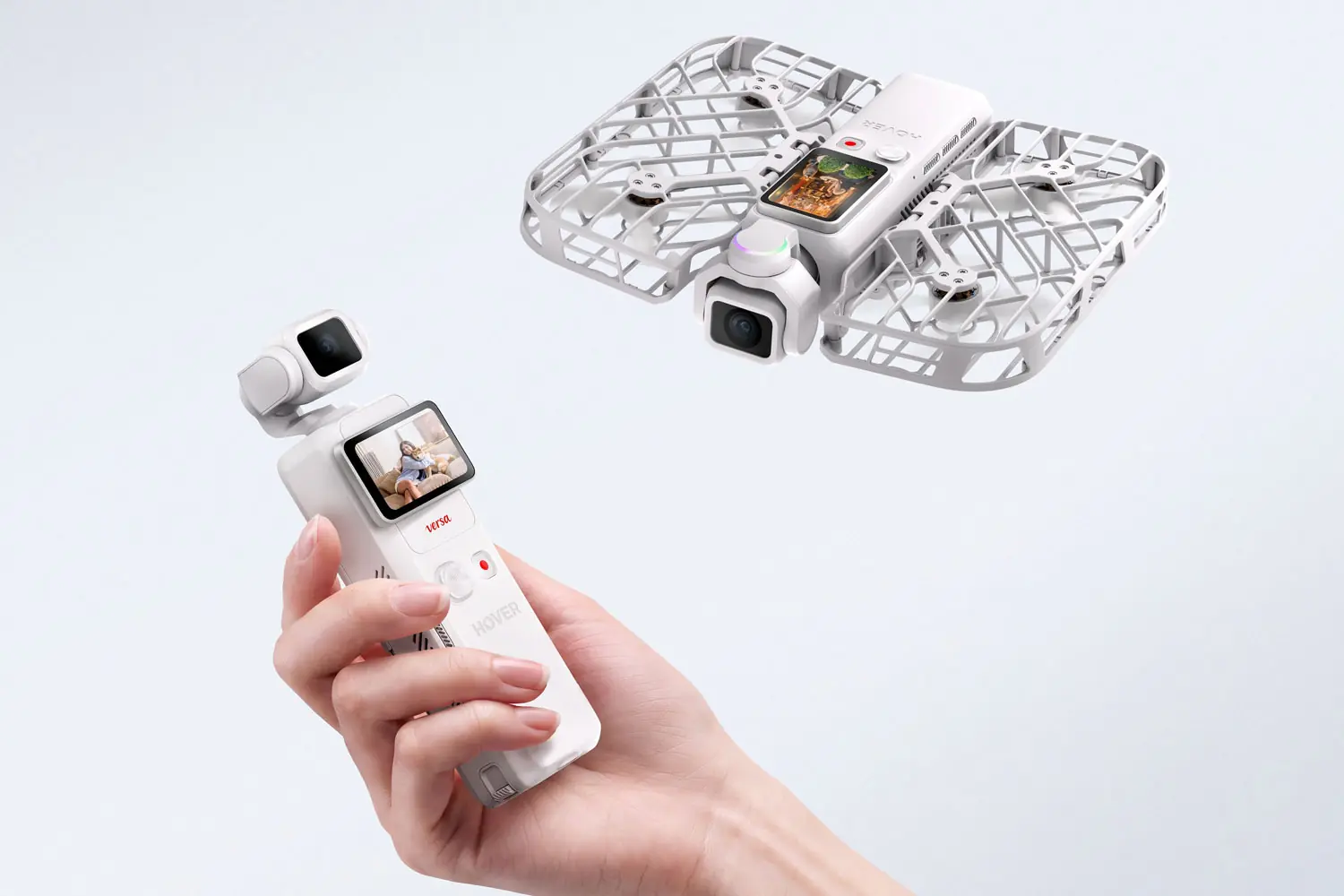
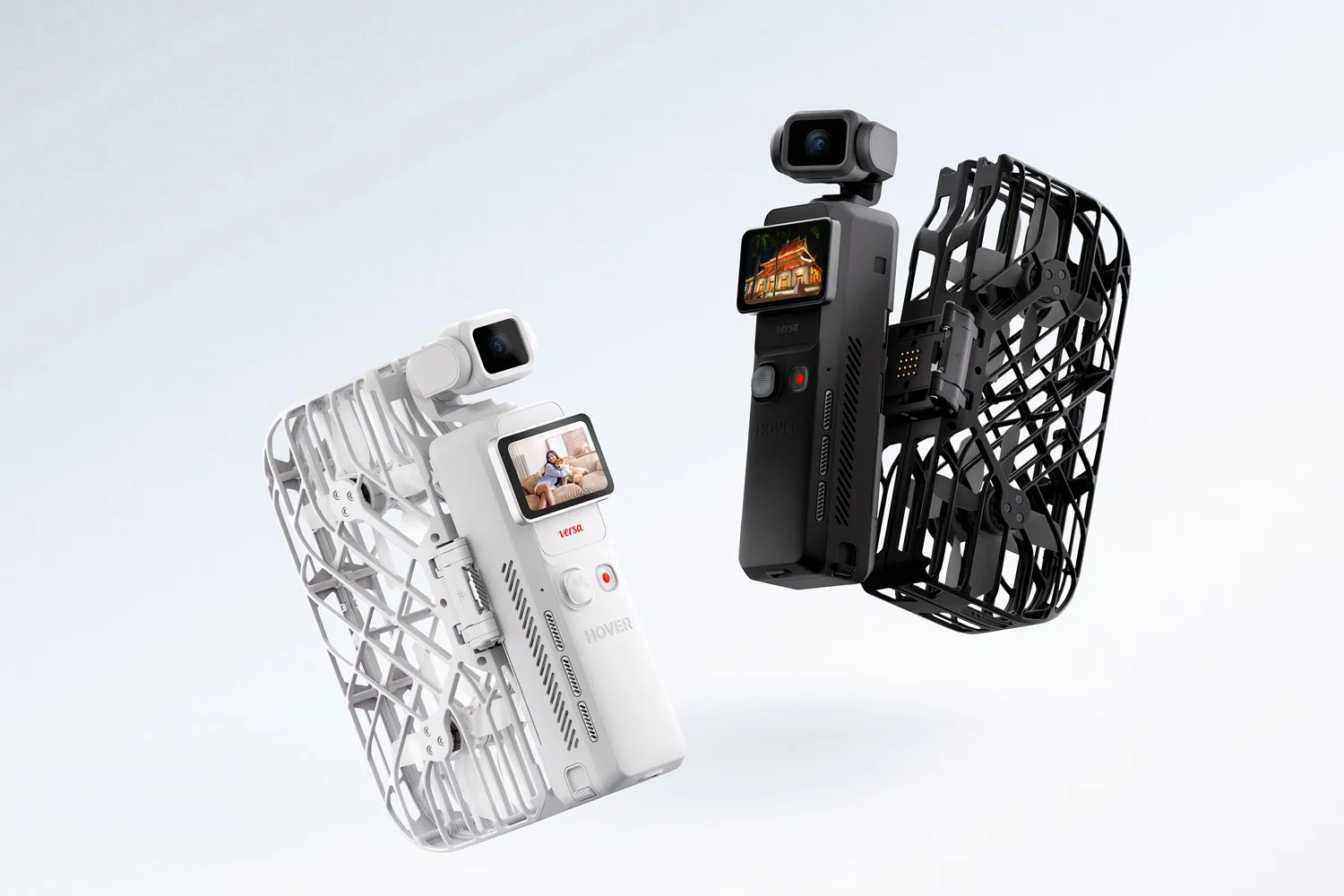
The HOVERAir VERSA features a camera mounted on a three-axis mechanical gimbal and can be used handheld to capture stabilised footage. Once the propeller module is attached, the same device becomes a small automated drone capable of taking off from and landing in the user’s palm.
The significance of this design lies in its combination of two equipment categories that have generally required separate devices. In theory, a creator can record footage at eye level and then continue with aerial shots without carrying an independent pocket gimbal and drone.
From hand to air
In its basic configuration, VERSA resembles a compact vlogging camera with an integrated gimbal and screen. HOVERAir says the stabilisation system operates across three mechanical axes to provide smooth footage when the camera is used handheld.
The rear of the gimbal module includes a sliding cover that conceals the connector for the flight unit. The presentation material indicates that the transformation is completed by attaching the protected propeller assembly around the camera, without replacing the main imaging module.
A physical recording button and a second control, which appears to function as a small joystick or navigation button, can be seen on the front. An RGB indicator is also positioned on the neck of the gimbal, probably to display recording status or the selected operating mode, although its exact functions have not yet been announced.
Autonomous flight and AI tracking
With the flight module connected, VERSA is designed to operate as a self-flying camera rather than a conventional drone requiring continuous piloting. According to HOVERAir, it can recognise and follow a subject, adjust the framing and perform automated camera movements without a separate remote controller.
The company lists more than ten intelligent flight modes, along with AI-assisted automatic composition. The system analyses the surrounding environment, suggests camera placement and applies an intelligent crop to keep the subject inside a balanced frame during both handheld recording and flight.
Take-off and landing can be performed from the user’s palm. This approach follows the philosophy of the company’s previous self-flying models, focusing on autonomous recording rather than traditional drone navigation by a pilot.
The 3D Worlds feature
One of the most distinctive capabilities announced by HOVERAir is called 3D Worlds. In this mode, VERSA performs a controlled 360-degree circular flight, captures images from different angles and uses them to reconstruct a three-dimensional representation of the scene.
According to the company, the resulting file can be viewed from different perspectives and shared across devices. The resolution of the 3D files, processing times, application requirements and export formats have not yet been specified.
What we know about the camera
The complete technical specifications of VERSA have not been released. HOVERAir has not yet revealed the size or resolution of the image sensor, the lens specifications, available frame rates, bitrate, colour modes or storage options.
The preview material displays a 4K recording option and a 24-minute indicator. However, it has not been confirmed whether the 24 minutes represent available recording time, remaining storage, handheld battery life or another status reading from the prototype. These figures therefore cannot yet be regarded as final specifications.
The company says the camera uses a new image processor and promises increased dynamic range, preserved shadow detail and improved low-light performance. These claims are not yet accompanied by measurements, full-resolution samples or detailed technical data.
Pricing and availability
HOVERAir has not announced the price, release date or markets in which VERSA will initially become available. It is also unknown whether the handheld module and flight module will be sold exclusively as a complete package or offered separately.
For comparison, Amateur Photographer reported a price of £451 for the HOVERAir X1 PRO at the time of publication, offering 12-megapixel photos and 4K video at 60p, and £609 for the X1 PROMAX, with photos at up to 48 megapixels and 8K recording. The waterproof HOVERAir AQUA was listed at £1,129.
The suggestion that VERSA could be positioned near the X1 family is based only on its format and possible capabilities. There is no confirmed price range until the official announcement.
What we think
HOVERAir’s idea addresses a genuine problem for solo creators, travellers and vloggers: carrying and coordinating different devices for ground-level and aerial footage. Using the same camera in both situations could also provide greater consistency in image quality and colour.
The practical value of VERSA, however, will depend on details that remain unknown. Sensor and lens quality, flight endurance, total weight, the durability of the attachment mechanism, wind stability, collision protection and final pricing will determine whether it becomes a useful production tool or remains an interesting modular concept.
Frequently asked questions
What is the HOVERAir VERSA?
It is a modular pocket camera with a three-axis mechanical gimbal that can be used handheld or connected to a propeller module and operated as an autonomous flying camera.
Does the HOVERAir VERSA record 4K video?
A 4K option appears in the presentation material, but the company has not yet published the final resolutions, frame rates or other recording specifications.
Does it require a remote controller?
HOVERAir says its main flight, tracking and framing functions are automated and do not require a conventional drone controller.
What does the 3D Worlds feature do?
The camera performs a predefined 360-degree flight, photographs the scene from different angles and creates a three-dimensional reconstruction that can be viewed from multiple perspectives.
When will it be released and how much will it cost?
The release date and official price have not yet been announced.