


Summary
- The Inouye Solar Telescope imaged the Sun’s surface at a resolution of approximately 19 kilometers
- The observations revealed magnetized Kelvin–Helmholtz instabilities in the photosphere for the first time
- FastCam operated at 740 frames per second with an exposure time of 100 microseconds
- The researchers analyzed 47 vortices measuring between 25 and 170 kilometers
- The structures may contribute to energy transport and the braiding of the Sun’s magnetic field
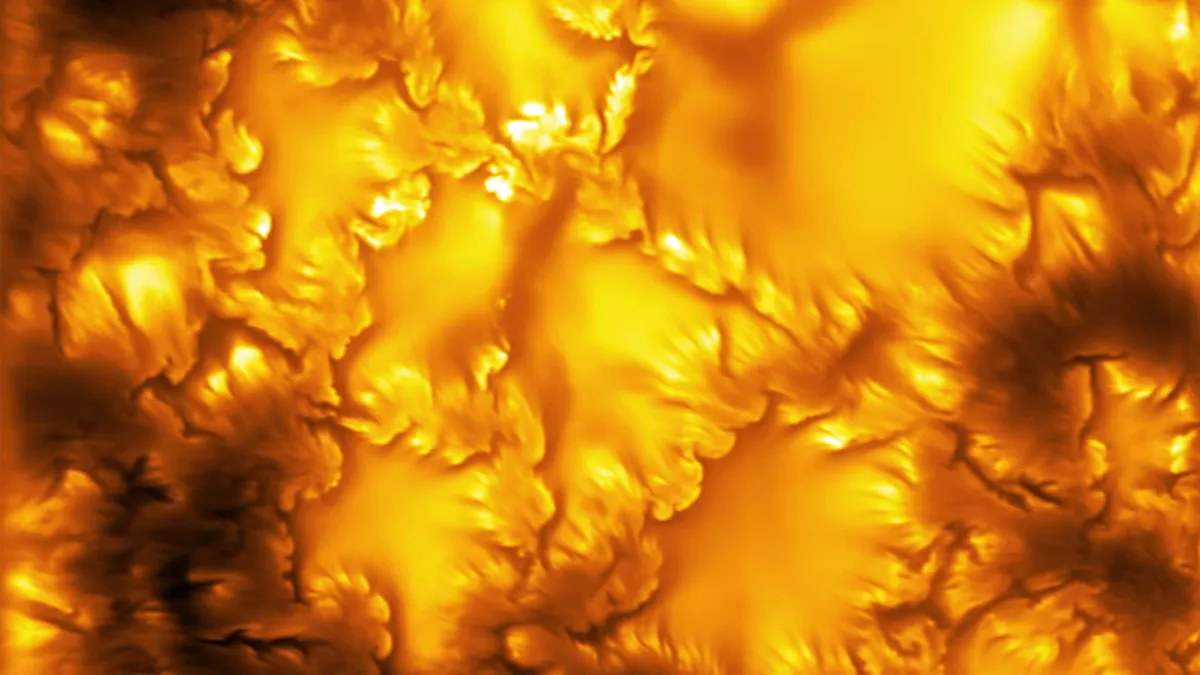
The sharpest images ever obtained of the solar photosphere have revealed magnetized Kelvin–Helmholtz vortices at scales as small as 19 kilometers.
Researchers from the National Solar Observatory and the Max Planck Institute for Solar System Research used the four-meter Daniel K. Inouye Solar Telescope in Hawaii to observe an active region near a sunspot. The results were published in Nature on August 5, 2026, and provide the first direct confirmation of Kelvin–Helmholtz instability on the Sun’s visible surface.
The discovery matters because these tiny vortices may help transport energy, mass, momentum and magnetic flux, influencing how the energy that powers solar activity is stored and released. A better understanding of these mechanisms could eventually improve models of solar flares, coronal mass ejections and the heating of the solar corona.
What the images revealed
The observations were made on April 14, 2025, in an area near the center of the solar disk containing small dark pores and magnetic concentrations around active region NOAA 14060.
The Inouye Solar Telescope recorded the photosphere at a wavelength of 416 nanometers, achieving a spatial resolution of approximately 19 kilometers. This is the telescope’s theoretical diffraction limit at that wavelength and the highest resolution yet achieved in images of the Sun’s visible surface.
Where previous observations showed relatively smooth and blurred boundaries between magnetic structures and solar granulation, the new images revealed a much more complex environment. The interfaces were filled with fine dark striations and tiny vortices that formed, evolved and disappeared within seconds.
What Kelvin–Helmholtz instability is
Kelvin–Helmholtz instability occurs when neighboring regions of a fluid move at different speeds or in different directions. The velocity difference creates waves along their boundary, which can develop into distinctive rolling vortices.
The phenomenon can be observed in clouds, oceans, planetary atmospheres and various astrophysical environments. On the Sun, possible examples had previously been identified in the corona and in higher atmospheric layers, but not in the photosphere.
Theoretical studies had long predicted that plasma flows around magnetic-flux concentrations could generate the required velocity shear. Direct observation remained difficult because the structures are smaller than the resolving power of most solar telescopes.
Vortices only tens of kilometers across
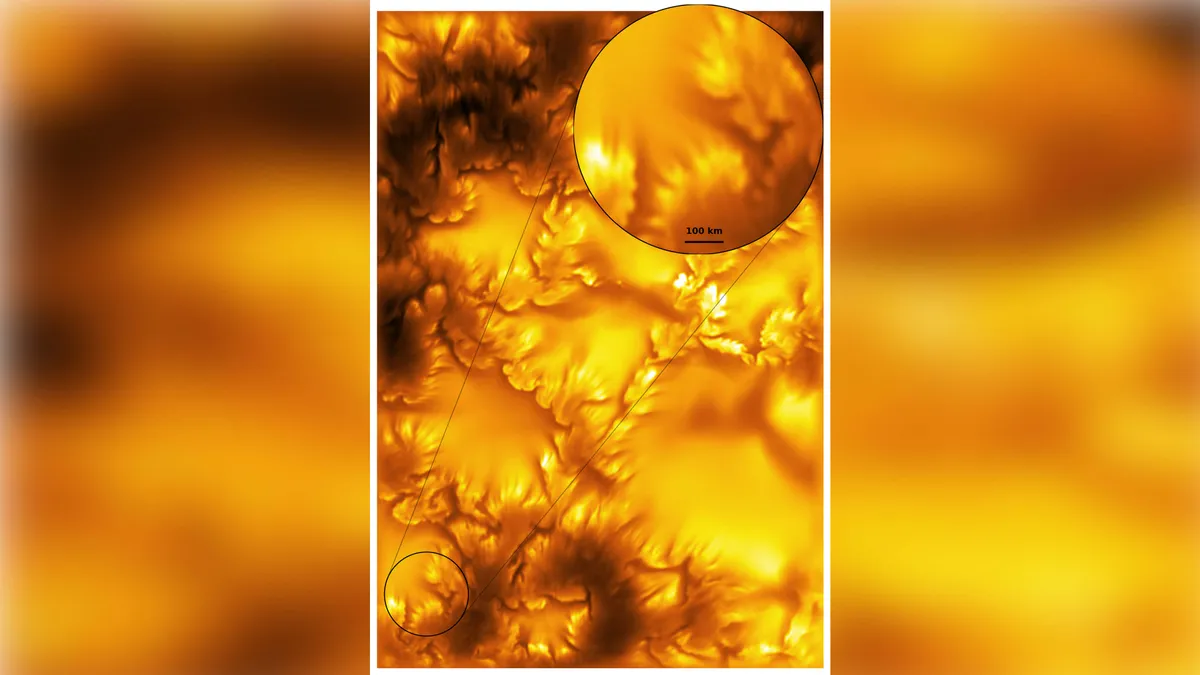
The researchers analyzed 47 vortices within the observed field. The characteristic distance between the structures was approximately 65 kilometers, while their measured sizes ranged from 25 to 170 kilometers.
The vortices traveled along the boundaries of magnetic regions at apparent speeds ranging from 0.67 to 3 kilometers per second. The smallest structures approached the 19-kilometer resolution limit, suggesting that even finer phenomena may remain unresolved.
The observations also showed smaller vortices forming on top of larger ones and neighboring structures merging into more turbulent flows. This behavior is associated with the transfer of energy between different spatial scales within solar plasma.
FastCam and 740 frames per second
The observations used the experimental FastCam system, developed through a collaboration between the National Solar Observatory and the Max Planck Institute for Solar System Research.
The camera recorded a 2K by 1K pixel region at 740 frames per second, with an exposure time of just 100 microseconds, or 1/10,000 of a second. Each pixel represented approximately six kilometers on the solar surface.
The field of view covered an area of approximately 5,800 by 4,350 kilometers, and the analyzed dataset lasted about three minutes. A total of 2,000 calibrated frames were combined to produce each reconstructed scientific image, reducing atmospheric and optical distortions. After processing, the effective interval between reconstructed images was 2.7 seconds.
A discovery that was not planned
The original purpose of the observations was not to search for Kelvin–Helmholtz instabilities, but to test a new diagnostic method for collecting data with the Inouye Solar Telescope.
The appearance of the fine vortices in the material was described by the researchers as a fortunate scientific accident. The original images were captured in grayscale and later colorized during processing to make the plasma structures easier to distinguish.
Simulations confirmed the phenomenon
The team compared the observations with three-dimensional radiative magnetohydrodynamic simulations performed using the MURaM code and a spatial grid spacing of 3.2 kilometers.
The simulations reproduced the striations, vortices and morphology visible in the real images. They also showed horizontal plasma flows producing strong velocity gradients along the edges of powerful, nearly vertical magnetic fields, creating the conditions required for the instability to develop.
The close agreement between the observations and synthetic data provides strong evidence that the structures are not imaging artifacts, but genuine dynamic processes occurring in the photosphere.
The connection to solar activity
Motions at the footpoints of magnetic structures in the photosphere are a major source of free magnetic energy. This energy can be released through electric currents and magnetic reconnection, contributing to phenomena ranging from small brightenings and jets to powerful flares and coronal mass ejections.
Kelvin–Helmholtz vortices may twist and entangle magnetic-field lines on very small scales. This process, known as magnetic-flux braiding, is considered a possible way of storing energy before it is released.
The study does not yet establish how much energy these vortices carry into the Sun’s upper atmospheric layers. It does, however, provide an observable mechanism that can be quantified in future research and incorporated into more complete models of the solar atmosphere.
What we think
This work stands out not only because of its extraordinary resolution, but because it connects direct observations with numerical simulations and a decades-old theoretical prediction. It does not, by itself, solve the problem of coronal heating or immediately enable more accurate space-weather forecasts. It does, however, open a new window onto the smallest processes in the photosphere, where at least part of the Sun’s large-scale activity may begin.
Frequently asked questions
What is the resolution of the new images of the Sun?
The finest resolved structures are approximately 19 kilometers across, corresponding to the theoretical resolution limit of the Inouye Solar Telescope at 416 nanometers.
What are Kelvin–Helmholtz instabilities?
They are vortices that form when neighboring layers of a fluid or plasma move at different speeds, creating waves and rolling structures along their boundary.
How were the images captured?
The researchers used FastCam on the Daniel K. Inouye Solar Telescope at 740 frames per second and an exposure time of 100 microseconds per frame.
Could the discovery improve space-weather forecasting?
The discovery does not provide an immediate new forecasting capability. Quantitative studies of the vortices could, however, help improve models describing the accumulation and release of magnetic energy on the Sun.