

Summary
- NASA’s APOD for September 14, 2026, presents the cosmic origins of the chemical elements
- The hydrogen in our bodies traces its roots to the Big Bang
- Carbon and oxygen were created through nuclear fusion inside stars
- Supernovae and other stellar processes created and dispersed heavier elements
- Neutron star collisions can produce heavy elements such as gold
- The NASA Goddard visualization was released in 2021 and selected as APOD on September 14, 2026
- A periodic table unlike the usual one
- The hydrogen in us comes from the Big Bang
- Carbon and oxygen were born inside stars
- Iron and supernova explosions
- Neutron star collisions and gold
- Some elemental origins are still uncertain
- What “we are made of star stuff” really means
- What we think
- Frequently asked questions
NASA shows through a striking periodic table that the elements in our bodies carry a history beginning with the Big Bang and passing through generations of stars, supernovae and neutron star collisions.
NASA’s Astronomy Picture of the Day (APOD) for September 14, 2026 is titled “Where Your Elements Came From” and presents the main cosmic processes in which the chemical elements now found on Earth — and in the human body — were created.
The image is compelling because it turns the familiar phrase “we are made of star stuff” into an actual map of the origins of matter. Hydrogen traces back to the primordial Universe, while elements such as carbon and oxygen were formed inside stars. Heavier elements are linked to stellar deaths and even more extreme cosmic events.
A periodic table unlike the usual one
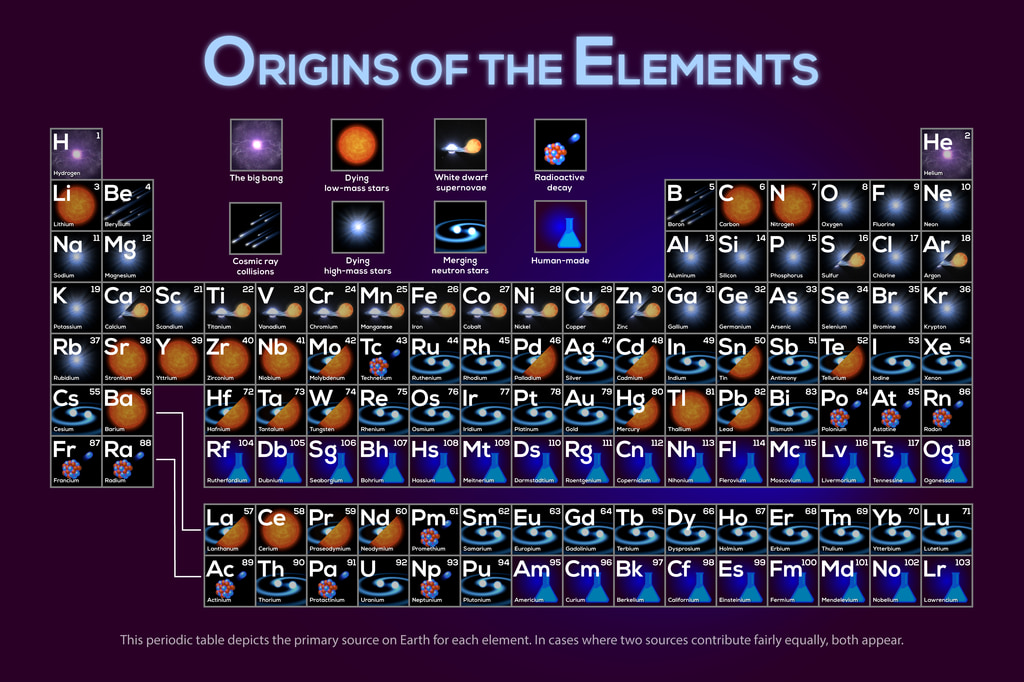
The graphic does more than arrange the elements by atomic number. It uses separate categories to show the main astrophysical processes thought to be responsible for producing them: the Big Bang, dying low- and high-mass stars, white dwarf supernovae, merging neutron stars, cosmic rays, radioactive decay and human-made elements.
The NASA Goddard Scientific Visualization Studio graphic was originally released on July 1, 2021 and draws on data compiled by Ohio State University astronomer Jennifer Johnson. NASA explains that the table depicts the primary source on Earth for each element and shows both sources when two contribute fairly equally.
The hydrogen in us comes from the Big Bang
The cosmic history of the elements begins before stars existed. APOD notes that the hydrogen in the human body — and in every molecule of water — came from the Big Bang, with no other appreciable sources of hydrogen in the Universe.
That does not mean water itself existed in the first moments of the Universe. It means the hydrogen atoms that later combined with oxygen have primordial origins. It is a striking example of how different the “ages” of the ingredients in a single molecule can be.
Carbon and oxygen were born inside stars
The carbon and oxygen in our bodies have a different history. They were created through nuclear fusion inside stars, where extremely high temperatures and pressures allow lighter atomic nuclei to form heavier ones.
When earlier generations of stars reached the ends of their lives, some of these elements were dispersed into space. Enriched gas and dust later became part of new stars and planets, including the Solar System.
Iron and supernova explosions
APOD states that much of the iron in our bodies was produced during supernovae from stars that exploded long before Earth formed. Iron is a characteristic example of how the chemistry of the human body is connected to violent stages of stellar evolution.
The full picture of cosmic nucleosynthesis is more complex than a simple “one element — one source” mapping. Different types of stars and explosions can contribute in different proportions, something the table itself reflects.
Neutron star collisions and gold
Some heavier elements require even more extreme conditions. NASA points to gold as a characteristic example, saying it was likely produced to a significant degree during neutron star collisions.
Such mergers can be accompanied by short-duration gamma-ray bursts and gravitational waves. At the same time, the precise contribution of different astrophysical sources to the production of some heavy elements remains an active area of research.
Some elemental origins are still uncertain
NASA itself emphasizes in the APOD explanation that for some elements, including copper, the exact sites and mechanisms of nuclear creation are not fully known. Observational and computational work continues to refine how much each cosmic process contributes.
That is also the key limitation of the impressive graphic: it is a scientific map of the best current understanding, not a permanent and final catalogue.
What “we are made of star stuff” really means
The phrase is not merely poetic. Many of the atoms that make up the human body were produced in earlier generations of stars and recycled through interstellar material before becoming part of the matter from which Earth formed.
What makes the story remarkable is that it has no single starting point. The same body contains hydrogen rooted in the primordial Universe and heavier elements that required entire stellar life cycles and violent cosmic events to form.
What we think
The choice of this visualization as Astronomy Picture of the Day is a strong example of how a powerful visual can make a complex scientific idea immediately understandable. The key point is not only that “we are made of star stuff,” but that different elements in our bodies carry different cosmic histories — from the birth of the Universe to some of the most violent explosions and collisions we know.
Frequently asked questions
Is the human body really made of material from stars?
Yes. Elements such as carbon and oxygen were produced through nuclear processes in earlier generations of stars and later became part of the material from which the Solar System formed.
Which element in our bodies came from the Big Bang?
Hydrogen is the clearest example. The hydrogen in our bodies and in water has primordial cosmic origins.
How were carbon and oxygen created?
Through nuclear fusion inside stars, where lighter nuclei can combine to form heavier elements.
Where is gold created?
Neutron star collisions are an important known source of heavy elements such as gold, although the exact contribution of different cosmic events is still being studied.
Is the image selected by NASA new?
No. The NASA Goddard visualization was originally released in 2021 and was selected as Astronomy Picture of the Day on September 14, 2026.