

Summary
- The photograph was taken on July 22, 2026, in British Columbia.
- Wildfire smoke made the Sun appear deep red.
- Several sunspots, including active region AR 4493, are visible.
- NASA reminds observers that looking directly at the Sun remains unsafe.
- The Sun will truly become red only when it evolves into a red giant in about six billion years.
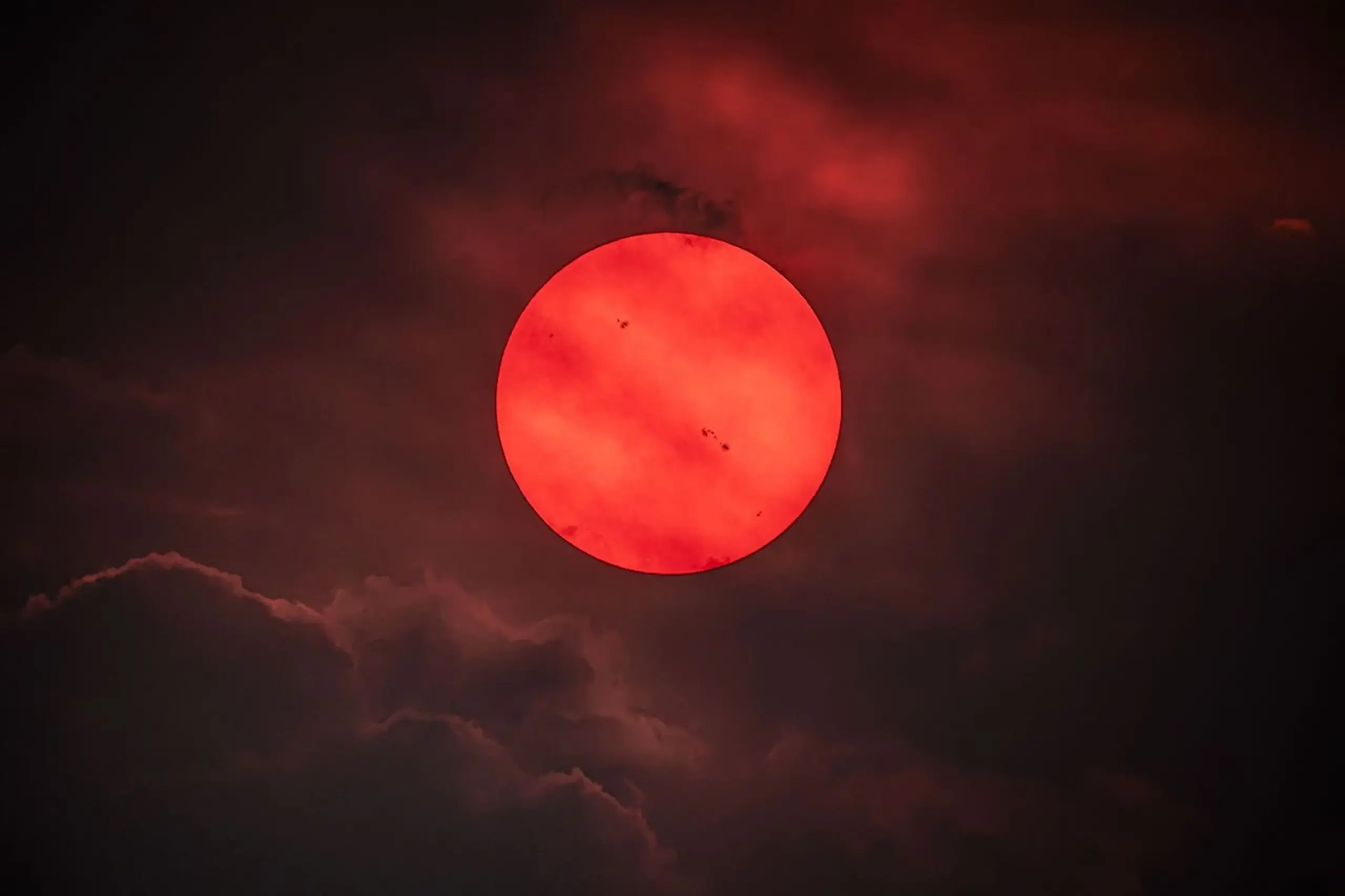
NASA’s Astronomy Picture of the Day features a striking image of the Sun appearing deep red because of wildfire smoke over western Canada.
On July 22, 2026, astrophotographer Debra Ceravolo captured the Sun from the Okanagan region of British Columbia. Dense wildfire smoke from the Pacific Northwest acted as a natural solar filter, allowing the solar disk to be photographed directly while revealing several sunspots.
The image was selected as NASA’s Astronomy Picture of the Day for July 30, 2026, highlighting both an impressive atmospheric phenomenon and ongoing solar activity.
Why the Sun appears red
Wildfire smoke contains tiny particles that scatter and absorb blue light more efficiently than red light. As a result, the sunlight reaching observers becomes dimmer and noticeably redder.
The same process often produces more vivid sunrises and sunsets when smoke or airborne particles are present in the atmosphere.
NASA also reminds observers that it is never safe to look directly at the Sun without proper protection, even when smoke makes it appear dimmer.
The visible sunspots
Several sunspots are visible in the photograph. The most prominent is active region AR 4493, located slightly below and to the right of the center of the solar disk.
According to NASA, it was a rapidly evolving giant active region and one of the most significant sunspot groups visible at the time.
A view resembling an exoplanet sky
The deep red appearance of the Sun resembles what might be seen from an exoplanet orbiting a red dwarf star.
In reality, however, this is our own Sun, whose appearance was temporarily altered by Earth’s atmosphere.
The Sun’s distant future
NASA notes that in about six billion years the Sun will actually begin to turn red as it enters its red giant phase.
This future stellar evolution is completely different from the temporary visual effect caused by wildfire smoke today.
What we think
This image demonstrates how atmospheric conditions on Earth can create spectacular astronomical photographs without changing the Sun itself. It also serves as an important reminder about safe solar observing while showcasing the beauty of astrophotography.
Frequently Asked Questions
Why did the Sun appear red?
Wildfire smoke scattered blue light more efficiently, allowing predominantly red light to reach observers.
What is AR 4493?
It is a large, rapidly evolving active solar region containing a prominent group of sunspots.
Is it safe to look at the Sun through wildfire smoke?
No. Direct solar observation without proper eye protection remains dangerous.
Will the Sun really become red?
Yes. It is expected to become a red giant in about six billion years.