

Summary
- NASA featured a circumhorizontal arc photographed in West Virginia
- The image was captured in 2021 near North Fork Mountain by Christa Harbig
- The phenomenon is produced by sunlight refracting through hexagonal ice crystals
- The Sun must be at least 58 degrees above the horizon
- The photograph was selected as the Astronomy Picture of the Day for August 2, 2026
A striking atmospheric phenomenon over West Virginia was selected by NASA as the Astronomy Picture of the Day for August 2, 2026.
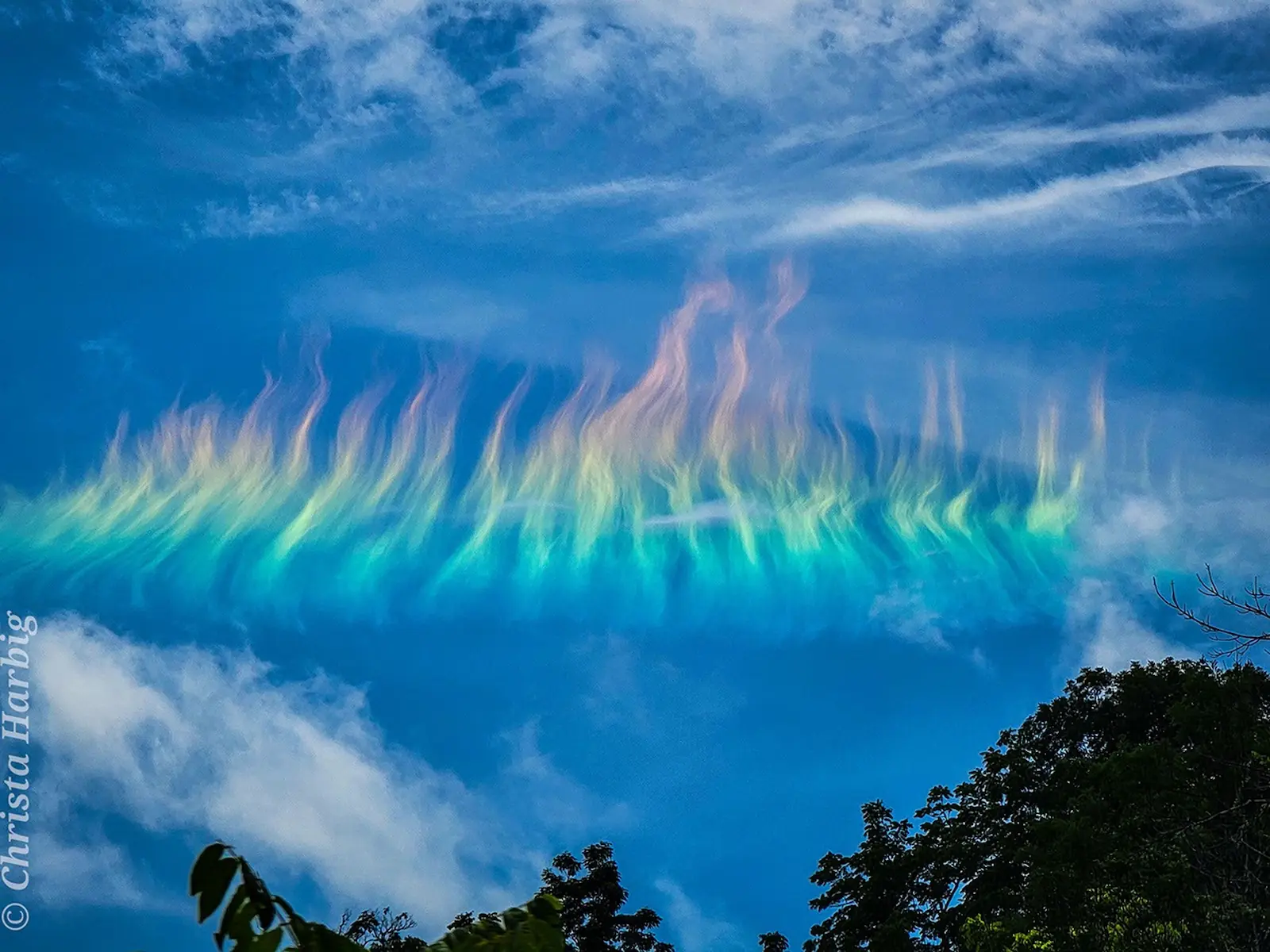
The image shows a circumhorizontal arc, informally known as a “fire rainbow,” formed within thin cirrus clouds and appearing almost parallel to the horizon. The photograph was captured in 2021 near North Fork Mountain in West Virginia, with NASA crediting Christa Harbig for the image.
The phenomenon is particularly interesting because it is not an ordinary rainbow. It is an optical effect that requires a very specific position of the Sun, suitable clouds and horizontally aligned ice crystals.
What is a “fire rainbow”?
The term “fire rainbow” is used because of the phenomenon’s appearance, as its colorful bands can resemble flames stretching across a cloud. However, it is related neither to fire nor to the conventional rainbow produced by water droplets.
Its scientific name is circumhorizontal arc. It is a colorful optical arc that appears parallel to the horizon when sunlight is refracted through ice crystals in high-altitude clouds.
The role of ice crystals
According to NASA’s explanation, ice crystals inside the distant cirrus cloud act like tiny floating prisms. To produce the colorful effect, they must be flat, hexagonal and aligned almost horizontally.
When many of these crystals share a similar orientation, they refract sunlight in a similar way. Different wavelengths are deflected at different angles, separating the colors and producing the distinctive luminous band.
The required conditions
The position of the Sun is a critical factor. For a circumhorizontal arc to become visible, the Sun must be at least 58 degrees above the horizon.
Cirrus clouds must also be present in a suitable position. In this case, the cloud type was cirrus fibratus, consisting of thin, fibrous formations made from ice crystals. The need for all these conditions to occur simultaneously explains why the phenomenon is not frequently observed.
The photograph in West Virginia
The photograph presented by NASA was captured in 2021 near North Fork Mountain in West Virginia, United States. In the image, the colorful arc stretches through a thin cloud, while the blue sky and dark treetops strengthen the visual contrast.
Christa Harbig’s photograph was selected as the Astronomy Picture of the Day for August 2, 2026. The APOD publication also lists Robert Nemiroff, Jerry Bonnell, Cecilia Chirenti and Keighley Rockcliffe among its authors and editors.
What we think
This image is a clear example of how simple natural elements, such as ice and sunlight, can produce a highly complex optical effect. At the same time, the scientific explanation behind the striking term “fire rainbow” helps prevent misconceptions about the phenomenon’s true nature.
Frequently asked questions
Is it a real rainbow?
No. A circumhorizontal arc is produced when sunlight is refracted through hexagonal ice crystals, while an ordinary rainbow forms in water droplets.
Why is it called a “fire rainbow”?
The informal name comes from the intense colors and their shape, which can resemble flames inside a cloud.
How high must the Sun be?
The Sun must be at least 58 degrees above the horizon, allowing its light to enter properly aligned ice crystals at the required angle.
Where and when was the photograph taken?
The photograph was captured in 2021 near North Fork Mountain in West Virginia, United States.