

Summary
- The August 12, 2026 total solar eclipse was captured by Meteosat-12.
- The Moon’s central shadow was about 290 kilometers wide as it moved across the Atlantic and Europe.
- Maximum totality lasted 2 minutes and 18 seconds.
- The next total solar eclipse will take place on August 2, 2027.
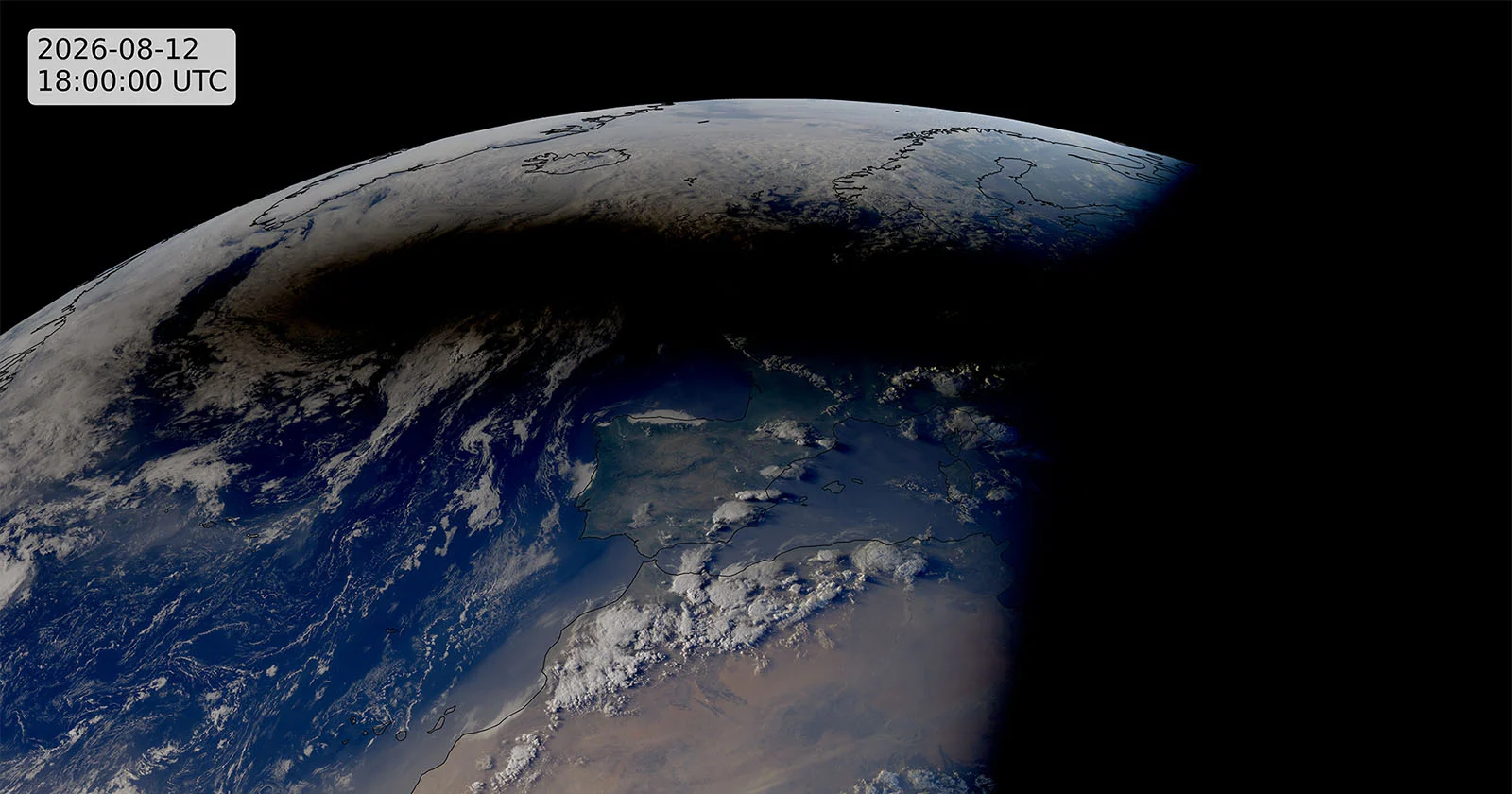
The August 12, 2026 total solar eclipse was captured from space, revealing the Moon’s enormous shadow as it moved across the Atlantic and Europe.
The eclipse was total across parts of Greenland, Iceland, Spain and a portion of Portugal, with EUMETSAT’s Meteosat-12 ideally positioned to follow its progress from geostationary orbit.
The satellite view provides a scale that is impossible for an observer on the ground to perceive, showing the Moon’s shadow itself traveling across vast areas of Earth rather than focusing only on the darkened Sun.
The eclipse from 35,786 kilometers above Earth
Meteosat-12 is primarily used by EUMETSAT to monitor weather and climate. On August 12, however, it also recorded a striking astronomical event as the Moon’s shadow passed over the planet.
The satellite is in geostationary orbit, approximately 35,786 kilometers above Earth, and continuously monitors Europe and northern Africa. This stable perspective allowed it to capture the eclipse on a planetary scale.
A dark band about 290 kilometers wide
The darkest central part of the Moon’s shadow, known as the umbra, was about 180 miles, or approximately 290 kilometers, wide.
Only locations inside this relatively narrow band saw the Sun become completely covered. Across a much larger area surrounding the umbra, observers experienced a partial eclipse.
The duration of totality varied significantly along the eclipse path. Maximum totality reached 2 minutes and 18 seconds, while at Station Nord in Greenland the total phase lasted just 16 seconds.
Earth darkens from above
From the ground, a total solar eclipse is primarily associated with the sight of the Sun being covered by the Moon and the appearance of the solar corona.
From space, however, the view changes completely. The dominant feature becomes the large dark region moving across clouds, oceans and continents as the Moon passes between the Sun and Earth.
This perspective makes it possible to understand not only the scale of the shadow but also how quickly it travels across different regions of the planet.
Images from the ground
At the same time, photographers in different parts of Europe captured the event from Earth’s surface.
Their images included both wide-angle views of the landscape during totality and close-up photographs of the Sun, with details such as solar prominences visible.
Comparing ground-based photographs with the satellite view reveals two completely different scales of the same event: from fine details around the solar disk to the Moon’s shadow covering areas hundreds of kilometers across.
The next total eclipse comes in 2027
The next total solar eclipse will take place on August 2, 2027.
Its path of totality will once again cross Spain before continuing across parts of northern Africa, Saudi Arabia and Yemen.
Because of its geostationary position and the region it monitors, Meteosat-12 is expected to be favorably positioned to observe part of that eclipse as well.
What we think
Images from space transform a total solar eclipse from a local celestial spectacle into an event on a planetary scale. Ground-based photographs remain invaluable for capturing solar detail and the experience of totality, but satellite observations offer something different: the ability to watch the Moon’s shadow travel across Earth itself.
Frequently asked questions
When did the 2026 total solar eclipse occur?
The total solar eclipse took place on August 12, 2026, and was visible as a total eclipse from parts of Greenland, Iceland, Spain and Portugal.
Which satellite captured the eclipse?
EUMETSAT’s Meteosat-12 captured the Moon’s shadow as it moved across Earth.
How large was the Moon’s central shadow?
The darkest part of the shadow, known as the umbra, was approximately 290 kilometers wide.
How long did totality last?
Maximum totality lasted 2 minutes and 18 seconds, although it was significantly shorter at some locations.
When is the next total solar eclipse?
The next total solar eclipse will take place on August 2, 2027, with its path crossing Spain, northern Africa, Saudi Arabia and Yemen.