

Summary
- Samba and Tango were photographed and filmed during their reentries over the South Pacific
- The airborne ROSIE mission observed each event for about 50 seconds
- The pilot banked the aircraft during Tango’s reentry to keep it in the instruments’ field of view for longer
- Twenty-nine of the 30 scientific instruments recorded both reentries
- A Nikon Z8 was used as a tracking camera, but the photographic system was only one part of a much larger scientific setup
- A photographic shoot that began long before the subject appeared
- The goal was not a “beautiful photograph”
- The camera was one of the tools, not the story
- The images of Samba, Tango and the aircraft
- When the pilot becomes part of the camera team
- Thirty instruments were watching the same event
- Lessons from Salsa improved the second campaign
- What we think
- Frequently asked questions
Two satellites breaking apart in Earth’s atmosphere were photographed and filmed from a moving aircraft over the South Pacific, in a shoot where the main challenge was not simply pressing the shutter but having the camera aimed at exactly the right part of the sky at exactly the right second.
ESA’s Cluster satellite Samba reentered on August 31, 2026, at 21:39:38 UTC, followed by Tango on September 1 at 21:30:31 UTC, roughly 24 hours later. Both descents had been targeted over a remote part of the South Pacific so the ROSIE airborne mission could observe them from an aircraft operating from Tonga.
For photography and video, the fascination lies in the extreme conditions of the shoot: a unique event lasting only seconds, an object fragmenting while moving at enormous speed, cameras positioned behind aircraft windows and almost no opportunity for a second attempt. The team ultimately managed to observe the two satellites for about 50 seconds on average.
A photographic shoot that began long before the subject appeared
In a conventional shoot, a photographer can move, change angle or wait for the subject. Here, essentially the opposite happened: the trajectory of the subject determined where the entire aircraft had to be.
ESA had modified the trajectories of Samba and Tango so their reentries would occur within a limited region of the Pacific. For Samba, the final prediction proved accurate to the second, while shortly before Tango’s reentry the remaining uncertainty had been reduced to around ±1 second. For an airborne photographic operation, that level of precision is what turns an almost impossible subject into something that can actually enter the frame.
The goal was not a “beautiful photograph”
ROSIE’s tracking cameras primarily had a scientific job. They had to confirm that the spacecraft was where it was expected to be, record the environment around it and, crucially, show how fragments separated from the main body and how their relative positions changed.
That makes the frames particularly interesting from a photographic perspective. Composition was not designed around aesthetic criteria; the wider field itself was part of the data. Researchers needed enough space around the bright object to follow the fragmentation cloud and correlate what appeared in the image with measurements from the other instruments.
The camera was one of the tools, not the story
At one of the aircraft’s tracking stations, the University of Stuttgart’s HEFDiG team used a Nikon Z8 as a tracking camera. The same camera recorded more than 50 seconds of Samba’s reentry, with dozens of luminous fragments appearing around the main spacecraft.
The specific camera model, however, is not the most important part. It was one component of a much larger measurement system, and its job was to provide visual context for the scientific data. ESA says multiple tracking cameras were involved, while their imagery was complemented by other instruments monitoring materials as the spacecraft broke apart.
The images of Samba, Tango and the aircraft
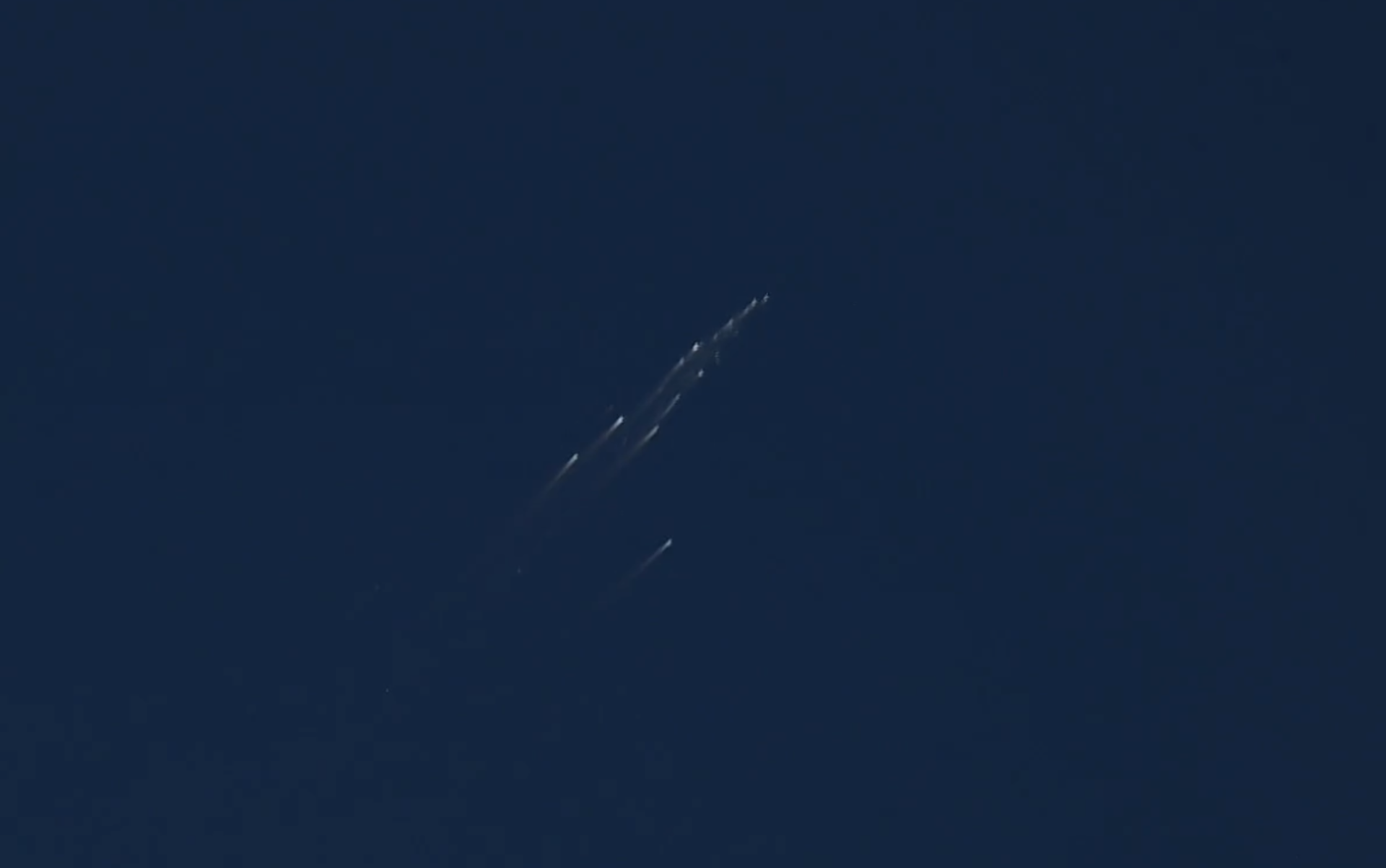
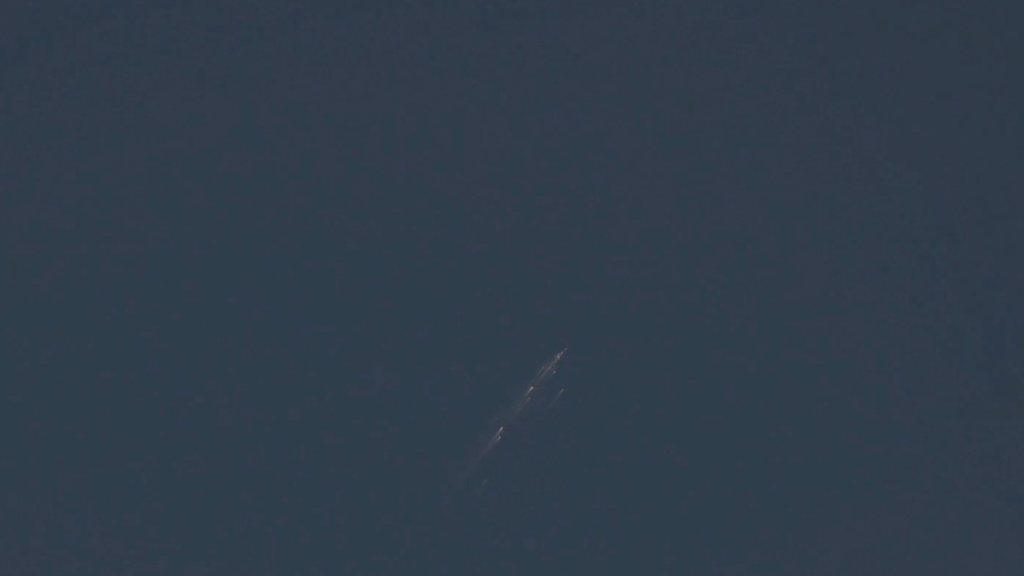
The Samba image shows multiple luminous trails and fragments travelling around the main object. ESA says the new footage revealed dozens of fragments, significantly more than the few brightest pieces captured during the comparable Salsa airborne observation in 2024.
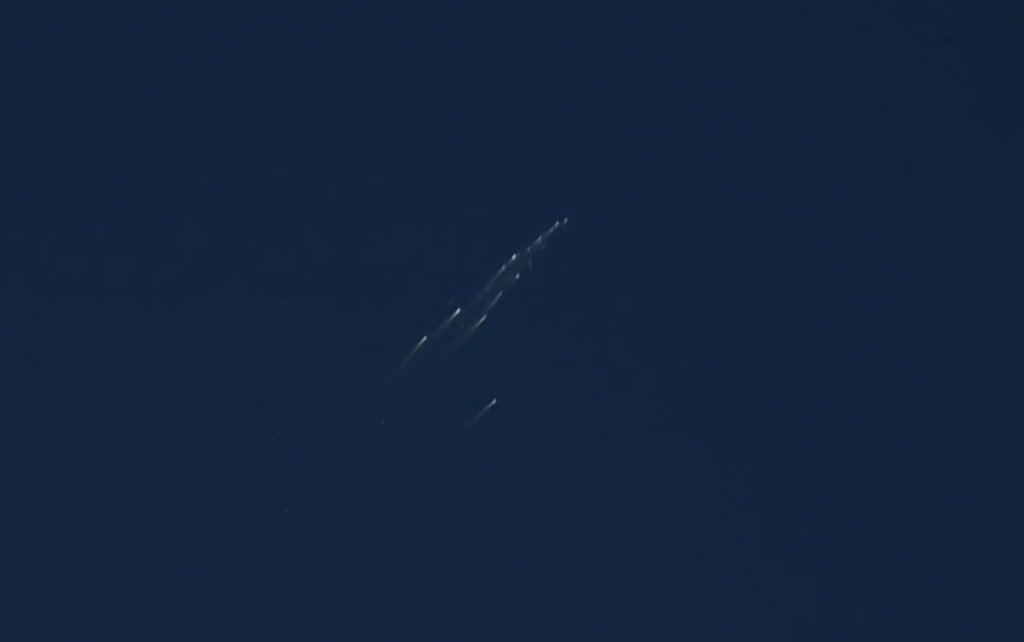
The Tango image similarly shows the luminous sequence of fragments during its final descent. This frame was also acquired at Station 3 aboard the aircraft as part of the same observation campaign.
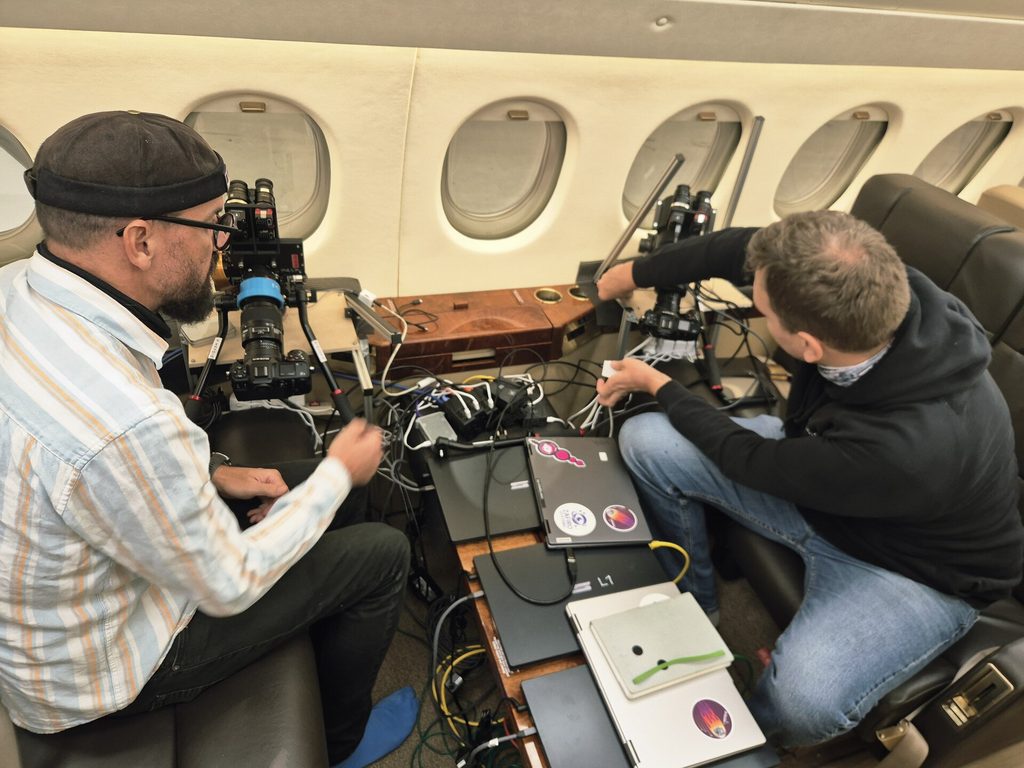
The installation itself shows how different this was from conventional aerial photography: cameras, optical systems, computers and cabling were positioned in front of the windows, effectively turning the cabin into a mobile observatory.
When the pilot becomes part of the camera team
During Tango’s observation, another factor entered the equation that is rarely part of a photographic assignment: the orientation of the entire aircraft was used to extend the shot.
As Tango moved through the field of view, the pilot banked the aircraft at the right moment so the luminous object remained visible to the instruments for a few additional seconds. In an event offering only around 50 seconds of useful observation, those extra seconds have real value.
Thirty instruments were watching the same event
Photographic imaging was only one layer of the mission. A total of 30 scientific instruments were aboard the aircraft, and 29 managed to record both reentries. They included visual and infrared cameras, while other instruments collected spectral data to identify characteristic signatures of materials as they heated, melted and broke apart.
The video and photographs therefore do more than provide dramatic documentation. They act as the temporal and spatial reference against which the rest of the measurements can be aligned: which fragment appeared when, where it was relative to the main body and which materials were detected at the same moment.
Lessons from Salsa improved the second campaign
ROSIE had already tested the same basic concept during Salsa’s reentry in 2024. That first campaign produced valuable lessons for both the science and the imaging. For the 2026 campaign, teams refined trajectory prediction, instrument configuration and target tracking, resulting in clearly more visible fragments and a longer useful observation period.
Before the reentries, PTTL had covered the preparations for the Samba and Tango airborne observation campaign, when roughly 30 instruments were still waiting for their final rendezvous above the ocean. The result now shows what it means in practice to plan an entire flight around just a few dozen seconds of photographic and scientific observation.
What we think
The fascinating part of this story is not that one particular camera body managed to record the footage. It is that photography was used in its most literal form as an observational tool: it had to capture a unique, extremely fast and unrepeatable event from a moving platform, while every second and every fragment carried scientific value. It is an excellent example of technical imaging sitting simultaneously between photography, documentation and measurement.
Frequently asked questions
How long did the photographic observation last?
ESA says Samba and Tango were observed for about 50 seconds on average. In Samba’s case, one of the tracking cameras recorded more than 50 seconds of footage.
Why were the cameras aboard an aircraft?
The reentries took place over a remote part of the South Pacific. An aircraft could carry the instruments directly into the region offering the best line of sight, something that would not have been practical from a fixed ground location.
Which camera was used?
ESA has confirmed that a Nikon Z8 was operated by the University of Stuttgart’s HEFDiG team at Station 3 as a tracking camera. It was one of several cameras and scientific instruments in the overall installation.
Do we know the lens and exposure settings?
No. The available published information does not specify lens, focal length, aperture, ISO or shutter speed for the released frames.
Why is the photographic material scientifically useful?
It allows researchers to follow the breakup sequence, the number and relative position of fragments, and combine that visual information with spectral and other measurements from the remaining instruments.