

Summary
- James Webb detected water and oxygen-rich dust in the envelope surrounding the evolved star IRS 3.
- IRS 3 lies about 0.55 light-years from Sagittarius A* and has an envelope extending roughly 10,000 astronomical units in radius.
- MIRI data showed that the star is oxygen-rich, overturning earlier indications that it might be carbon-rich.
- The discovery shows that dust and molecular material can still form and survive in the extreme environment of the Galactic Centre.
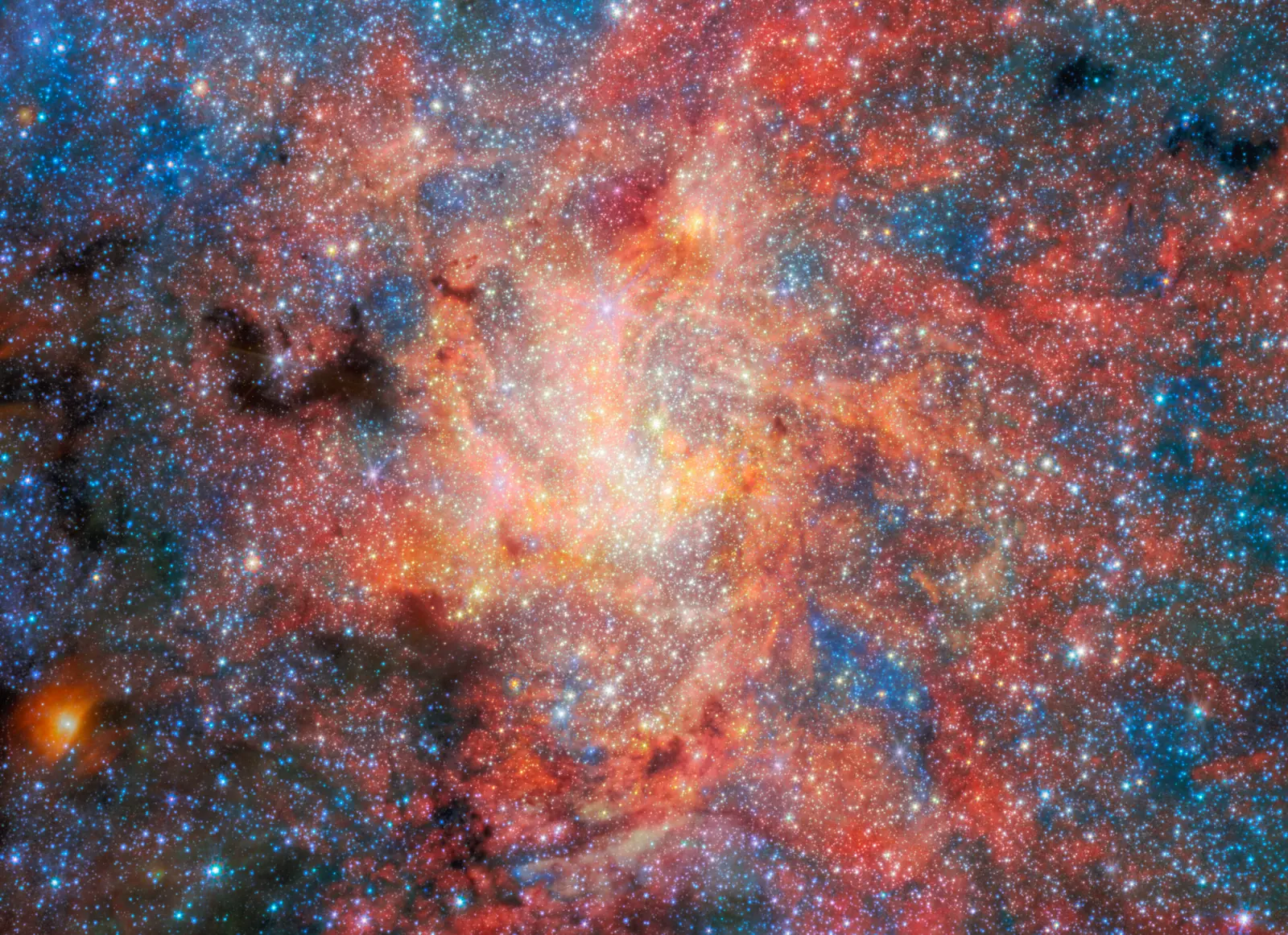
The James Webb Space Telescope has detected water and oxygen-rich dust around the evolved star IRS 3, just 0.55 light-years from Sagittarius A*, the supermassive black hole at the centre of the Milky Way.
An international team of astronomers used the NASA/ESA/CSA James Webb Space Telescope to study IRS 3 and found that the star continues to create and inject dust and molecular material into its surroundings despite the intense radiation found so close to Sagittarius A*. For the first time, water has been clearly detected in the star’s extended envelope.
The discovery is important because it demonstrates that evolved stars can continue enriching interstellar material even in the extreme environments of galactic centres. Dust and molecules expelled by such stars provide material that can later contribute to new generations of stars and planetary systems.
A star just 0.55 light-years away
IRS 3 lies at a projected distance of about 0.17 parsecs, or 0.55 light-years, from Sagittarius A*, the supermassive black hole at the centre of the Milky Way. It is one of the strongest infrared sources in the region, and its remarkable dusty envelope has made it a particularly interesting target for astronomers.
The star is on the asymptotic giant branch, known as the AGB phase, an advanced stage of stellar evolution. During this phase, stars become large, relatively cool and highly luminous, while powerful stellar winds continuously carry gas and dust away from their outer layers.
Based on the observations and stellar modelling, researchers estimate that IRS 3 has a mass of approximately six times that of the Sun and an age of around 72 million years. It is also undergoing intense mass loss, which is feeding the enormous envelope surrounding it.
Webb changed the chemical identity of IRS 3
Earlier studies had left open the possibility that IRS 3 was carbon-rich. Webb’s spectrum, however, revealed two strong features associated with silicate dust, which is composed of silicon and oxygen. The new data therefore identify IRS 3 as an oxygen-rich evolved star.
Webb’s Mid-Infrared Instrument, MIRI, played a decisive role. For the first time, a continuous mid-infrared spectrum of this particular star was obtained, allowing scientists to distinguish the signatures of dust and molecules more clearly. The scientific study reports coverage from 4.9 to 27.9 micrometres with MIRI’s Medium Resolution Spectrometer.
An enormous dusty envelope
By combining Webb’s spectrum with radiative-transfer simulations of different possible envelope structures, researchers reconstructed the distribution of dust around IRS 3. Their results indicate a layered, shell-like structure extending to a radius of roughly 10,000 astronomical units.
The temperature of the dust changes dramatically with distance. Close to the star it reaches about 1,200 Kelvin, while in the outer regions of the envelope it drops to around 100 Kelvin. The study’s models include warmer inner regions followed by progressively cooler shells dominated mainly by silicate material.
The first clear detection of water around IRS 3
The most striking result was the presence of water within the envelope of IRS 3. This is the first clear detection of water in this object and demonstrates that molecular material can remain detectable even within the intense radiation environment of the Galactic Centre.
The finding does not mean that water was detected inside the black hole or immediately next to its event horizon. The water exists in material surrounding IRS 3, which lies about 0.55 light-years in projected distance from Sagittarius A*. This distinction is important when interpreting the result.
Why the discovery matters for the life cycle of matter
AGB stars are major sources of cosmic dust. As they lose their outer layers, they return elements and compounds to the interstellar medium that can later be incorporated into new generations of stars and planets. Until now, it was unclear how effectively this process could continue in the exceptionally harsh environment around a supermassive black hole.
IRS 3 demonstrates that at least some evolved stars can continue producing and expelling dust within the Milky Way’s inner parsec. This supports the idea that the recycling of stellar material does not necessarily stop in galactic centres because of their intense radiation.
The MICONIC observations
The observations were obtained in 2025 as part of the Guaranteed Time Observations programme MICONIC, Mid-Infrared Characterisation of Nearby Iconic galaxy Centres, using Webb’s MIRI instrument. The scientific paper, led by Florian Peißker of the University of Cologne, was published in Astronomy & Astrophysics.
ESA’s Macarena García Marín, a co-author of the study and principal investigator of the MICONIC programme, highlights that the continuous mid-infrared spectral coverage made it possible to clarify the star’s true chemical nature and identify the characteristics of its silicate grains.
Webb is an international partnership between NASA, ESA and the Canadian Space Agency. ESA contributed, among other elements, the NIRSpec spectrograph and 50% of MIRI through a European consortium working with JPL and the University of Arizona.
What we think
The most important aspect of the discovery is not simply the presence of water, but the evidence that dust production and molecular survival can continue in one of the Milky Way’s most extreme stellar environments. Webb also provides a striking example of how spectroscopy can change even the basic classification of a familiar object, turning IRS 3 from a source with an uncertain chemical nature into a much better understood laboratory for studying the recycling of matter near a supermassive black hole.
Frequently asked questions
How close is IRS 3 to Sagittarius A*?
Its projected distance is approximately 0.17 parsecs, or about 0.55 light-years. On astronomical scales it is very close to the Galactic Centre, although it is not located next to the black hole’s event horizon.
What exactly did James Webb detect?
Webb recorded signatures of oxygen-rich silicate dust and the first clear evidence of water in the extended envelope surrounding IRS 3.
Why is the presence of water interesting?
The Galactic Centre is characterised by intense radiation. The detection shows that molecular material can survive within the dense, protected environment of a stellar envelope even under these conditions.
What does it mean that IRS 3 is oxygen-rich?
It means that the chemistry of the star and its envelope favours materials such as silicate grains. The new observations overturn earlier indications that had suggested the star might instead be carbon-rich.
Was water found in the black hole?
No. The water was detected in the envelope of IRS 3, a star located about 0.55 light-years in projected distance from Sagittarius A*.