

Summary
- NASA’s Chandra detected evidence for a jet from a black hole in a neighboring galaxy
- The jet may be striking the gas cloud around the “red potato” galaxy
- The galaxy is located about 11.7 billion light-years from Earth
- Cold gas is present, but the galaxy is forming fewer new stars than expected
- The study shows how black holes can affect galaxy evolution in the early universe
NASA’s Chandra has revealed evidence that a jet from a black hole may be stirring the gas around an ancient galaxy, limiting the birth of new stars.
The galaxy MQN01 J004131.9-493704, nicknamed the “red potato” because of its appearance in images from the James Webb Space Telescope, lies about 11.7 billion light-years from Earth and appears to be affected by a jet coming from a supermassive black hole in a neighboring galaxy.
The discovery is important because it points to a possible mechanism by which black holes can influence star formation in the early universe, during a period when galaxies and their supermassive black holes were growing rapidly.
A galaxy inside a cosmic “pot” of gas
MQN01 J004131.9-493704 is located in a region where enormous web-like structures of galaxies and gas meet in the early universe. Astronomers targeted the area with Webb because they knew it contains one of the heaviest concentrations of galaxies and growing supermassive black holes yet identified so early in cosmic history.
The galaxy was informally nicknamed the “red potato” because in Webb images it appears as a small, irregular, pale yellow oval with a red outer ring, embedded in a bright, hazy red cloud. Its red appearance is linked to the fact that it mostly contains older and cooler stars, which appear red in optical and infrared data.
Why it is not forming as many stars as expected
Data from the European Southern Observatory’s Very Large Telescope show that the galaxy is surrounded by an enormous cloud of relatively cold gas. Normally, such gas provides the raw material for new stars, as some of it can fall into the galaxy and fuel intense star formation.
Researchers expected the “red potato” to contain large numbers of young stars, as seen in nearby galaxies surrounded by cold gas. Instead, its star formation rate turned out to be relatively low. This led the team to search for what is preventing the gas from reaching the galaxy.
A key clue is that the gas cloud around the galaxy is unusually turbulent compared with large gas clouds surrounding other galaxies. This turbulence may prevent much of the gas from falling onto the “red potato,” depriving it of the material needed to form many new stars.
The role of the black hole in the neighboring galaxy
Using the Chandra X-ray Observatory, astronomers found that a jet of particles from a growing supermassive black hole in a neighboring galaxy is pointed toward the gas cloud around the “red potato.” This jet may be striking the cloud, injecting energy and particles into it and causing the observed turbulence.
The neighboring galaxy lies about 200,000 light-years from the “red potato.” Unlike the red galaxy, it is forming stars very actively, including massive, hot stars, as are most of the other nearby galaxies in the region.
The researchers also considered other possible explanations for the turbulence in the gas, including outbursts from a supermassive black hole at the center of the “red potato” itself or energy from a burst of new star formation. However, they consider these scenarios less likely than the jet from the neighboring black hole.
What the composite image shows
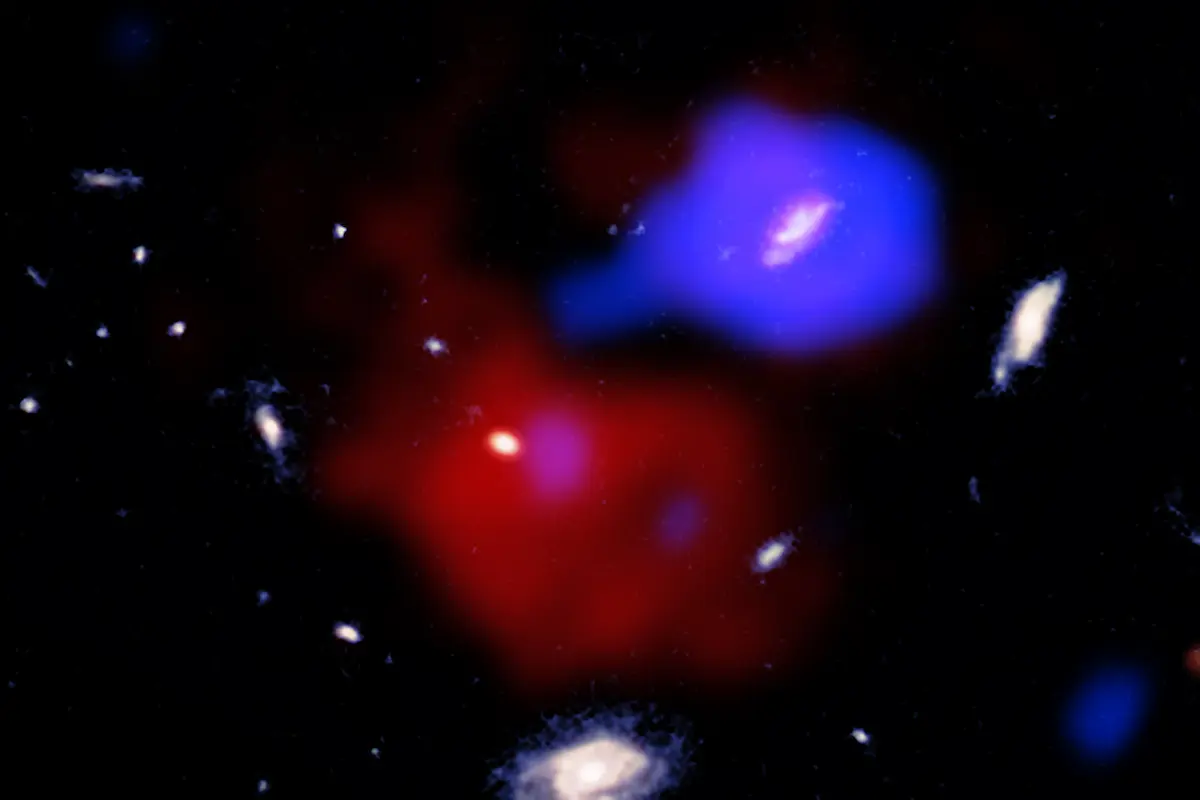
The composite image combines X-rays from Chandra, infrared data from the James Webb Space Telescope and radio data from the Atacama Large Millimeter/submillimeter Array. In the image, X-rays are shown in blue, infrared light in red, green and blue, and radio light in red.
The X-rays reveal the growing supermassive black hole and the jet it has produced. Radio light traces the relatively cold gas in the region, while Webb’s infrared data complete the view of the two galaxies and their environment.
In the image, the “red potato” lies near the center, inside the bright red cloud. To the upper right is the neighboring galaxy, embedded in a pool of blue X-ray haze. The blue emission has a short tail, the X-ray jet, pointing toward the red cloud around the galaxy.
The broad and diffuse appearance of the X-ray source does not mean the entire region is diffuse emission. NASA notes that it is caused by the difference in resolving power between JWST and Chandra, as well as the processing required to show the faint jet. Apart from the jet, the blue emission from the neighboring galaxy is a point source of X-rays.
The technical details of the observation
The image covers about 20 arcseconds, or roughly 500,000 light-years. The galaxy is located in the constellation Phoenix, at J2000 coordinates RA 00h 41m 31.9s and Dec -49° 37´ 3.7″.
Chandra observations were made in 22 separate observations from July 2022 to September 2023. The total observing time was 176 hours, or 7 days and 8 hours, using the ACIS instrument. The Obs. IDs were 25375, 25711-25730 and 27667.
The distance is estimated at about 11.7 billion light-years, with a redshift of z=3.25. The study, led by Weichen Wang of the University of Milan-Bicocca in Italy, is being published in Astronomy & Astrophysics, with DOI 10.1051/0004-6361/202659351.
Researchers including Sebastiano Cantalupo and Andrea Travascio, also from the University of Milan-Bicocca, are involved in the work. Data from the Hubble Space Telescope were also used to support the measurements needed to reveal the galaxy’s red color and low star formation rate.
A rare window into the early universe
This work is one of the few published studies probing the behavior of gas around passive galaxies in the early universe, at distances greater than about 11 billion light-years from Earth.
Astronomers want to understand how galaxies and black holes interact with each other, especially during this critical epoch in cosmic history. The “red potato” offers a rare example in which a galaxy may be starved not because it lacks the raw material, but because energy from a neighboring active galaxy keeps that material stirred up and difficult to use.
NASA’s Marshall Space Flight Center manages the Chandra program, while the Smithsonian Astrophysical Observatory’s Chandra X-ray Center controls science operations from Cambridge, Massachusetts, and flight operations from Burlington, Massachusetts.
What we think
The case of the “red potato” shows how complex galaxy evolution was in the early universe. The presence of cold gas is not enough for new stars to form; the behavior of that gas, energy from neighboring black holes and the environment of the cosmic web can dramatically change a galaxy’s path.
Frequently Asked Questions
What is the “red potato” galaxy?
It is the galaxy MQN01 J004131.9-493704, which received the nickname “red potato” because of its appearance in images from the James Webb Space Telescope.
How far away is it?
It is located about 11.7 billion light-years from Earth, in the constellation Phoenix, with a redshift of z=3.25.
What did Chandra discover?
Chandra found evidence that a jet from a supermassive black hole in a neighboring galaxy may be striking the gas cloud around the “red potato.”
Why is it not forming many new stars?
The cold gas around it appears unusually turbulent, possibly because of the neighboring black hole’s jet. As a result, the gas does not easily fall into the galaxy to fuel intense star formation.
Which telescopes were used?
The study used data from the Chandra X-ray Observatory, the James Webb Space Telescope, the Atacama Large Millimeter/submillimeter Array, the Very Large Telescope and the Hubble Space Telescope.