


Summary
- Hubble observed the spiral galaxy NGC 4654.
- The galaxy lies 72 million light-years away.
- Ram pressure stripping created a long gaseous tail.
- A past encounter with NGC 4639 likely enhanced its asymmetry.
- Despite losing gas, the galaxy continues forming new stars.
The Hubble Space Telescope has captured a strikingly asymmetric spiral galaxy, revealing the extreme forces capable of reshaping galaxies over millions of years.
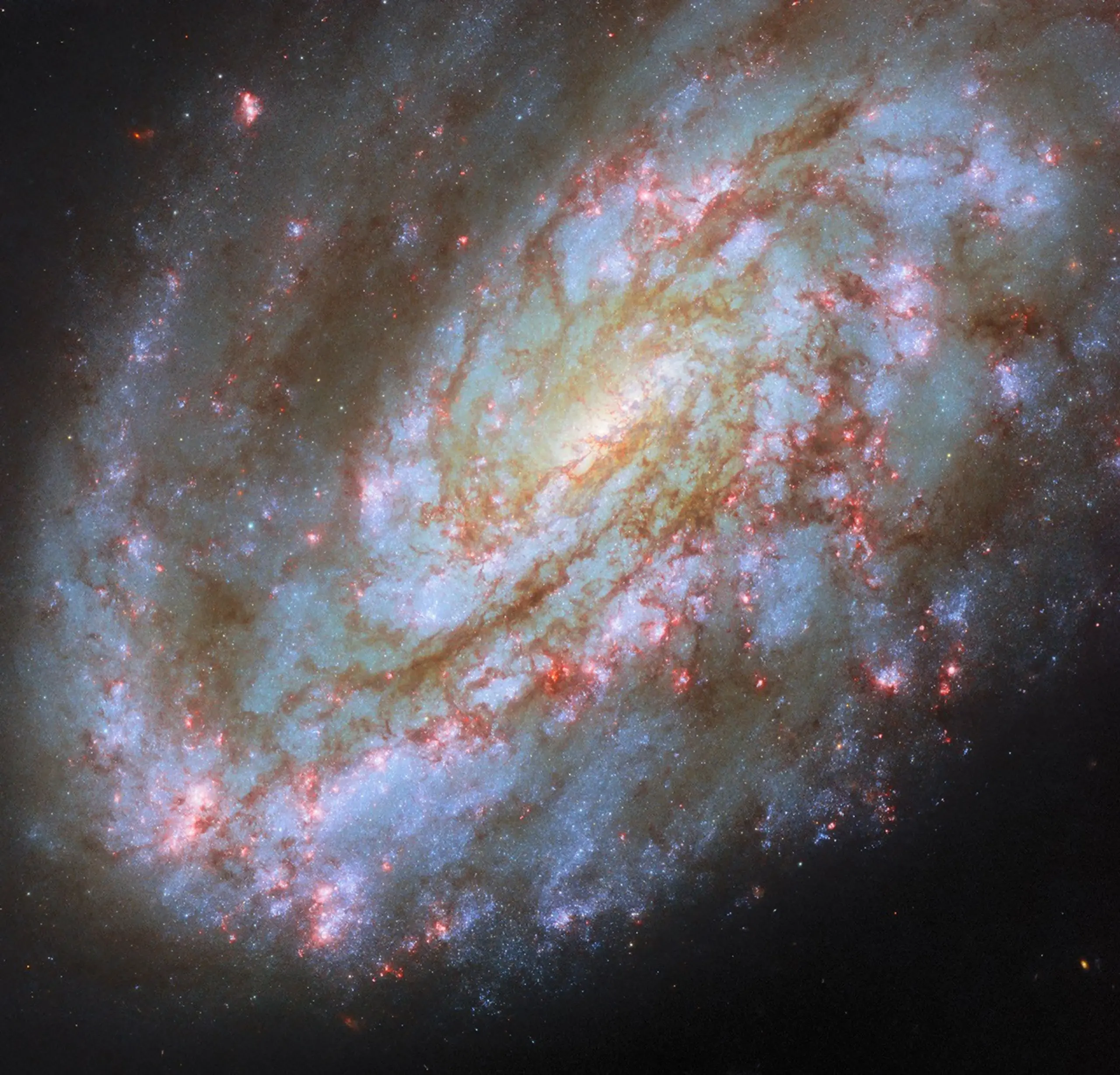
NASA and ESA released a new Hubble image of NGC 4654, an intermediate spiral galaxy located about 72 million light-years from Earth in the Virgo constellation within the Virgo Cluster. One side of the galaxy appears smooth and well-defined, while the opposite side extends into a long tail of gas beyond the image’s field of view.
The observation helps astronomers understand how interactions between galaxies and their surrounding environments influence galaxy evolution and star formation.
Ram pressure stripping at work
The gaseous tail is the result of ram pressure stripping. As NGC 4654 travels rapidly through the hot, diffuse gas between galaxies in the Virgo Cluster, the surrounding medium compresses its leading edge while pushing gas behind it, producing the elongated tail.
More than gas was affected
The galaxy’s stars are also unevenly distributed. One spiral arm is rich in stars and gas, while the opposite arm contains significantly fewer stars.
Astronomers believe ram pressure alone cannot explain this feature. They suggest NGC 4654 also experienced a close flyby with the neighboring galaxy NGC 4639 roughly 500 million years ago. That gravitational interaction likely removed gas from one side of the galaxy, reducing star formation there and creating today’s asymmetric appearance.
Star formation continues
Although many galaxies experiencing ram pressure stripping show declining star formation, NGC 4654 continues producing nearly two solar masses of stars each year.
Bright pink regions visible throughout the Hubble image trace energized gas clouds where new stars are forming, extending across the spiral arm, the weak central bar, and the galaxy’s outer disk.
Studying gas and star formation
The observations come from two Hubble research programs investigating how gas moves through galaxies, when it collapses to form stars and star clusters, and how newborn stars influence their surroundings.
What we think
NGC 4654 is an impressive reminder that galaxies are constantly evolving. Their appearance is shaped by gravity, surrounding gas, and interactions that unfold over hundreds of millions of years.
Frequently Asked Questions
What is NGC 4654?
It is an intermediate spiral galaxy located about 72 million light-years from Earth in the Virgo Cluster.
What is ram pressure stripping?
It is the process by which hot gas between galaxies removes gas from a galaxy moving rapidly through it.
Why is the galaxy asymmetric?
Astronomers believe both ram pressure stripping and a past encounter with NGC 4639 contributed to its unusual shape.
Is the galaxy still forming stars?
Yes. NGC 4654 continues forming nearly two solar masses of stars every year.