

Summary
- Luna 3 captured 29 images of the Moon’s far side on October 7, 1959
- The dual AFA-Ye1 camera used 200 mm and 500 mm lenses with 35 mm film
- The film was developed, fixed, dried and scanned automatically inside the spacecraft
- The analog signal revealed that the far side has far fewer maria and many more craters
- 29 exposures that changed the map of the Moon
- Yenisey: two lenses and 35 mm film
- Film from spy balloons
- An automatic photographic laboratory in space
- From negative to radio signal
- Why the images look so poor
- The discovery hidden beneath the noise
- From the V-2’s steel magazine to a lunar “radio fax”
- What we think
- Frequently asked questions
In 1959, Luna 3 photographed the Moon’s far side for the first time, developed the film inside the spacecraft itself and transmitted the images to Earth as an analog radio signal.
The Soviet spacecraft launched on October 4, 1959, and three days later began a photographic process that had never been attempted before: 29 exposures on 35 mm film of the side of the Moon that cannot be seen from Earth.
The mission’s significance goes beyond the historic first. Without a digital sensor, memory, RAW or JPEG, engineers built a complete analog chain of image capture, chemical processing, optical scanning and radio transmission across hundreds of thousands of kilometres.
29 exposures that changed the map of the Moon
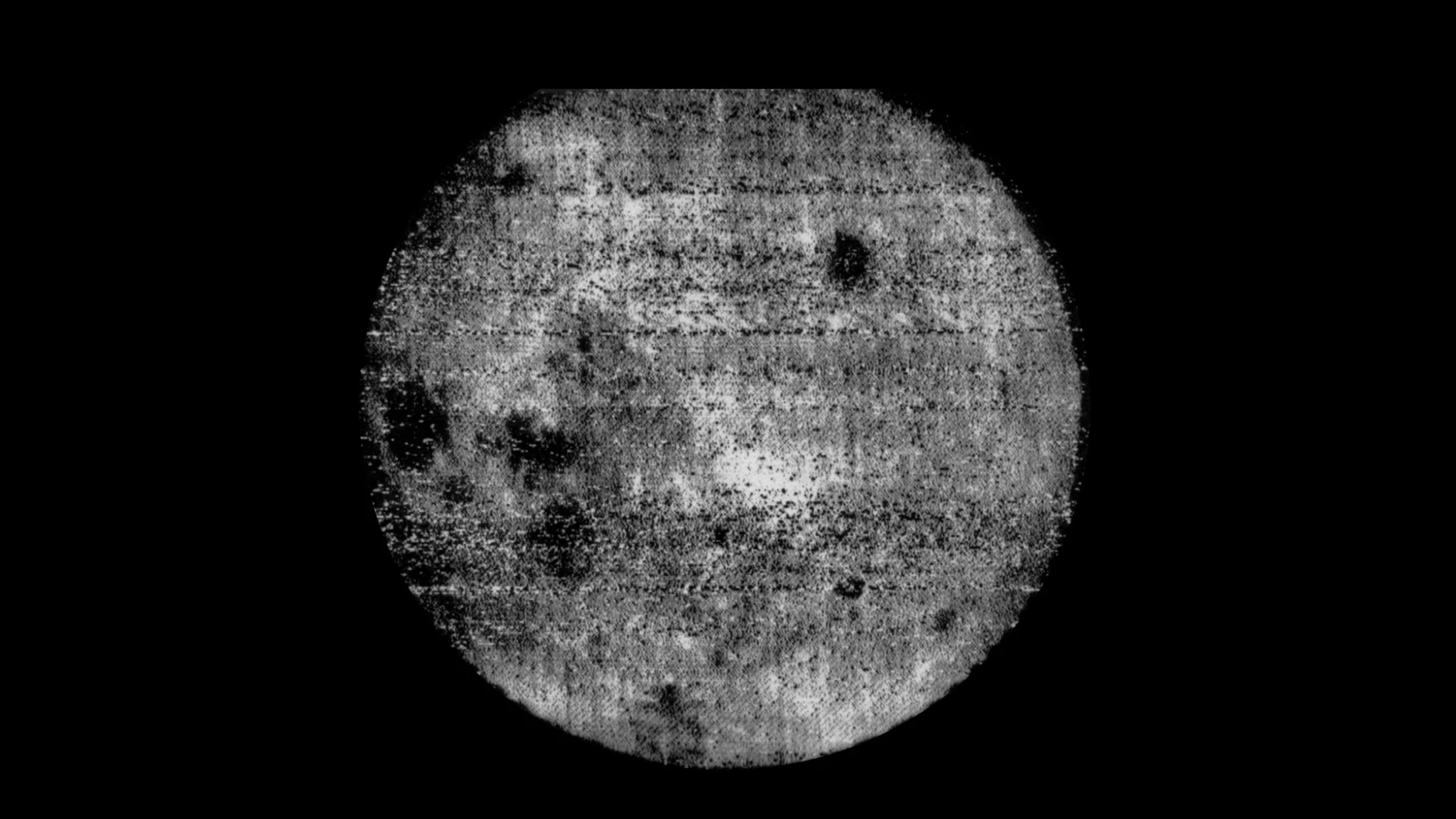
On October 7, 1959, at about 03:30 UTC, Luna 3 had already passed over the Moon’s southern polar region and was looking back at the sunlit far side. According to the current NASA Science documentation, the first image was taken from a distance of about 63,500 kilometres. Other official reconstructions give a slightly different distance because they refer to a different frame or geometric reconstruction of the sequence.
The photography session lasted about 40 minutes. Twenty-nine photographs were recorded, covering roughly 70% of the far side, while NASA’s historical Beyond Earth report notes that 17 images were of usable quality.
The exact first needs careful wording: Luna 3 was the first spacecraft to return images of the Moon’s far side. It did not land, did not enter lunar orbit and was not the first camera in space. It performed a lunar flyby while travelling in a highly elliptical orbit around Earth.
Yenisey: two lenses and 35 mm film
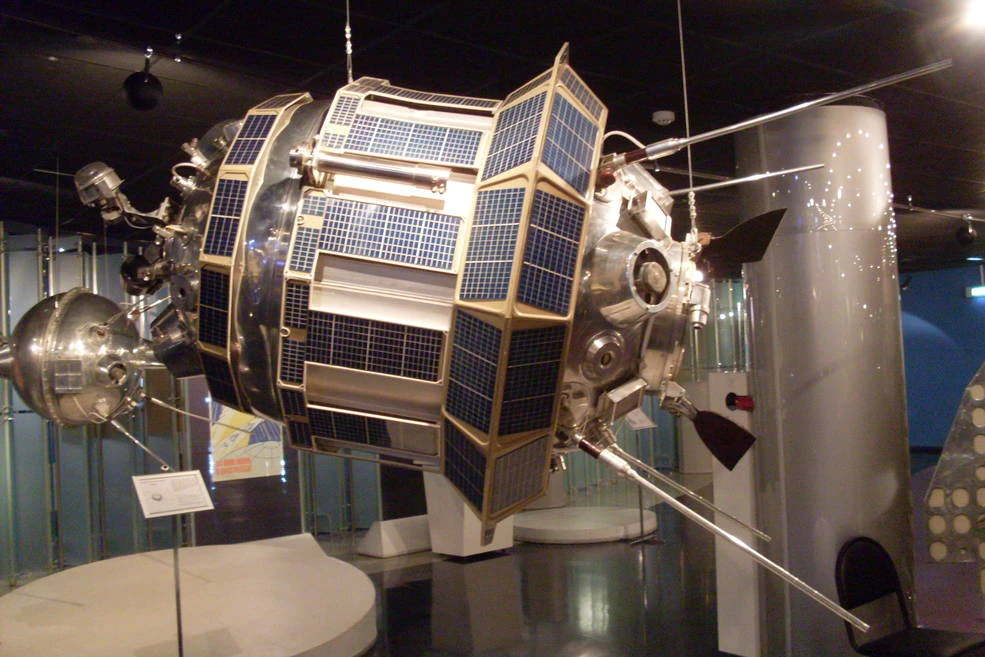
At the heart of the mission was the Yenisey photo-television unit, often referred to as Yenisey-2. It was developed by the VNII-380 institute in Leningrad and included the dual AFA-Ye1 camera built by the Krasnogorsk Mechanical Plant.
The AFA-Ye1 had two optical systems, a 200 mm lens for a wider field and a 500 mm lens for greater image scale over a smaller area. The two lenses simultaneously exposed adjacent frames on a roll of 35 mm film with a total capacity of up to 40 images.
Before an exposure could be made, Luna 3 had to orient itself accurately. Its Chayka attitude-control system achieved three-axis stabilisation, allowing the camera to remain pointed at the Moon throughout the photography session.
Film from spy balloons
The most unexpected detail in the story concerns the photographic material itself. NASA reports that the film, known to the Soviets as ASh, came from American aerial reconnaissance stock recovered from a Project GENETRIX balloon.
The American programme had sent hundreds of balloons over the Soviet Union and China in 1956. The CIA’s declassified history confirms both the scale of GENETRIX and the fact that several payloads were not recovered by the United States.
The unused film found on Soviet territory was stored at the A. F. Mozhayskiy Military Academy. Yenisey’s developers discovered that its resistance to temperature changes and radiation made it suitable for the mission. Strong primary and institutional sources document its American origin and GENETRIX connection, but not the manufacturer of the particular roll with equal certainty; the description “Kodak” therefore cannot be treated as confirmed.
An automatic photographic laboratory in space
Luna 3 had no way to return the film to Earth. The only solution was to carry the laboratory with it. After the exposures were completed, the exposed film was automatically developed, fixed and dried inside the spacecraft.
NASA’s historical account describes onboard processing followed by a scan that worked much like a facsimile. The mission’s success therefore depended not only on the camera but also on chemistry, mechanical film transport and strict temperature control inside a small automated vehicle.
From negative to radio signal
The developed negative moved past a fine beam of light. As the photographic density changed from point to point, a photoelectric detector converted the difference in brightness into a varying electrical signal. NASA describes scans of up to roughly 1,000 lines per image.
Yenisey offered a fast mode at 50 lines per second and a slow mode at 0.8 lines per second. The signal was transmitted to Earth, where receiving stations reconstructed the image. No digital file was sent: every photograph travelled through a continuous analog chain, from the film’s silver-halide crystals to the final recording on the ground.
Why the images look so poor
The quality visible today is the sum of many possible losses. Light passed through the lens onto film, the negative underwent automatic chemical processing, moved mechanically, was optically scanned, converted into an electrical signal, transmitted by radio and reconstructed by ground equipment.
Every stage could reduce signal-to-noise ratio, contrast and detail. This is why NASA describes the photographs as noisy and low-resolution. Even so, they were clear enough to identify major craters and dark plains and to create the first map of a region no human had ever seen.
The discovery hidden beneath the noise
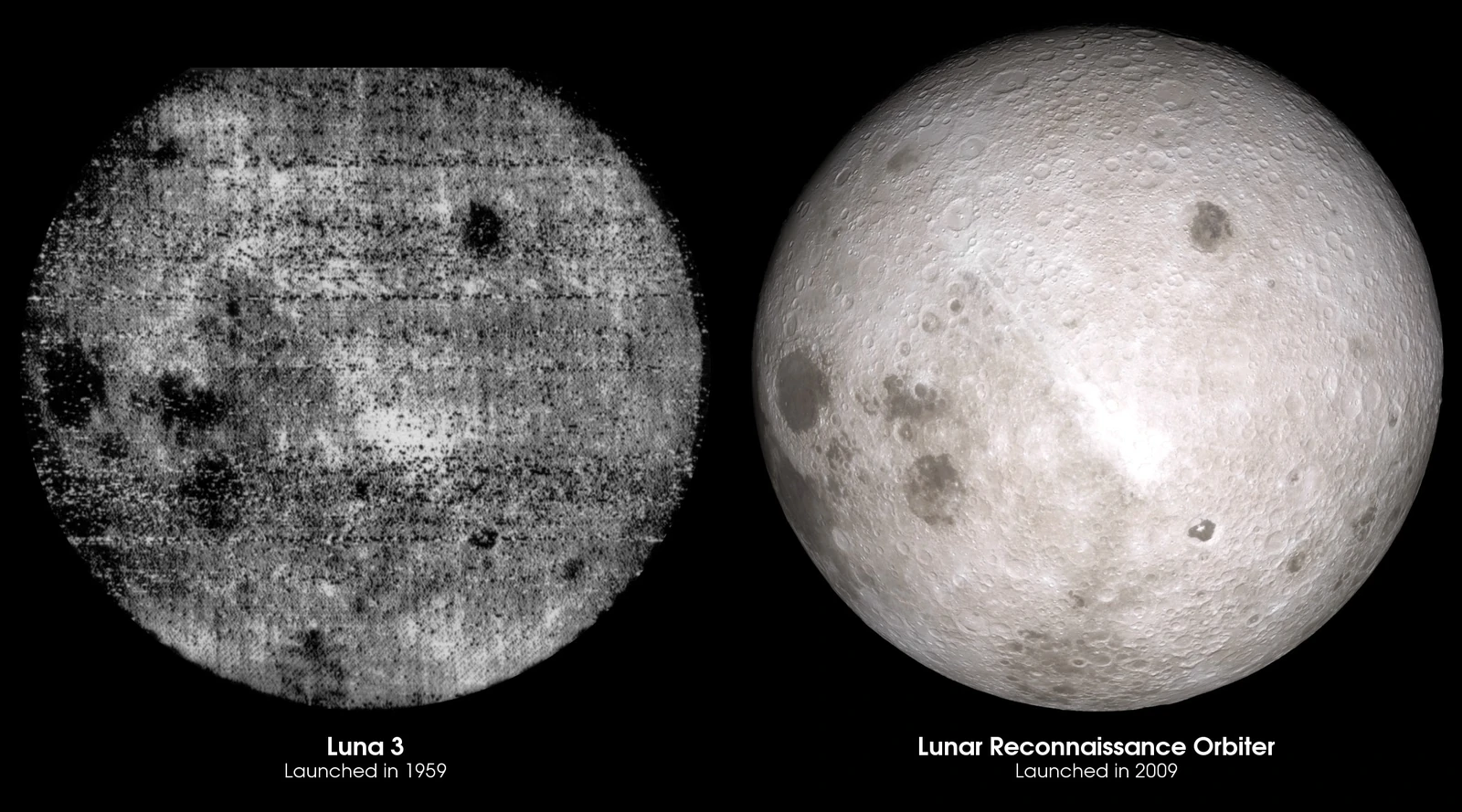
Luna 3 revealed that the far side does not resemble the face we see from Earth. The vast dark maria, the basaltic plains that dominate the familiar lunar face, are far less common. Instead, the far side is densely covered in craters.
The difference was significant enough to affect theories of the Moon’s geological evolution. Today, the comparison of Luna 3 with Lunar Reconnaissance Orbiter data by NASA’s Scientific Visualization Studio shows how much genuine information was hidden inside the imperfect 1959 images.
The same NASA group also provides an official visualisation of the far side based on modern LRO data, enabling a direct comparison between the first analog attempt and today’s high-resolution mapping.
From the V-2’s steel magazine to a lunar “radio fax”
Just 13 years before Luna 3, the first photograph of Earth from space had been captured aboard an American V-2. That film had to return physically and survive the rocket’s crash inside an armoured magazine.
On Luna 3, the same basic photographic medium faced the opposite problem: the film could not come home. In 13 years, space photography moved from rescuing a negative on the ground to developing film automatically behind the Moon and transmitting the image by radio.
What we think
Luna 3’s value lies as much in the image as in the process that made it possible. The mission combined optics, film, photochemistry, precision mechanics and telecommunications in one autonomous system, in an era before digital imaging. Its photographs look poor by today’s standards, but they are a convincing example of how technical innovation should be measured by the problem it solves, not only by the clarity of the final frame.
Frequently asked questions
Why is it called the far side rather than the dark side of the Moon?
This hemisphere receives sunlight normally. It is called the far side because the Moon’s synchronous rotation keeps it permanently turned away from Earth.
Did Luna 3 use a digital camera?
No. It used a dual AFA-Ye1 camera with 35 mm film, which was processed automatically, optically scanned and transmitted as an analog electrical signal.
Was the film really American?
NASA documents that the ASh film was repurposed from an American Project GENETRIX reconnaissance balloon that had come down on Soviet territory. The specific manufacturer of the roll is not documented with the same certainty.
How many photographs did Luna 3 return?
NASA records 29 exposures made in about 40 minutes, covering roughly 70% of the far side. Historical documentation notes that 17 images were of usable quality.