

Summary
- M-CAM 1 captured the Mercury Transfer Module’s final image before separation
- The MTM separated from BepiColombo on September 3, 2026
- The mission has travelled approximately 9.9 billion kilometres
- Mercury orbit insertion is scheduled for November 21
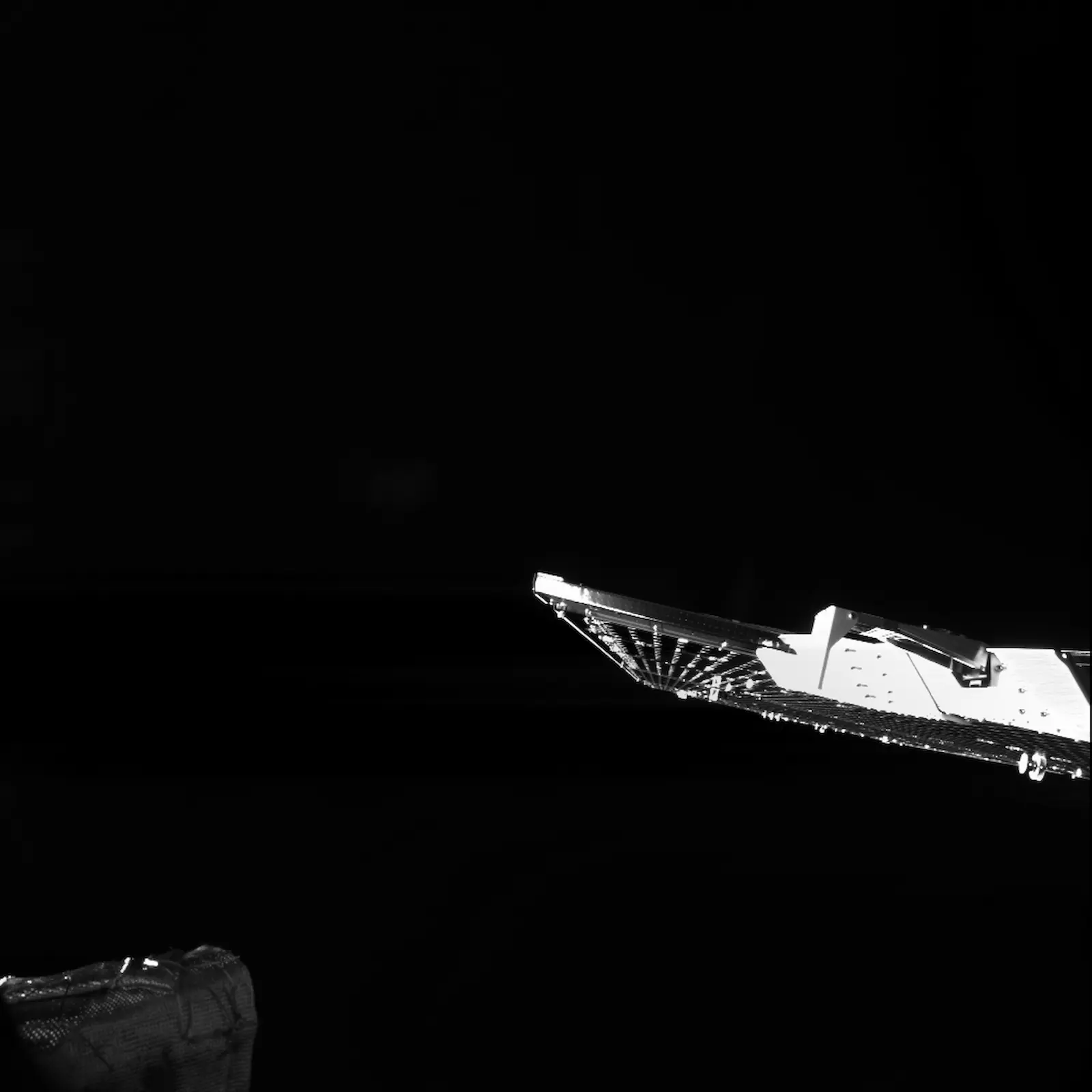
ESA has published the final image from the Mercury Transfer Module’s M-CAM 1, captured only hours before the module permanently separated from BepiColombo after nearly eight years of interplanetary travel.
The final set of “selfies” was taken on the morning of September 3, 2026, before the successful separation of the Mercury Transfer Module, which had supplied electrical power and solar-electric propulsion during BepiColombo’s long journey to Mercury. M-CAM 1 recorded part of the MTM solar array and elements of the remaining spacecraft.
The moment marks a major milestone. BepiColombo has travelled around 9.9 billion kilometres and completed nine planetary flybys on its way to the final Mercury arrival phase. The module that made much of that journey possible is no longer required, and its removal clears the way for orbit insertion.
What exactly was the Mercury Transfer Module?
The MTM was the mission’s interplanetary “travel” stage. It carried the solar-electric propulsion system and supplied power during the multi-year cruise.
Its three Monitoring Cameras were not designed as high-resolution scientific instruments. Their main purpose was to monitor the spacecraft’s condition, although they also captured striking views of Earth, Venus and Mercury. The final M-CAM 1 image therefore serves as the visual conclusion to a chapter that began with launch in 2018.
What happens to the module now?
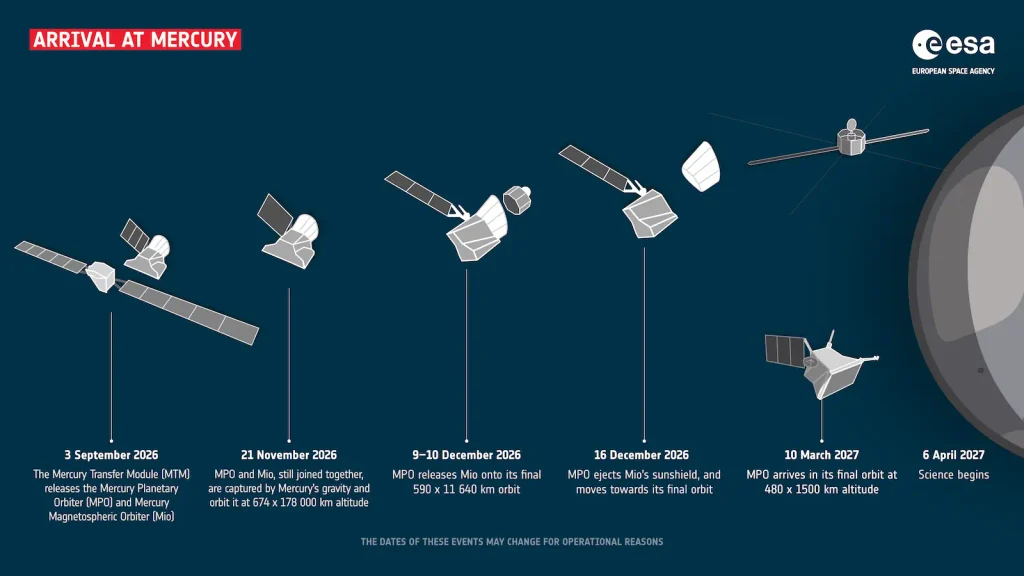
Separation was completed on September 3 and confirmed through ESA ground stations.
With no remaining power, control or active attitude system, the MTM will continue orbiting the Sun. ESA expects it to pass roughly 130,000 kilometres from Mercury in late October before continuing through interplanetary space.
The next major step comes on November 21
The composite spacecraft is scheduled to enter orbit around Mercury on November 21, 2026. Separation of the European Mercury Planetary Orbiter and the Japanese Mio spacecraft will follow in December, with regular science operations planned to begin in April 2027.
PTTL previously followed the mission’s Mercury encounters, including BepiColombo’s sixth and final gravity-assist flyby. The mission is now moving from flybys to true orbital exploration.
What we think
The last M-CAM 1 image is not technically the mission’s most important photograph, but it captures the scale of the undertaking particularly well. A module that travelled for almost eight years and helped a spacecraft cover 9.9 billion kilometres has completed its role. The crucial stage begins now: the scientific exploration of Mercury itself.
Frequently asked questions
Why was the MTM separated?
Its main role in propulsion and power delivery during the interplanetary cruise is complete, and it is not required for the final orbital phase.
When will BepiColombo enter Mercury orbit?
Orbit insertion is scheduled for November 21, 2026.
When will science operations begin?
The regular scientific phase is planned to begin in April 2027.