


Summary
- Red Bull spent nine months and roughly 600 hours preparing the wingsuit total-eclipse photograph.
- Noah Wetzel shot from roughly 1.4 kilometers away using a Canon EOS R5 Mark II, a 600mm lens and remotely triggered flashes.
- The technical difficulty is remarkable, but difficulty alone is not a measure of aesthetic value.
- The article asks whether knowing the making-of can influence the way we judge an image.
- Readers can vote simply on whether or not they like the final photograph.
- A shot planned almost down to the last meter
- Canon EOS R5 II, 600mm and flashes from 1.4 kilometers away
- Why flash output was critical
- There was also a second photographic plan
- Everything ultimately came down to seconds
- Difficulty belongs to the process, not the result
- When the making-of becomes more impressive than the result
- The result is both photographic and branded
- “Staged” does not mean less photographic
- Wetzel explored a similar idea back in 2017
- Vote: Do you like the result or not?
- An important safety reminder
- The next major European eclipse arrives in 2027
- Frequently asked questions
- What we think
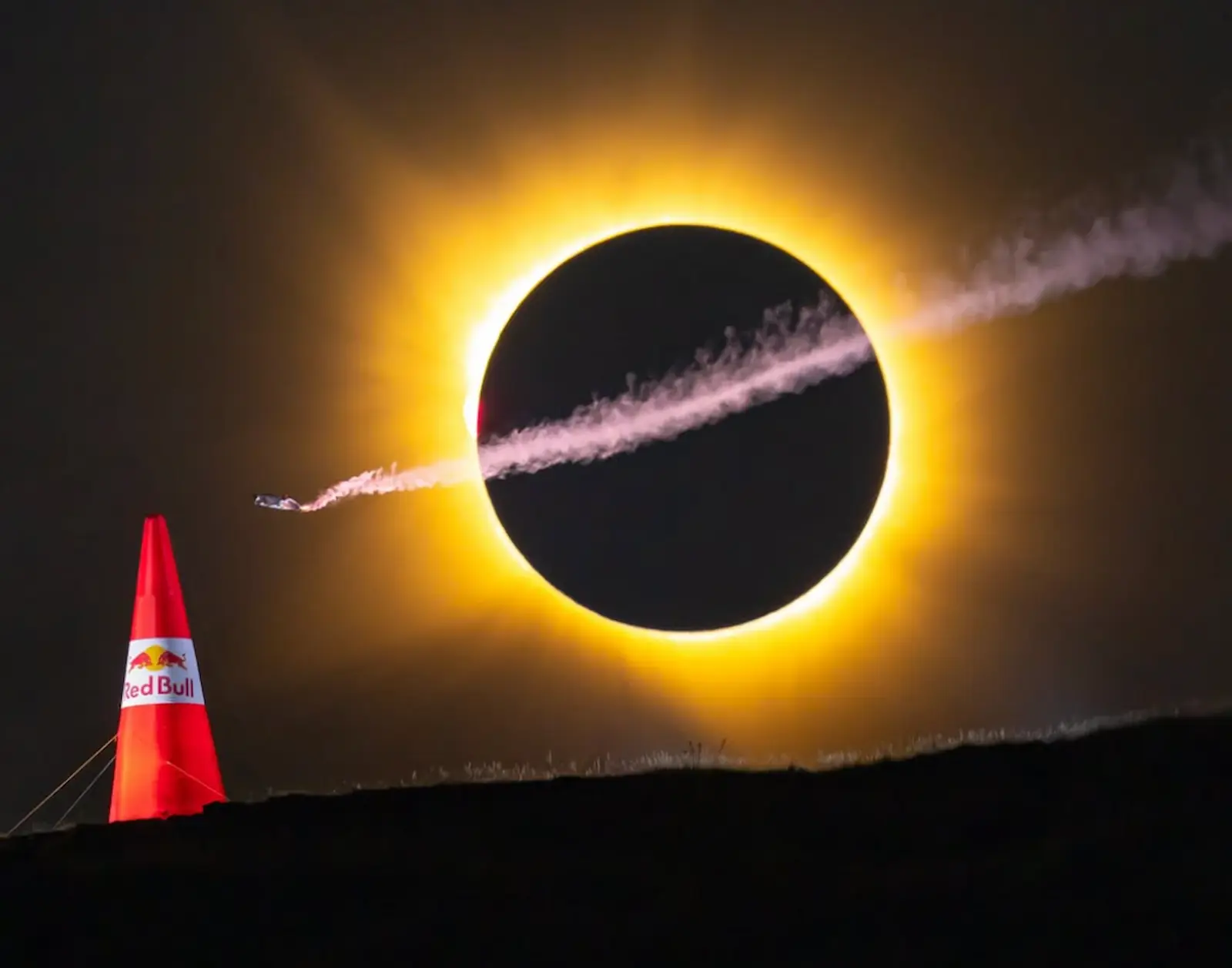
Noah Wetzel’s wingsuit shot against a total solar eclipse required nine months of preparation, but it raises a fundamental question: how much should the difficulty of creating an image influence the way we judge the final result?
On August 12, 2026, near Alarilla, Spain, Noah Wetzel photographed Mike Brewer and Dani Román flying in wingsuits across a total solar eclipse in a Red Bull project that required roughly 600 hours of work, four test productions and nine months of planning for just 84 seconds of totality at the location.
The technical achievement is impressive and the probability of failure was significant. That does not automatically mean the final result will appeal to every viewer. This is precisely where the story becomes relevant to photographers and creators: production difficulty, successful execution and the aesthetic power of the result are different things.
A shot planned almost down to the last meter
The project was not based on luck. Wetzel had to calculate the eclipse’s position low on the horizon, the camera location, the athletes’ flight path and the precise part of the sky they would cross.
The photographer was positioned roughly 1,400 meters away, while the wingsuit flyers were traveling at around 150 mph, or more than 240 km/h. The timing margin for the intended frame was extremely small.
The team completed four test productions. One took place before sunrise in Moab, Utah, and required moving a large amount of equipment through difficult terrain.
Dani Román also helped with understanding the terrain in Spain and flew during the actual eclipse, giving the team another chance to achieve the intended alignment.
Canon EOS R5 II, 600mm and flashes from 1.4 kilometers away
For the primary frame, Wetzel used a Canon EOS R5 Mark II with a Canon RF 600mm f/4.
He had considered tighter compositions at focal lengths of 840mm and 1,200mm, but 600mm provided more tolerance for deviations in the athlete’s path while also allowing him to use the lens without an extender.
The final settings for the primary setup were 1/200s, ISO 2500 and f/4.
The particularly interesting technical point is that freezing the movement did not depend only on shutter speed. With the athlete traveling so quickly, Wetzel relied on the short flash duration, roughly 1/2500s at the selected output.
The main setup used four flashes: three Godox AD1200 Pro units and one Godox AD360 II+ C, operating at 1/8 power. The lighting system was designed to be triggered from roughly 1.4 kilometers away.
Why flash output was critical
The choice of 1/8 power was a compromise.
More output would provide more light, but would also increase flash duration. Lower output would reduce the duration and improve motion freezing, but might not provide sufficient illumination on the athlete.
At 1/8 power, the team attempted to find the appropriate balance.
The system could also support two consecutive frames while the Canon EOS R5 Mark II’s mechanical shutter operated at 12 fps.
For photographers, this may be one of the most useful technical lessons of the entire production: when flash provides the dominant illumination on a subject, flash duration can matter more for freezing movement than the camera’s shutter speed itself.
There was also a second photographic plan
A project with such a small margin for error could not rely on one camera alone.
Photographer Dane Cronin was positioned closer to the distinctive red Red Bull pylon with a Canon EOS R5 and two Godox 600B flashes, providing a second chance to record the flight if the primary setup failed.
The secondary camera was set to ISO 1250, 1/25s and f/3.2 and could take advantage of rear-curtain synchronization so the motion trail appeared behind the athlete.
The setup demonstrates something that often remains invisible in a finished commercial result: behind one final frame there can be multiple cameras, alternative plans and an entire infrastructure designed around the possibility of failure.
Everything ultimately came down to seconds
Despite nine months of preparation, the final moments did not unfold like a completely controlled studio production.
Wetzel had to change position shortly before totality and reconsider his focus. He had stored a focus preset on the ridgeline, but changing camera position created uncertainty over whether it remained accurate.
The athletes were almost impossible to distinguish from the photographer’s location in the darkness of totality. Small lights on them served as reference points.
Román flew through first, with Brewer following roughly 20 seconds later. In that short interval, the apparent position of the eclipse relative to the horizon had already changed enough that Wetzel needed to readjust his composition.
With the athletes traveling at more than 240 km/h, pressing the shutter slightly too early or too late could destroy the intended alignment.
Difficulty belongs to the process, not the result
This may be the most interesting part of the entire story.
The fact that a result is extraordinarily difficult to produce does not automatically make it aesthetically extraordinary.
It can certainly be both. But one does not prove the other.
The 600 hours of work, nine months of preparation, probability of failure, specialized lighting and the athlete’s speed all describe the process of creating the shot.
A viewer who sees the result without knowing the making-of cannot see those 600 hours.
They see the composition, the light, the balance between elements, the scale of the human figure against the eclipse and the overall visual impact.
Ultimately, the result either appeals to them or it does not.
Production difficulty cannot impose that response.
When the making-of becomes more impressive than the result
This project also highlights a particularly modern aspect of photography.
Audiences today do not necessarily see only the final frame. They see behind-the-scenes videos, equipment, maps, tests, failed attempts, drones, production crews and the dramatic countdown before the shot.
That can significantly influence the way we perceive the result.
If someone first learns that a shot required nine months and roughly 600 hours of work, and only then sees the final frame, it becomes difficult to judge it without that information.
If they see the result first with no context, their reaction may be different.
That is why it is useful to separate two questions: “How impressive was it to create?” and “Do I like the result?”
The answers do not have to be the same.
The result is both photographic and branded
There is another factor that should not be ignored.
This was a Red Bull project rather than an independent photographic outing.
In the final frame, the enormous dark Moon and bright corona dominate the image, the athlete appears very small within the composition, the trail crosses the disk and the brightly illuminated red Red Bull pylon sits on the left.
The result therefore also needs to be considered as a branded visual.
The corporate identity is not an accidental element that happened to enter the composition. It is part of the production concept itself.
From that perspective, the project immediately connects an extreme sport, a rare natural event and the brand behind the production.
That, however, is a different criterion from whether the final result appeals to a viewer purely on an aesthetic level.
“Staged” does not mean less photographic
The fact that almost everything was planned in advance is not inherently negative.
A large part of photography is based precisely on constructing and controlling conditions.
In fashion, portraiture, advertising, automotive photography, light painting and much of action photography, the creator does not simply wait for something to happen. They build the conditions required for the image they have already visualized.
The important question, therefore, is not whether the shot was staged.
The important question is whether all that preparation produced a result that can stand on its own without the production story.
Wetzel explored a similar idea back in 2017
The 2026 project was not Noah Wetzel’s first experience with such a concept.
In 2017, he photographed a mountain biker during a total solar eclipse, and that image received recognition in the Red Bull Illume competition.
The new production dramatically increased the difficulty: greater distance, a much faster subject, an extremely narrow time window and the need for artificial lighting from a very long distance.
So even if the final result does not appeal to every viewer, the project remains an extremely interesting case study in photographic planning, lighting and coordination.
Vote: Do you like the result or not?
Here we deliberately separate the difficulty of the production from what the viewer ultimately sees.
The question is not whether the nine months of work were worth it, or whether the project was technically difficult.
Do you like the result of the project shots?
We judge the final visual result, not the effort
43 total votes
An important safety reminder
Photographing the Sun with a telephoto lens requires extreme caution.
During the partial phases of an eclipse, a suitable solar filter is required in front of optical equipment. Looking at the bright Sun through a camera lens, telephoto lens, binoculars or telescope without appropriate protection can cause serious eye injury.
The exception applies only to the brief period of complete totality, when the Sun’s bright surface is fully covered.
No impressive result is worth risking eyesight or equipment.
The next major European eclipse arrives in 2027
Photographers in Europe will not need to wait many years for another major opportunity.
On August 2, 2027, another total solar eclipse will cross southern Spain before continuing through parts of North Africa, including Morocco, Algeria, Tunisia, Libya and Egypt.
For creators considering a complex shot involving a foreground or moving subject, the practical lesson from the Red Bull project is not that 600 hours and a huge production are required.
It is that the Sun’s position, perspective, subject distance and the path of a moving object can all be studied long before the shutter is pressed.
Frequently asked questions
How long did the Red Bull project take to prepare?
Noah Wetzel and the team worked on the project for roughly nine months, spending approximately 600 hours on preparation and completing four test productions before the actual eclipse.
Which camera was used for the main frame?
The primary setup used a Canon EOS R5 Mark II and Canon RF 600mm f/4, with settings of 1/200s, ISO 2500 and f/4.
How was an athlete moving at more than 240 km/h frozen?
The short flash duration, around 1/2500s at the selected output, played a critical role rather than relying only on the camera’s 1/200s shutter speed.
Does a very difficult shot guarantee a good result?
No. Difficulty may increase appreciation for the technical execution and production, but whether the result works aesthetically remains a separate question.
What exactly does the poll ask?
The poll does not ask readers to judge the difficulty or technical achievement of the project. It simply asks whether they like the final result or not.
What we think
Noah Wetzel’s project is unquestionably an extremely difficult technical and organizational achievement. That does not oblige the viewer to regard the aesthetic result as equally successful.
The 600 hours, flashes triggered from 1.4 kilometers away and an athlete traveling at more than 240 km/h explain why the production is remarkable. They are not, by themselves, reasons to like what we ultimately see.
That is why the poll is interesting. The question is deliberately simple and concerns only the result: do you like it or not? Technical excellence, difficulty and aesthetic value often overlap, but they are not the same thing.



Comments
Ψήφισα με μισή καρδιά… ναι.
Το αποτέλεσμα της ψηφοφορίας μέχρι τώρα όπως βλέπω, είναι σαν την ψήφο μου!
Το μόνο που με ενοχλεί είναι ο κώνος της Redbull! Τίποτε άλλο. Είναι υπέροχη η λήψη. Θεωρώ όμως λάθος ότι ο κώνος ήταν τόσο ψηλός και τόσο φωτισμένος. Θα φαινόταν μια χαρά και διαφήμιση θα γινόταν, αν ήταν πιο χαμηλός ή αν ήταν κάπως σκοτεινός, να φαίνονται τα γράμματα λίγο οριακά. Θα προκαλούσε την περιέργεια κι όλοι θα τον σχολίαζαν στο τέλος.