Summary
- Jim Frohna explains the cinematography of Verity and its Brian De Palma influences.
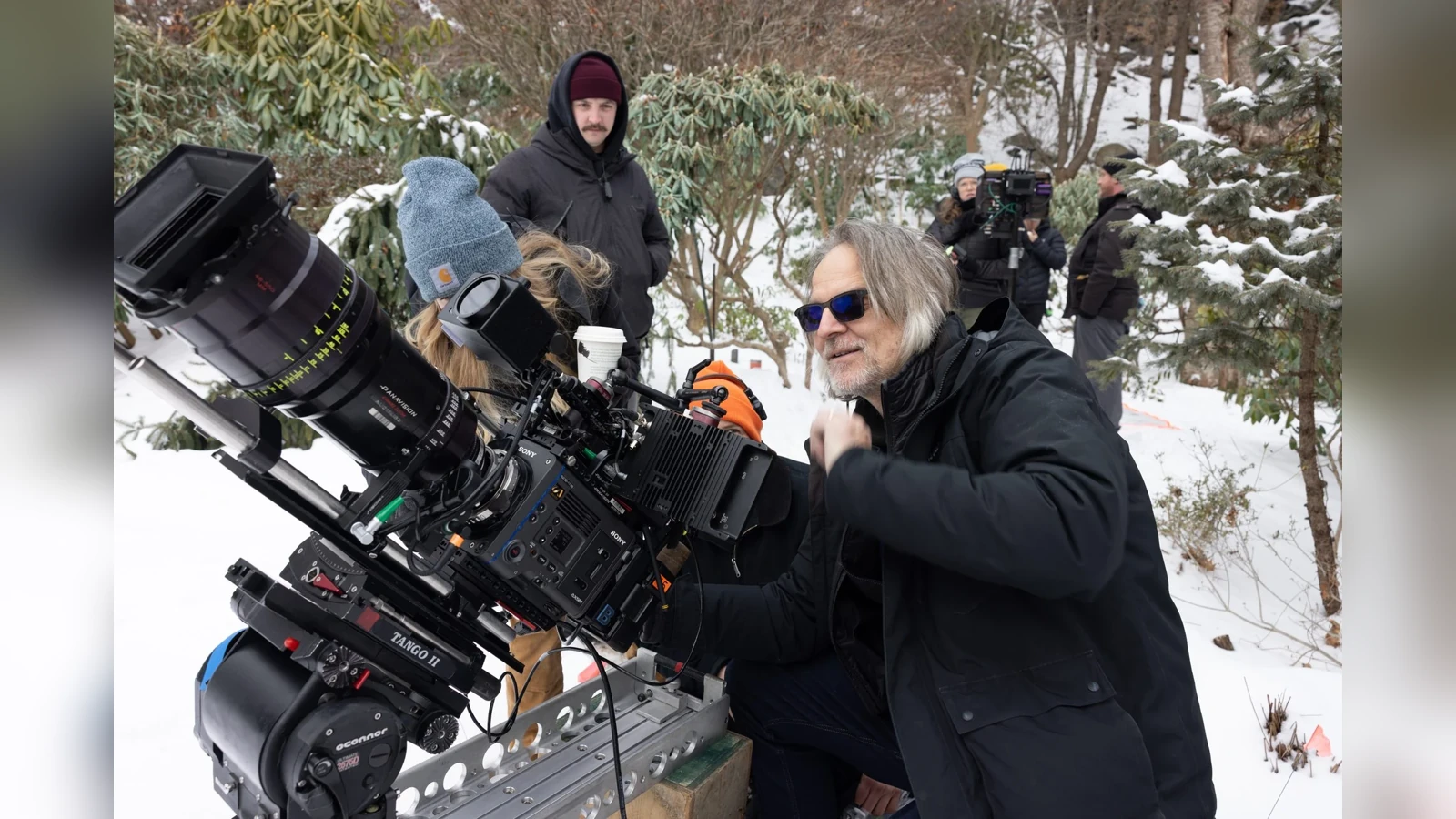
- The production used a Sony VENICE 2 and Panavision T Series anamorphics.
- Warm kitchen light contrasts with a cold hallway.
- A split-diopter combines different layers of action to build suspense.
One of the most unsettling moments in Verity did not rely on a spectacular effect: Jim Frohna combined two distinct worlds of light and a split-diopter to reveal a threat before the characters notice it.
The cinematographer explains how he and director Michael Showalter designed the look of the psychological thriller starring Dakota Johnson, Anne Hathaway and Josh Hartnett. Hitchcock, Brian De Palma and the erotic thrillers of the 1980s and 1990s informed a visual language that feels glamorous yet deeply uneasy.
Sony VENICE 2 and Panavision T Series anamorphics
Following camera and lens tests, the production selected the Sony VENICE 2 with Panavision T Series anamorphics, all offering a maximum T2.3 aperture. Frohna was looking for strong contrast, clarity and dependable low-light performance. The film was photographed in a 2.39:1 aspect ratio with a 1/2 Glimmer Glass filter throughout.
The T2.3 designation matters on set: a T-stop measures actual light transmission, rather than the geometric aperture expressed by an f-stop.
A warm kitchen and a cold hallway
In a nighttime scene at the house, Lowen (Dakota Johnson) and Jeremy (Josh Hartnett) are in the kitchen. Two LiteMat Spectrum 1 fixtures mounted to wooden beams and diffused through unbleached muslin created soft light suggestive of an overhead practical. The camera was rated at ISO 3200 and set to 3800K, while the LiteMats were at 2700K, giving the scene its distinctly amber warmth.
Down the hallway, two ARRI SkyPanel S360-C fixtures on a lift outside the house sent subdued simulated moonlight through the windows. Four Astera Titan Tubes placed low alongside frosted glass provided subtle shape to the figure at 6000K. The exposure difference between the brighter foreground and distant background approached five stops.
The split-diopter that reveals danger before the characters see it
The crucial composition places the lovers on the left side of the frame and a faint figure deep in the hallway on the right. Frohna used a 75mm lens with a +1 diopter. A split-diopter makes two different focus regions possible within the same shot, even if the boundary between them remains visible.
The audience registers the figure before the characters do. The reference to Brian De Palma, particularly Dressed to Kill, lies in this sense of being watched. A nearly imperceptible dolly move toward the lovers then suggests an observing presence. A-camera operator Ari Issler proposed the move on set, working with dolly grip Mike Morini.
A tiny light for Anne Hathaway’s close-up
For Verity’s close-up, Frohna used a single Rosco Dash above the lens with Lee Hampshire Frost 253 diffusion. The setup evokes the classic “Obie light”: flattering to the face, but here unsettling against the kitchen’s warmth. The color contrast was further heightened during the digital intermediate (DI) grade.
The scene was filmed at a house in Armonk, New York, although the story takes place in wintry Vermont. Frohna also credits gaffer Michael Marzovilla, camera operators Ari Issler and Jennie Jeddry, and DIT Luke Taylor.
What we think
What stands out is how directly the technical choices control what the viewer knows. The split-diopter is not there just to make the frame look unusual. It lets us watch two layers of action simultaneously and anticipate danger before the protagonists do.
The lighting also offers a useful lesson for filmmakers working with smaller crews. Two well-diffused sources at a deliberate color temperature can establish a believable warm space. What matters most is how that space contrasts with its surroundings, not how many fixtures you can put on set.
Frohna’s most valuable lesson is consistency: framing, focus, camera movement and color each reveal a different part of the same story. That is worth remembering on a major production or a small independently shot thriller.